Blockhouse No. 1
Two plaques have been mounted on this building. Both have been stolen. The first, a bronze tablet ceremoniously unveiled in 1905 by Mary Van Buren Vanderpoel of the Women's Auxiliary to the American Scenic and Historic Preservation Society, vanished by 1913. A replacement sign erected in 1999 has also gone missing. Blockhouse No. 1, the oldest structure originally built within what became Central Park, seems determined to shed every attempt at official recognition -- which is fitting for a fort that was finished two days before the war it was built for ended.
Rushed Into Existence
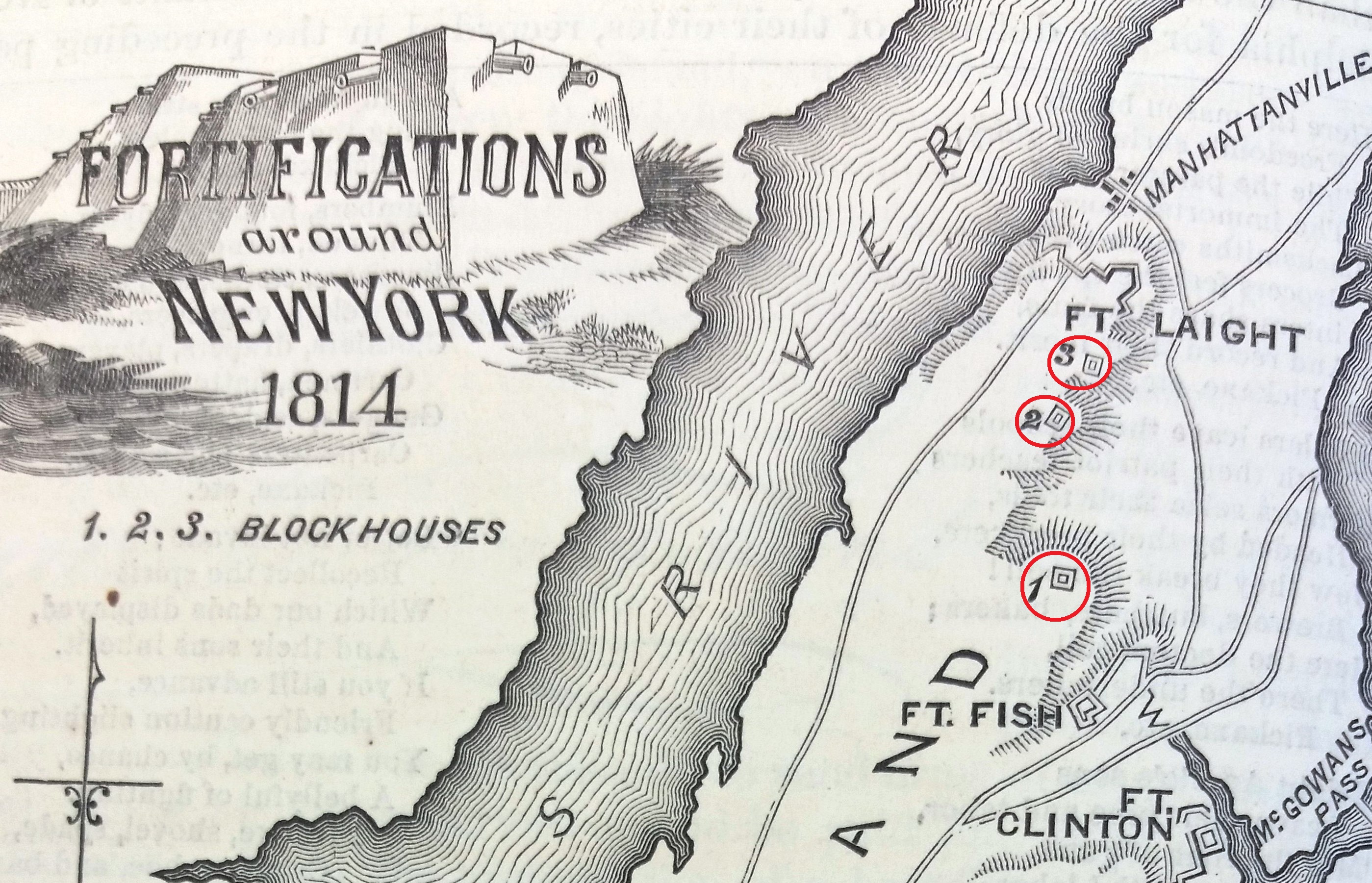
In 1814, with the War of 1812 dragging on and rumors of a British invasion swirling through New York, volunteer citizens scrambled to fortify northern Manhattan. Under the direction of General Joseph Gardner Swift, they hauled building materials up to a rocky overlook of Manhattan schist and assembled a two-story bunker with gunports and a sunken platform for a revolving cannon turret. The volunteers brought whatever they could find, which is why the walls are an uneven mix of red sandstone blocks and native schist. Construction finished on December 22, 1814, just two days before the Treaty of Ghent was signed in Belgium to end the war. The British invasion never came. Blockhouse No. 1 was part of a chain of fortifications stretching from the Hudson to the Harlem River, accompanied by Blockhouses No. 2, 3, and 4 in what is now Morningside Park. It is the only one that survives.
Deeper Foundations
Trial excavations performed in 1995 revealed that the blockhouse was built on foundations dating back far earlier than 1814. During the Revolutionary War in 1776, British and Hessian troops had sealed off lower Manhattan from colonial forces by controlling the passes through northern Manhattan with a series of fortifications. The foundations of Blockhouse No. 1 appear to date from this period of British occupation. So the War of 1812 structure sits atop a Revolutionary War base, layering one conflict's anxiety over another's. The fort went through several phases of construction: the original hasty military build, a later addition of two feet of stonework when it served as an ammunition storage building, and finally, at the turn of the twentieth century, the addition of a new entrance staircase and a tall flagpole. In 1905, it was recorded as standing 19 feet tall at the western wall with a base 34 feet square.
A Romantic Ruin by Design
When Frederick Law Olmsted and Calvert Vaux designed Central Park in the 1850s, they chose to treat Blockhouse No. 1 not as a preserved monument but as a picturesque ruin. They let vines crawl over its walls and planted Alpine shrubbery around it, folding the military structure into their vision of naturalistic landscape. The blockhouse stands in the North Woods at the northwest corner of the park, perched on a rocky outcrop that is still rugged, high, and difficult to reach. It overlooks Harlem Meer and the Lasker Rink to the east. At its wartime peak, nearly 2,000 New York state militiamen had garrisoned the fortifications in this area. By the time Olmsted and Vaux arrived, the fort was already a curiosity, its military purpose forgotten in a city expanding relentlessly northward.
Locked and Largely Forgotten
The blockhouse today stands behind a large metal gate, unoccupied and unused. The Urban Park Rangers occasionally lead tours inside, but independent exploration is not allowed. In the early twentieth century, it served as a gathering spot for patriotic holidays -- the 1905 plaque ceremony was received by General Frederick Dent Grant, the son of Ulysses S. Grant. But the park moved on, and the fort became one of Central Park's deepest secrets, known mainly to dedicated explorers of the North Woods. Its distinction as the second-oldest structure in the park (after the ancient Egyptian obelisk known as Cleopatra's Needle, which predates it by millennia) and the oldest structure originally built within the park's boundaries makes it a historical footnote of a peculiar kind: a defensive position in a park designed for peace, a military relic wrapped in Olmsted's romantic greenery, still watching over a city that no longer needs its guns.
From the Air
Located at 40.799N, 73.956W in the northwest corner of Central Park, Manhattan. The blockhouse sits on an elevated rocky outcrop in the North Woods section, overlooking Harlem Meer to the east. Nearest airports: LaGuardia (KLGA) 5nm east, Teterboro (KTEB) 9nm northwest. Central Park's rectangular green footprint is the dominant visual landmark. Best viewed at 1,500-2,500 ft AGL; the structure itself is very small and hidden under tree canopy.