Bloedel Reserve
Prentice Bloedel made his fortune cutting down trees. As vice-chairman of MacMillan Bloedel Limited, one of British Columbia's largest lumber companies, he oversaw the harvest of old-growth forests across the Pacific Northwest. Then he spent the second half of his life putting a forest back together. On 140 acres of Bainbridge Island, Bloedel and his wife Virginia set out to build something that didn't exist anywhere in North America: a Western expression of the Japanese garden -- not its ornaments or its manicured surfaces, but its deeper qualities of naturalness, subtlety, reverence, and tranquility.
The Lumberman's Garden
The Bloedels' project was shaped by contradiction. The fortune that funded the reserve came from industrial logging, yet the reserve itself is an argument for the spiritual value of undisturbed landscape. Prentice Bloedel was drawn to the conservation movement and to Asian philosophy, influences that guided his vision for the property. He didn't want a Japanese garden in the conventional sense -- no pagodas, no ornamental bridges. He wanted the essence of the Japanese approach applied to the mossy, cedar-scented landscape of the Pacific Northwest. The result is a garden that feels inevitable rather than designed, as though the forest simply decided to be beautiful in a particular way.
Landscapes Within a Landscape
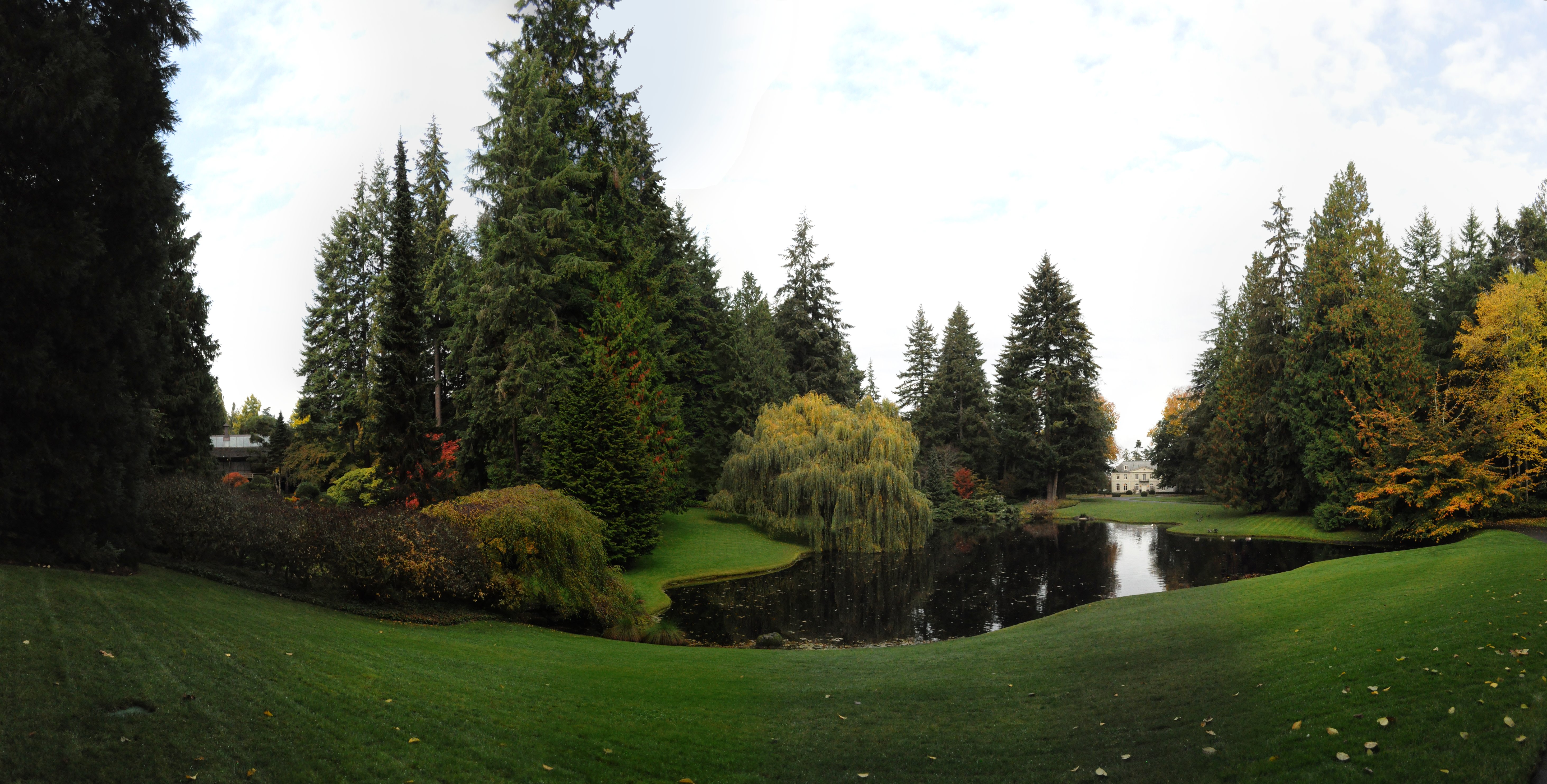
The reserve contains multitudes. A traditional Japanese garden occupies one portion, but around it unfold gardens that defy easy categorization: a stone garden inspired by Zen meditation, a moss garden where green light filters through a canopy of second-growth forest, a rhododendron glen that blazes with color in spring. The reflection garden -- designed with the help of landscape architects Richard Haag and Thomas Church, among others -- uses a shallow pool to mirror the sky and surrounding trees, creating a space that seems to exist in two dimensions simultaneously. Lakes both natural and landscaped dot the property. Immaculate lawns give way to deep woods. Each transition feels deliberate but unhurried.
A House Preserved, A Reserve Shared
The Bloedels' French Chateau-style home still stands at the heart of the property, preserved as a visitor center with many of its original furnishings intact. The family ran the reserve as a private foundation before opening it to the public in 1988. In 2010, it became a registered public charity. Visitors must reserve tickets in advance -- the reserve limits attendance to protect the experience of quiet contemplation that the Bloedels intended. Walking its trails, you can feel the particular silence of a place designed for paying attention: to the texture of moss on stone, to the way light moves across water, to the sound of wind through trees that a lumber baron planted as an act of restitution.
From the Air
Located at 47.708N, 122.548W on the northern end of Bainbridge Island, Washington. The 140-acre reserve is visible as a large forested area distinct from surrounding residential development. Best viewed at 2,000-3,000 feet AGL when crossing Puget Sound west of Seattle. Bainbridge Island is directly accessible by ferry from downtown Seattle. Nearest airports: Bremerton National Airport (KPWT), 11 nm southwest; Boeing Field/King County International (KBFI), 14 nm east-southeast.