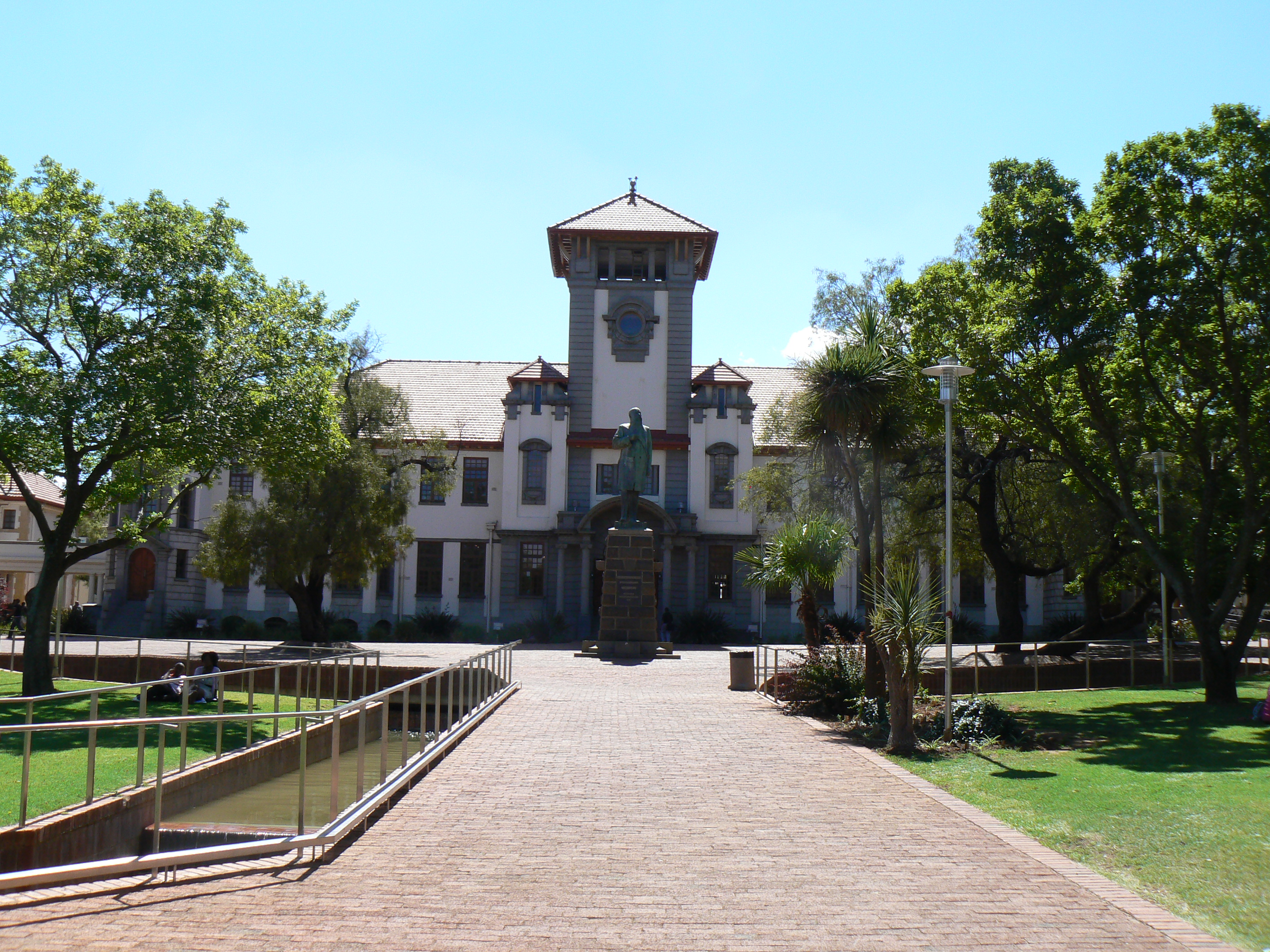
Bloemfontein
J. R. R. Tolkien was born here in 1892, in a city whose Afrikaans name means 'Fountain of Flowers.' His father, Arthur, had come to manage a bank branch on the Free State plains, chasing a promotion that the English countryside could not offer. Three years later, young Ronald left for England with his mother and brother. Arthur died of rheumatic fever before he could follow. Tolkien never returned, and Bloemfontein has surprisingly little to show for its most famous son. No grand museum, no hobbit-hole replica, just a plaque and a quiet pride. It is a fitting introduction to a city that has shaped history while somehow remaining in the background.
Three Capitals, One Country
South Africa distributes its power across three cities, and Bloemfontein holds the judiciary. The Supreme Court of Appeal sits here, making this the place where the country's most consequential legal arguments reach their final hearing. Pretoria holds the administrative capital, Cape Town the legislature, but Bloemfontein adjudicates. The arrangement dates to the Union of South Africa in 1910, a compromise designed to give each province a stake in the national government. Founded in 1846 as a frontier settlement, the city grew into the capital of the Orange Free State republic, then survived the Anglo-Boer War to become one of the pillars of the new nation. Today, with a population of roughly half a million, it remains the capital of the Free State Province, a compact city ringed by sprawling suburbs where the pace of life is noticeably slower than in Johannesburg or Cape Town.
Where a Movement Was Born
On 8 January 1912, several hundred members of South Africa's educated Black elite gathered in Bloemfontein. Lawyers, teachers, journalists, and chiefs came together to form the South African Native National Congress, the organization that would be renamed the African National Congress in 1923. Their purpose was to protest racial discrimination and appeal for equal treatment before the law. John Dube became the first president; Solomon Plaatje served as secretary general. The movement they launched in this quiet Free State city would eventually dismantle apartheid, though the struggle took the better part of a century. The contrast is striking: one of the twentieth century's most consequential political organizations emerged from a city that, even today, feels unhurried enough that restaurants begin looking askance at diners who arrive after half past seven in the evening.
Roses, Stars, and a Stuffed Liger
Bloemfontein's nickname, 'City of Roses,' is not poetry but botany. The annual rose festival celebrates a profusion of blooms that thrive in the Free State's dry, sunny climate, and the city's gardens are lush enough to justify the name year-round. But the city's curiosities extend well beyond horticulture. On Naval Hill, which rises behind the city center, sits sub-Saharan Africa's first digital planetarium. Nearby, the Boyden Observatory, established by Harvard University, has been conducting astronomical research since 1927. The observatory's remote location and clear skies made it an ideal complement to Harvard's Northern Hemisphere instruments, and it remains a working research facility. Down the hill, the city zoo contains what may be its most unexpected attraction: a stuffed liger, a cross between a lion and a tiger, bred at the zoo in the 1930s. At 798 kilograms, it held the record as the largest cat ever to have lived.
Monument and Memory
The National Women's Monument stands on the southern edge of the city, a somber reminder of the Anglo-Boer War's civilian toll. It commemorates the roughly 27,000 Boer women and children who died in British concentration camps between 1899 and 1902, along with the Black people who perished in separate camps that received even less attention from history. The adjacent Anglo-Boer War Museum documents the conflict in detail, from the scorched-earth policies that destroyed Boer farms to the camp conditions that shocked even some British observers. A few kilometers away, the Oliewenhuis Art Museum occupies a former governor's residence set in manicured grounds, its galleries holding a collection of South African art that spans centuries. The tree-lined President Brand Street connects many of these sites, a boulevard whose name honors the longest-serving president of the old Orange Free State, and whose shade offers welcome relief from the Free State sun.
From the Air
Coordinates: 29.10S, 26.22E. Bloemfontein sits on a plateau at approximately 1,400 m (4,600 ft) elevation in the central Free State, surrounded by flat farmland and grassland. Naval Hill, topped by the planetarium and observatory, is visible from the air as a prominent feature north of the city center. The N1, N6, and N8 national highways converge here in a distinctive hub pattern. Bram Fischer International Airport (FABL) lies 15 km northeast of the city center. The terrain is gently undulating with good visibility. The surrounding landscape is dry grassland, transitioning to Karoo semi-desert to the south. Recommended viewing altitude: 3,000-5,000 ft AGL.