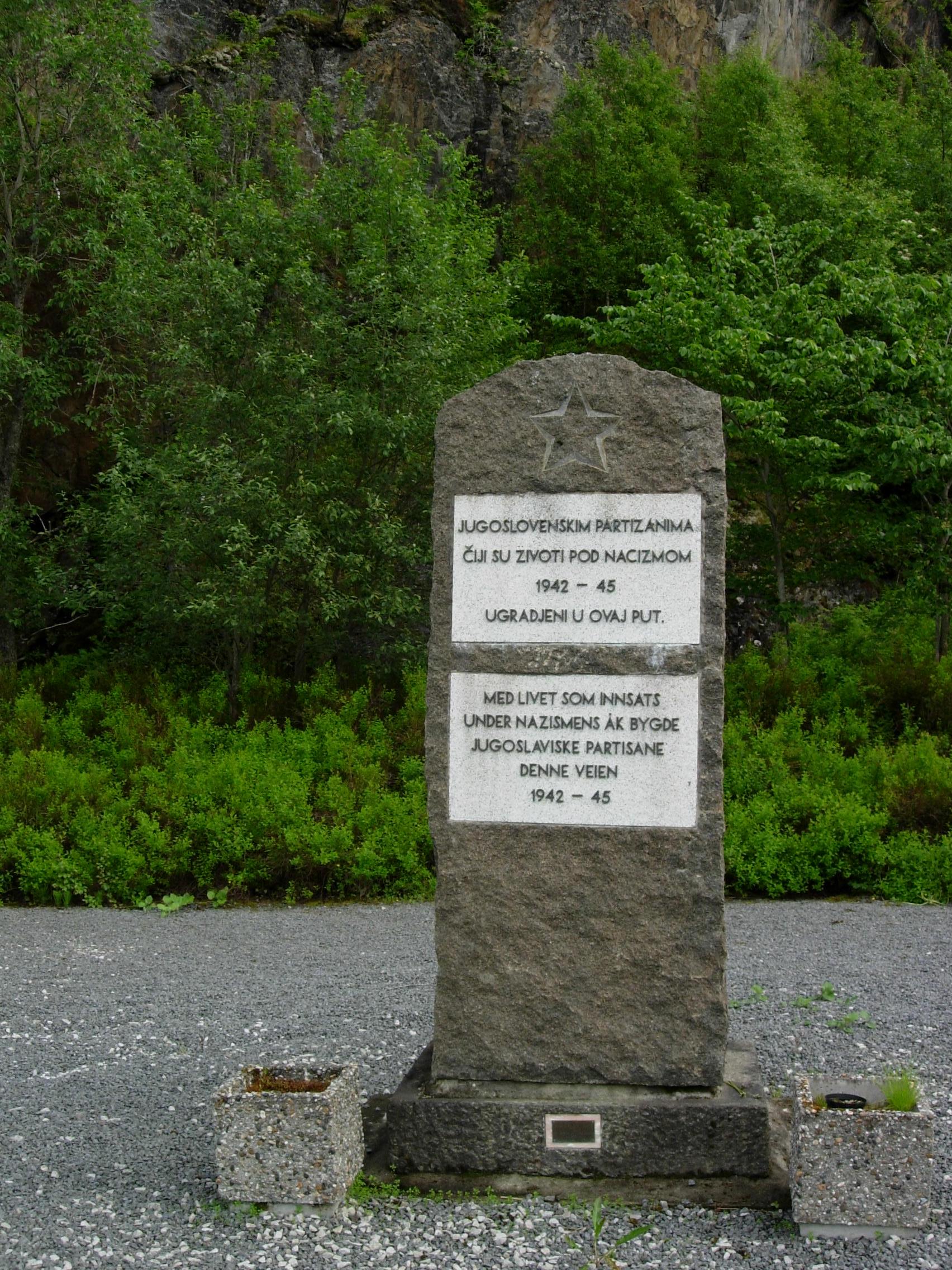
Blood Road
The name comes from a single act of defiance. In July 1943, along a road being blasted and hacked through the mountains northeast of Rognan in Nordland county, a prisoner of war was shot by his guards. His brother took the blood and painted a cross on the exposed rock face. The guards could wash it away, but they could not erase what it meant. The road became Blodveien—the Blood Road—and that name has outlasted everything the occupation authorities intended for it. What was meant to be a new section of Norwegian National Road 50, connecting Rognan to Langset along the east side of Saltdal Fjord, became instead a monument to the cost of forced labor in occupied Norway.
The Prisoners Who Built It
Between 1942 and 1945, the Wehrmacht forced prisoners of war to construct the road as part of its infrastructure expansion across occupied Norway. The workers were Yugoslav, Polish, and Soviet captives, transported through central Europe to the Baltic port of Stettin (now Szczecin), then shipped to Bergen or Trondheim, and finally sent north to one of five main camps scattered across Nordland. The Botn camp, just 2 kilometers outside Rognan, was active from July 1942 to June 1944. When the first prisoners arrived by ship on July 25, 1942, twenty-eight of their number had already been shot upon arrival in Bergen. Farmers at the nearby Furumo farm watched as the survivors were marched from the shore to the camp in small groups, guards shouting and striking them, many falling as they walked. By war's end, the Wehrmacht had used 140,000 prisoners as forced labor across Norway—roughly 75,000 of them Soviet citizens.
Inside the Wire
The Botn camp was built by Norway's Public Roads Administration after receiving orders in early June 1942. Two barbed-wire fences, each about 2 meters high with a half-meter gap between them, enclosed the compound. Inside stood two barracks with simple boarded walls, no foundations, and five-tiered bunk beds stacked to the ceiling. The camp commandant was Hauptsturmführer Franz Kiefer, who commanded six SS officers, two NCOs, and ten to twelve military police. Einsatzgruppe Wiking oversaw the project, and the unit was responsible for systematic violence against the prisoners during construction. Several German construction companies served as subcontractors—Müller-Altvatter of Stuttgart, Eschweiler Tiefbau of Eschweiler, and Röllinger KG of Fürth. Between Korgen and Narvik alone, up to 50 smaller camps held around 30,000 prisoners. The Blood Road was not an isolated project; it was one thread in a vast network of forced labor stretching across northern Norway.
Justice, Slowly and Unevenly
Accountability came in stages. In Belgrade in the fall of 1946, a military court tried thirty-two guards from the Yugoslav camps in Norway. Former prisoners served as witnesses, alongside statements from Norwegian eyewitnesses recorded by the British War Crimes Commission. The Supreme Military Court ruled on December 1, 1946: death sentences for twenty-two guards, prison terms of five to twenty years for the rest. Five of those condemned to death were SS officers from the Botn camp, including Untersturmführer August Riemer, convicted for mass executions in November 1942 and January 1943. In Norway, investigations into the Botn camp began in the summer of 1947. The Eidsivating Court of Appeal handed down death sentences in two cases—one for the murder of a prisoner at Botn, another for the killing of four prisoners at Korgen. Both sentences were eventually commuted or pardoned, but Supreme Court Justice Reidar Skau articulated a principle that resonated beyond the individual cases: prisoners of war are "in a particularly vulnerable position and have no other guardian than that which strong legal protection can provide."
The Uncomfortable Truth
What made the Blood Road story especially difficult for postwar Norway was the role of Norwegian collaborators. Five hundred Norwegian guards from the Hirdvaktbataljonen—a battalion within the collaborationist Hirden—served at the four main camps and their satellites. Criminologist Nils Christie, assigned to investigate in 1950 while still a student, found 249 names of Norwegian guards—more than the official investigation had uncovered. His 1952 thesis, Fangevoktere i konsentrasjonsleire (Concentration Camp Guards), was primarily a sociological study of the Norwegians who worked in the camps: who they were, how they justified their actions, what conditions made ordinary people capable of cruelty. The work attracted almost no public attention for twenty years. When it was finally published as a book in 1972, Norway had to confront the fact that the Blood Road was not built solely by foreign occupiers. Some of the hands holding the whips were Norwegian.
From the Air
The Blood Road runs along the eastern shore of Saltdal Fjord at approximately 67.10°N, 15.48°E, northeast of Rognan in Saltdal Municipality. From the air, the route is now part of the E6 highway, visible as a road tracing the fjord's edge between Rognan and Langset. The former camp site at Botn lies about 2 km northeast of Rognan. The cemeteries at Botn—one Yugoslav, one German—are visible clearings near the road. Best viewed at 3,000–6,000 ft to trace the road's path along the fjord. Nearest airport: Bodø Airport (ENBO), approximately 80 km west-southwest.