Bloody Island: The Massacre at Bo-no-po-ti
The Pomo called it Bo-no-po-ti -- Island Village. Every spring, families gathered on the island at the north end of Clear Lake to fish during the spawning season, as they had for thousands of years. On May 15, 1850, the U.S. Army's 1st Dragoons arrived at the island under Lieutenant Nathaniel Lyon with orders to punish those responsible for killing two white settlers. The people on the island were not the ones who had done the killing. Most of the younger men were away hunting in the mountains to the north. What the soldiers found were elders, women, and children, gathered at a seasonal fishing camp. They attacked anyway. The National Park Service estimates that the army killed at least 60 of the roughly 400 Pomo present that day. Other accounts, including Pomo oral traditions and later ethnographic studies, place the number between 100 and 200. The island the Pomo had called Bo-no-po-ti became known as Bloody Island. Today it is no longer an island at all -- the lake has receded, and the site is a hilltop north of the water, its history visible only to those who know where to look.
Enslavement on the Lakeshore
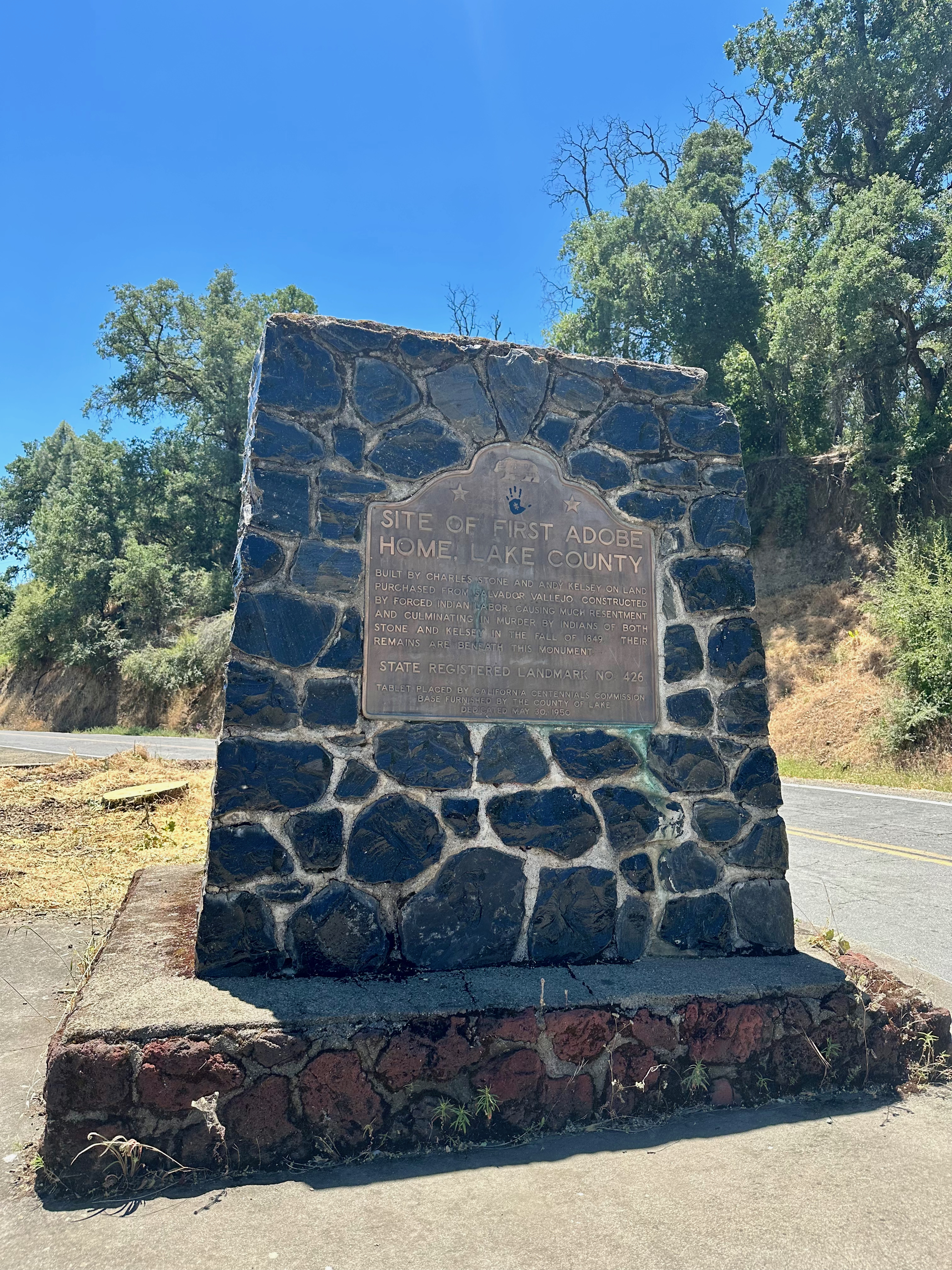
The violence at Bo-no-po-ti did not begin on the morning of the massacre. It began years earlier, when two settlers named Andrew Kelsey and Charles Stone arrived in the Clear Lake region and began enslaving the local Pomo. They confined families to a single village surrounded by a stockade, forbade them from carrying weapons or fishing implements, and fed them starvation rations -- as little as four cups of wheat per day for an entire family. When the Pomo protested, they received lashes and harder labor. Kelsey and Stone forced the Pomo to build them a permanent adobe house near present-day Kelseyville and paid their workers with short rations and a few handkerchiefs. In the spring of 1849, Ben Kelsey -- Andrew's brother -- conscripted 50 Pomo men for a gold-seeking expedition to the Placer fields. When Kelsey fell ill with malaria, he was carried home. The Pomo laborers were abandoned and left to starve. Only one or two returned alive. Andrew Kelsey lied to the remaining families, telling them their men would return soon.
A Rebellion and Its Consequences
The Pomo reached a breaking point. Starved, beaten, lied to, and grieving for the men who had not come home from the gold fields, they rose against their captors. Andrew Kelsey and Charles Stone were killed. The rebellion was an act of desperation by people who had exhausted every other option, but the U.S. government did not see it that way. The army dispatched a punitive expedition to Clear Lake under Lieutenant Nathaniel Lyon and Lieutenant J. W. Davidson, both of the 1st Dragoons Regiment. Their orders were to find and punish those responsible. Lyon would later gain fame as the first Union general killed in the Civil War, but in the spring of 1850, he was a lieutenant leading cavalry into the homeland of a people whose names he did not know and whose grievances he had not been asked to understand.
The Morning of May 15
The soldiers found the Pomo on Bo-no-po-ti, the island where families had gathered for the spring fish spawn. The people on the island were not the ones who had killed Kelsey and Stone. They were a seasonal fishing camp -- grandparents, mothers, children, a community engaged in the same activity their ancestors had practiced at this site for at least 6,000 years, and possibly far longer. Archaeologists have dated artifacts on the island to 14,000 years ago, among the earliest evidence of human habitation in the western hemisphere. None of that mattered to the soldiers. They opened fire. A report filed in July 1850 by Major Edwin Allen Sherman claimed that "there were not less than four hundred warriors killed and drowned at Clear Lake and as many more of squaws and children who plunged into the lake and drowned, through fear." Sherman's numbers are now considered inflated, but even the most conservative modern estimates acknowledge that the army killed at least 60 people, the majority of them noncombatants.
What the Water Took
Clear Lake has receded since 1850. Bo-no-po-ti is no longer an island. It is a low hilltop north of the current waterline, surrounded by reclaimed agricultural land, its contours difficult to read unless you know what you are looking at. The change in landscape has made the site easy to overlook, which may be one reason the massacre remained poorly known outside the Pomo community for so long. California Historical Landmark No. 427, placed at the intersection of Highway 20 and Reclamation Road in 2005, marks the approximate location. A 2015 study in the journal Genocide Studies and Prevention analyzed how the plaque reflects -- and sometimes distorts -- memory of the event for both Native and non-Native communities. The massacre is now recognized as part of the broader California genocide, the systematic killing and displacement of indigenous peoples throughout the state during the mid-nineteenth century.
Ceremony and Remembrance
The Pomo did not forget. Every year, tribal members gather near the site of the massacre to honor those who were killed. In 2020, on the 170th anniversary, a ceremony of remembrance was held at the location -- not a ceremony of anger, but one that included an element of forgiveness, a deliberate act by descendants who chose to acknowledge the full weight of what happened without letting it define the limits of what comes next. The Elem Pomo and other Pomo bands around Clear Lake continue to live in the region, maintaining cultural practices and pressing claims to ancestral lands despite centuries of violence, displacement, and environmental contamination. Bloody Island is a name that tells you what happened here. Bo-no-po-ti is the name that tells you what this place was before -- and what it still means to the people whose ancestors gave it that name.
From the Air
The site of the Bloody Island massacre is located at approximately 39.15N, 122.89W at the north end of Clear Lake in Lake County, California. The former island is now a hilltop on the northern shore due to lake recession, located near the intersection of Highway 20 and Reclamation Road, northwest of the town of Upper Lake. Clear Lake, the largest natural freshwater lake entirely within California, is the dominant visual landmark. The nearest airports include Lampson Field (1O2) in Lakeport and Ukiah Municipal Airport (KUKI) to the northwest. At 2,000-3,000 feet AGL, the former island's contours are difficult to distinguish from surrounding terrain without local knowledge. The northern end of Clear Lake and the agricultural land that was once lake bottom are clearly visible on approach from any direction.