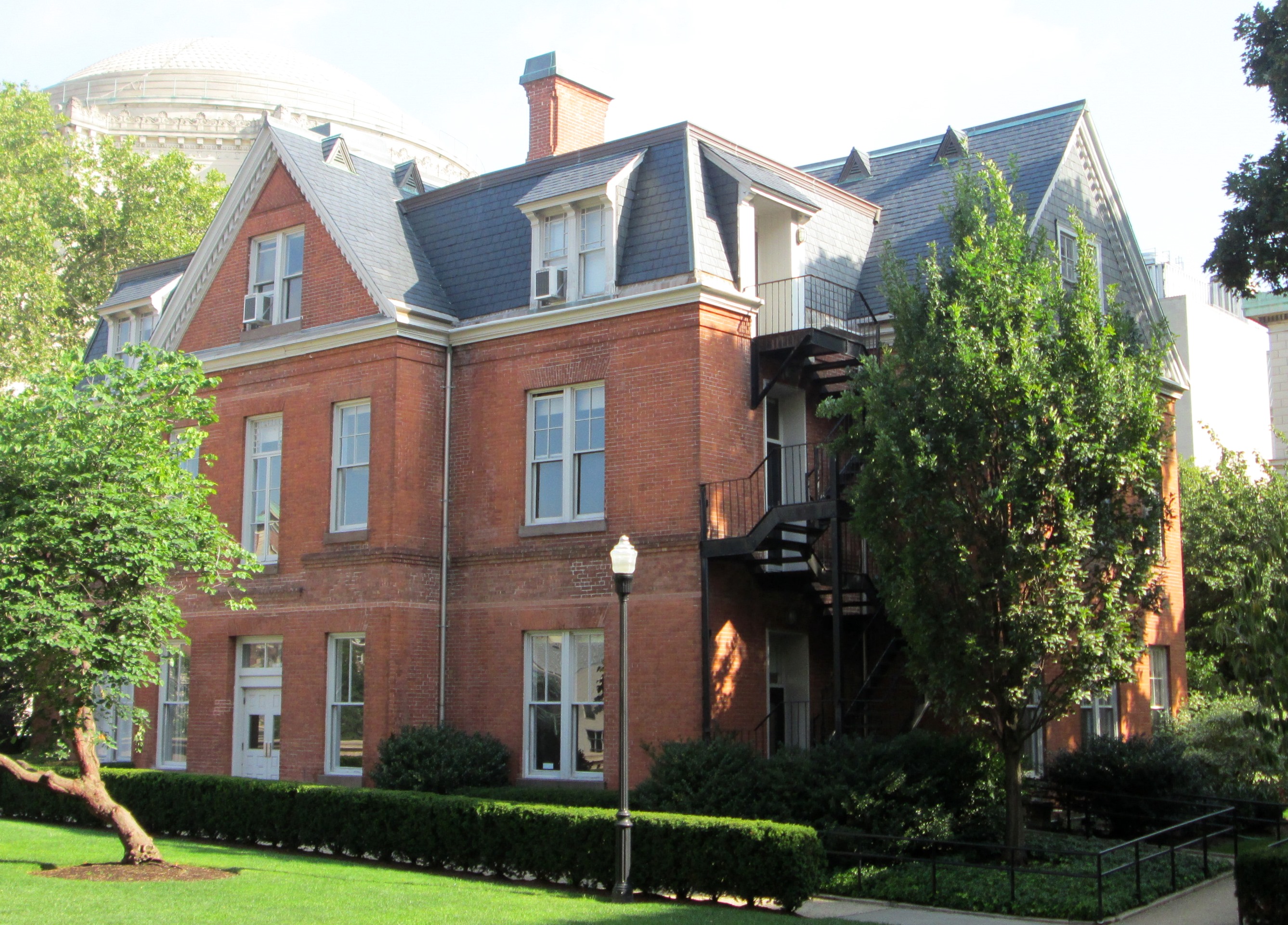
Bloomingdale Insane Asylum
In 1872, Julius Chambers, a reporter for the New York Tribune, had himself committed to the Bloomingdale Insane Asylum with help from his editor and some friends. After ten days inside, they arranged his release. The articles he published exposed abuses of patients, led to a dozen people being freed after they were found to be sane, and forced the institution to reorganize its administration. The asylum occupied what is now the campus of Columbia University in Morningside Heights, Manhattan -- and if you walk across Columbia's quad today, only one building from the original institution remains to hint at what stood here before.
A Dutch Name, An English Road
The name Bloomingdale traces back to the era of Dutch rule in New Amsterdam, likely derived from Bloemendaal, a village in the flower-growing region near Haarlem in the Netherlands. In the early nineteenth century, Bloomingdale was a small settlement on upper Manhattan, and the road connecting it to the thriving city to the south was called Bloomingdale Road -- now known as Broadway. Between 1816 and 1818, the Society of the New York Hospital purchased 26 acres of farmland here to build an asylum for the mentally ill. The large, elegantly detailed Federal-style brownstone building was ready for patients by 1821. At the time, it was the only hospital in New York State dedicated to caring for people with mental illness.
Gardens as Medicine
The asylum grounds were laid out with walks, gardens, orchards, vegetable plots, barns, and pasture land. Farming and gardening were considered therapeutic -- the idea that working the land could calm a troubled mind was central to nineteenth-century psychiatric thinking. The institution expanded steadily: a 30-bed building for male patients went up in 1829, and another wing for female patients followed in 1837. But the asylum's role shifted in 1841, when poor patients began to be transferred to the newly opened New York City Lunatic Asylum on Blackwell's Island, now Roosevelt Island. From that point forward, Bloomingdale served exclusively those whose families could afford to pay. The campus continued to grow for decades, becoming an island of green within a city pushing relentlessly northward.
The City Closes In
By the 1880s, Manhattan's development had surrounded the asylum. The trustees of the New York Hospital began selling parcels of the property to other institutions. The Leake and Watts Orphan Asylum took over land that is now the site of the Cathedral of St. John the Divine. In 1889, the Bloomingdale Asylum relocated entirely to a new campus in White Plains, New York, eventually becoming the Payne Whitney Psychiatric Clinic after businessman Payne Whitney bequeathed a large gift for mental health care. Columbia College purchased the bulk of the vacated Morningside Heights property in 1892 and began planning its new campus. The Juilliard School also acquired a portion, using it until 1969. The Manhattan School of Music now occupies what was once asylum land along Claremont Avenue.
The Last Building Standing
Of all the asylum's structures, only one survives: Buell Hall, originally called Macy Villa. Designed by architect Ralph Townsend and donated by William H. Macy in 1885, it was built to resemble a private home -- a gabled brick building with white trim intended to comfort wealthy gentlemen afflicted with mental illness. It now houses La Maison Francaise at Columbia University. The building is easy to miss amid the imposing neoclassical architecture that surrounds it, a modest domestic structure standing where grand institutional ambitions once flourished. The American artist Charles Deas was institutionalized at the asylum from 1848 until his death in 1867, his career as a painter of the American frontier ending behind these walls. The asylum's historical records are now housed in the Medical Center Archives of the Weill Cornell Medical Library, preserving the paper trail of an institution that helped shape New York's understanding of mental health care -- and its failures.
From the Air
Located at 40.809N, 73.961W on the campus of Columbia University in Morningside Heights, Manhattan. The former asylum grounds roughly correspond to the modern Columbia campus between Broadway and Amsterdam Avenue, around 116th to 120th Streets. Buell Hall, the sole surviving building, is on the eastern side of the campus. Nearest airports: Teterboro (KTEB) 9nm northwest, LaGuardia (KLGA) 5nm east. The Columbia campus is visible as a cluster of buildings west of Morningside Park. Best viewed at 2,000-3,000 ft AGL.