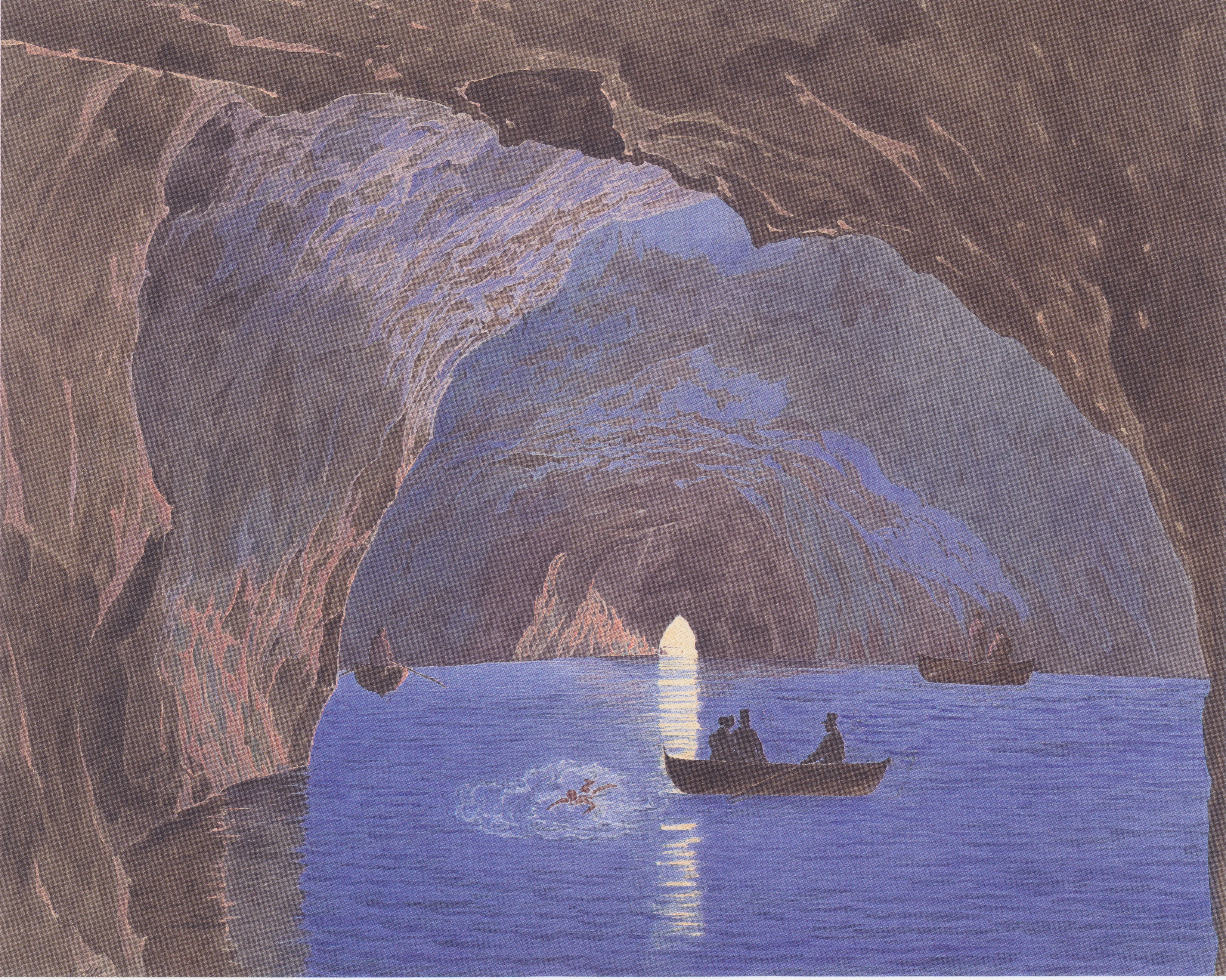
Blue Grotto (Capri)
You have to lie flat on your back in a four-person rowboat. The oarsman grabs a metal chain bolted to the rock, the swell lifts the boat toward the ceiling, and for one breathless moment the cave mouth — barely a meter high at low tide — seems ready to close over you like a jaw. Then you are through, and the darkness gives way to something impossible: water glowing the deep, saturated blue of stained glass, as if the Mediterranean had swallowed a cathedral and kept the light.
The Physics of Enchantment
The Blue Grotto's color is not a trick of paint or minerals. It is pure optics. The cave stretches 60 meters long and 25 meters wide, with a sandy bottom roughly 150 meters below the surface at its deepest. Light enters from two sources: the narrow arched entrance above the waterline, and a much larger submerged opening below it, separated by a band of rock one to two meters tall. Because the underwater opening sits deeper, it admits less light in total — but that light must travel through far more water to reach the cave. Seawater absorbs red wavelengths and passes blue ones, so by the time the light climbs upward from below, it has been stripped down to pure cobalt. Dip your hand beneath the surface and it appears silver, a phenomenon caused by tiny air bubbles clinging to your skin, refracting light at a different angle than the surrounding water. The effect is startling enough to make you pull your hand back and try again, convinced your eyes have made an error.
Known Long Before It Was 'Discovered'
The standard story credits German writer August Kopisch and painter Ernst Fries with discovering the grotto in 1826, a claim Kopisch himself promoted when he published Entdeckung der blauen Grotte auf der Insel Capri in 1838. The truth is less tidy. A Neapolitan song from the 18th century, "La Grotta Azzurra," already referred to the cave by name, which means local fishermen and swimmers had known about it for generations. What Kopisch and Fries actually did was introduce the grotto to the Romantic literary world, and that was enough. Within a decade, Capri's obscure sea cave had become a must-see for the European Grand Tour set. The Romans, it turns out, knew the cave even earlier — statues recovered from the grotto floor suggest it served as a personal swimming grotto for Emperor Tiberius, who ruled from Capri between 27 and 37 AD.
A Cave That Summoned Artists
Once the Romantics took notice, the Blue Grotto became a magnet for creative ambition. In 1842, Danish choreographer August Bournonville set the second act of his ballet Napoli inside the cave, where a demon named Golfo transforms the heroine Teresina into a naiad. Mark Twain arrived in 1867 and recorded his impressions in The Innocents Abroad, adding the grotto to the American literary imagination. Alberto Moravia placed a pivotal scene of his 1954 novel Il disprezzo — later filmed by Jean-Luc Godard as Contempt — inside the cave, using its eerie light as a backdrop for psychological collapse. Ann Weil's 1953 Newbery Honor book Red Sails to Capri brought the grotto to younger readers. Something about the cave's combination of danger, beauty, and confined space has drawn storytellers for two centuries, each finding a different metaphor in the same blue water.
The Price of Entry
Visiting the Blue Grotto requires more than a ticket. It requires cooperation from the sea itself. The entrance is roughly 2 meters wide and just 1 meter high during low tide, which means access is impossible when the water is rough or the tide runs high. Boatmen from the Cooperativa Battellieri Grotta Azzurra control the approach, guiding their small craft through the opening by pulling hand-over-hand along a fixed chain. The passage demands trust — you are essentially helpless for several seconds, lying flat while rock scrapes past inches above your face. In 2011, a visitor suffered a broken neck entering the cave when boatmen continued operations despite dangerous sea conditions. The cooperative initially denied liability but later settled damages. Swimming inside the grotto is now forbidden. The cave that enchanted emperors and Romantic poets remains beautiful, but it has never pretended to be safe.
From the Air
The Blue Grotto sits on the northwest coast of Capri at 40.561°N, 14.205°E, tucked beneath sheer limestone cliffs at sea level. From 2,000-4,000 feet AGL, the entire island of Capri is visible as a rocky mass in the Bay of Naples, with the grotto's cliff face along the northern shore. The nearest airport is Naples International Airport (LIRN), approximately 20 nautical miles to the northwest. Mount Vesuvius provides a prominent visual reference to the northeast. The Sorrento Peninsula stretches east. Sea conditions around Capri can create turbulence at low altitudes, and marine haze frequently reduces visibility in the Bay of Naples.