Blue Lagoon Island
In 1875, an Englishman named Charles King-Harman bought a small Bahamian island from the British Crown for thirty-five pounds. He would go on to be knighted, govern Cyprus, and presumably accumulate many fine possessions -- but none with a story quite like Salt Cay, the legal name for a scrubby island whose lagoon had been a salt marsh for as long as anyone could remember. Pirates had stopped there to harvest salt for preserving food while they waited for permission to enter Nassau Harbour. Privateers did the same. The island changed hands five times in the next three decades, its price ticking up and down with the modest ambitions of each owner. Today it is called Blue Lagoon Island, and tourists arrive by ferry to swim with dolphins in a lagoon that was, not so long ago, a swamp.
Thirty-Five Pounds and a Salt Marsh
The island's early transaction history reads like a lesson in Bahamian real estate speculation -- modest, hopeful, and frequently disappointed. King-Harman held it for eleven years before selling to Sir Augustus John Adderley for one hundred and five pounds. Adderley kept it six years. Two Americans bought it for one hundred forty-five pounds, intending to grow corn and vegetables. The farming failed. In 1902, they sold to Abraham Van Winkle at a ten-pound loss. Van Winkle was the first owner to see the island not as farmland but as something closer to a fantasy. He hired hundreds of laborers to dredge out the salt marsh, blasted a channel from the sea into the lagoon, planted five thousand palm trees, and laid over a mile of winding concrete paths. Then he imported monkeys, peacocks, turkeys, pheasants, parrots, and iguanas. He ferried guests from Nassau on his boat for a dollar a head. Salt Cay was becoming, for the first time, something people visited on purpose.
The Cartoonist's Treasure Island
In 1916, John T. McCutcheon bought the island sight unseen -- by mail -- for seventeen thousand five hundred dollars, from Van Winkle's estate. McCutcheon was the chief foreign correspondent of the Chicago Tribune, a Pulitzer Prize-winning political cartoonist, and apparently the kind of man who purchases Caribbean islands based on a written description. He renamed it Treasure Island, and for the next sixty-three years the McCutcheon family treated it as a private retreat. Part of its charm, the family maintained, was the primitive living conditions. No electricity, no running water, just palm trees and paths and the animals Van Winkle had introduced decades earlier. The name Treasure Island stuck in the Bahamas for generations, an artifact of a newspaperman's romantic imagination applied to a former salt flat.
Demolition Squads and Depth Charges
During World War II, the Allies requisitioned Treasure Island for a year and put it to use that Van Winkle and McCutcheon could never have imagined. Three teams of British and American underwater demolition squads trained there, swimming the seven-mile circuit around the island daily. Explosives and depth charges detonated in the surrounding waters with such regularity that the concussions were later blamed for weakening the island's cliffs and collapsing a small fort. In the evenings, the squads tossed hand grenades over the cliff face. The island that had been a pirate rest stop and a cartoonist's retreat became, briefly, a proving ground for combat swimmers who would go on to clear beach obstacles ahead of Allied landings. When the war ended, the island returned to private hands, but the scars of the training -- the collapsed fort, the blasted rock -- remained.
Dolphins in the Lagoon
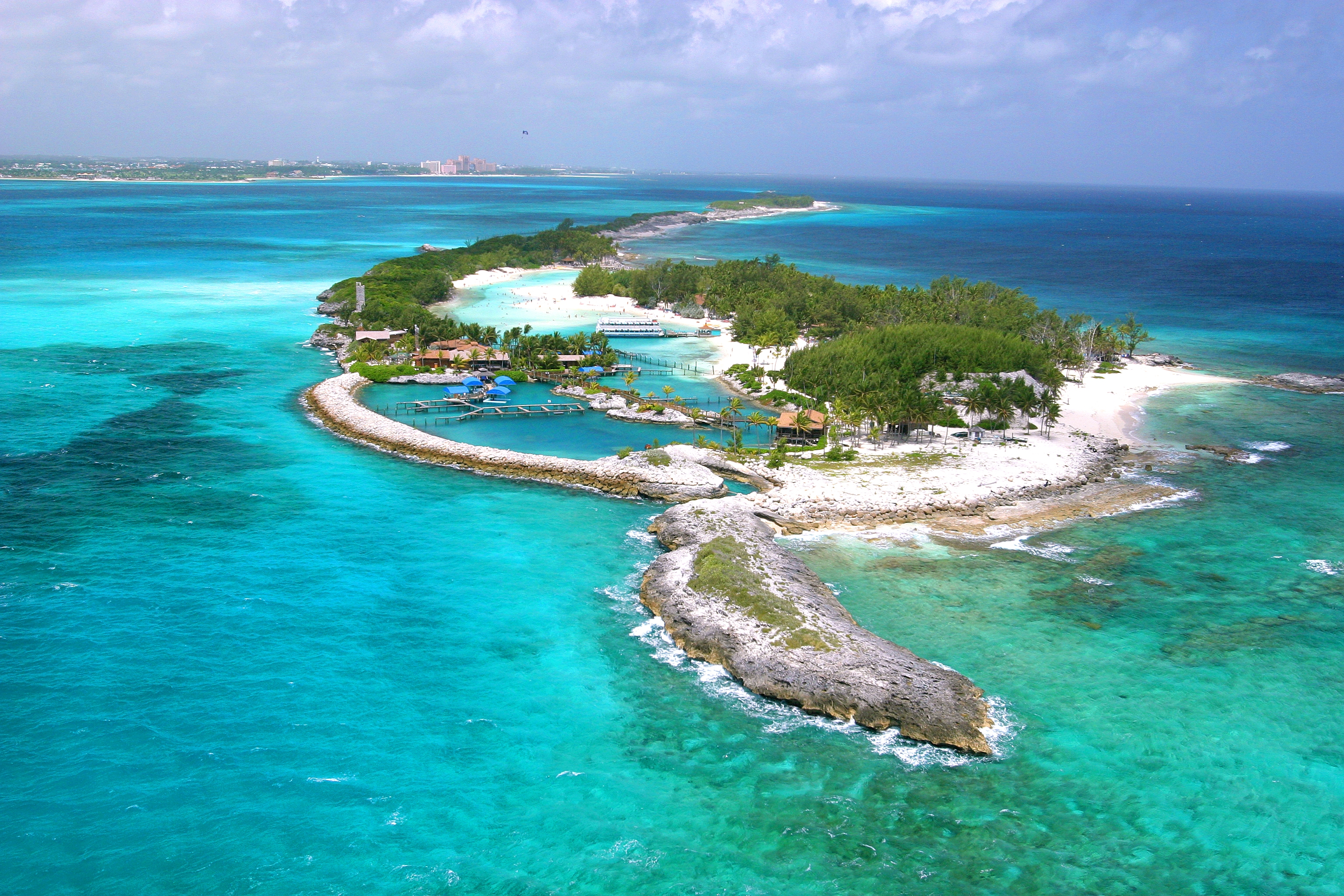
The modern era of Blue Lagoon Island began in 1979 when L. A. Meister purchased it. In 1991, a distant storm -- over two thousand kilometers away -- sent nine-meter swells that cut the island physically in two at the lagoon's northwestern corner. A bridge now spans the gap. Two years later, Dolphin Encounters established a marine mammal facility on the island, launching the educational and commercial programs that define the place today. A multimillion-dollar expansion in 1995 enlarged the dolphin habitat to over three acres with depths up to twenty-five feet. The island that was once a salt marsh where pirates paused, then a private garden stocked with peacocks, then a secret military training ground, is now a place where cruise ship passengers pay to touch a dolphin's nose. Each reinvention says less about the island itself -- a small, low-lying cay five kilometers from Nassau -- than about what each generation wanted a Caribbean island to be.
From the Air
Located at 25.098N, 77.271W, Blue Lagoon Island sits approximately 5km east-northeast of Nassau in the shallow waters between New Providence and Rose Island. From altitude, the island's most distinctive feature is its central lagoon -- a vivid turquoise oval surrounded by green vegetation, clearly different from the surrounding ocean. The bridge connecting the island's two halves (split by a 1991 storm) is visible at low altitude. Nearest airport: Lynden Pindling International Airport (MYNN/NAS), approximately 10nm west. The island is a useful visual waypoint when navigating the chain of small cays east of Nassau Harbour.