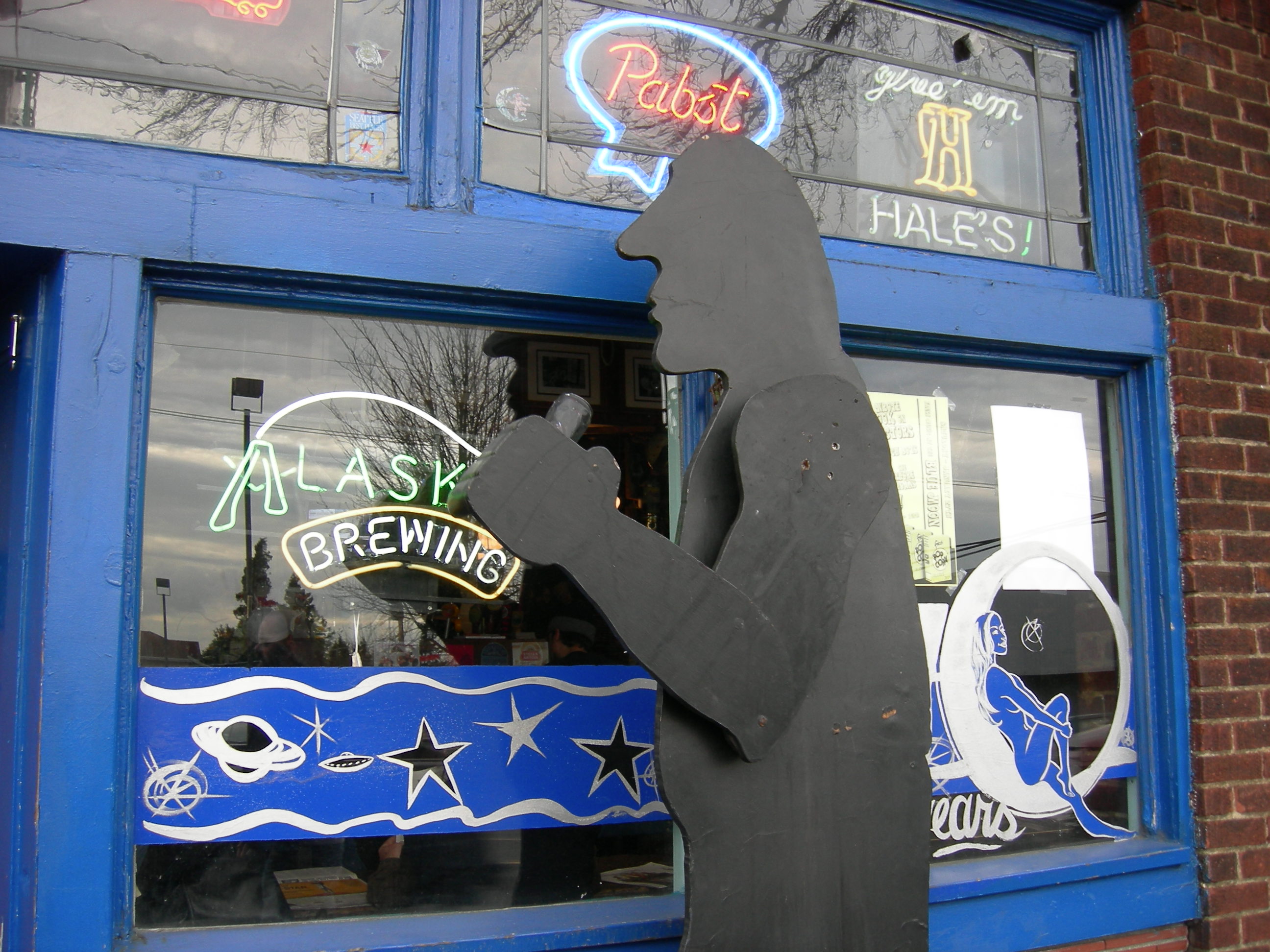
Blue Moon Tavern
The story goes that Tom Robbins, sometime in the late 1960s, fed coins into the pay phone at the Blue Moon Tavern and tried to place a collect call to Pablo Picasso in Barcelona. He got through. Picasso refused the charges. Whether the tale is true hardly matters -- it captures something essential about the Blue Moon, a bar where ambition always outran the budget, where broke writers and blacklisted professors drank cheap beer and believed they were the center of the literary universe. Opened in April 1934 by twenty-one-year-old Henry "Hank" John Reverman, who spent his college fund on a liquor license instead of a degree, the Blue Moon sits on the western edge of Seattle's University District. It has been pouring drinks for more than ninety years.
Prohibition's Last Call
Reverman opened the Blue Moon just as Prohibition was ending, making it one of Seattle's earliest post-repeal taverns. From the beginning, the bar broke with convention. It was among the first in the city to forcefully cross racial barriers, serving anyone who walked through the door at a time when much of Seattle remained deeply segregated. Hank ran the place for several years before leaving for military service, where he became a pilot. The bar passed through other hands, but its character was already set: a gathering place defined not by who it excluded but by who it welcomed. That principle -- doors open, pretensions checked -- would carry the Blue Moon through the decades that followed.
The Professors' Refuge
In the early 1950s, McCarthyism reached the University of Washington. Faculty members suspected of leftist sympathies were investigated, dismissed, or pressured to resign. Several of them found refuge a few blocks from campus at the Blue Moon. Joe Butterworth, a UW professor swept up in the purge, turned the bar into his personal writing desk, working amid the clatter of glasses and the haze of cigarette smoke. The tavern's heyday stretched through the 1950s and 1960s, when it became an unofficial faculty lounge for the kind of professors the university would not officially claim. Poets gathered alongside labor organizers, graduate students argued with dockworkers, and the line between the academy and the street blurred in the way it can only blur in a place where the beer is cheap enough that nobody needs to posture.
Roethke Mews and a Close Call
Among the Blue Moon's most celebrated regulars was Theodore Roethke, the Pulitzer Prize-winning poet who taught at the University of Washington from 1947 until his death in 1963. In 1995, the city honored that connection by naming the alley to the west of the bar Roethke Mews. But the tribute almost came too late. By the 1970s, the Blue Moon had declined, and in 1989 developers set their sights on the property. Community activists led by historian Walt Crowley rallied to save it. An attempt to win landmark status in 1990 failed, yet the developers ultimately spared the building anyway. The Blue Moon survived not because of any official designation but because enough people fought for it -- a bar saved by the kind of stubborn loyalty it had always inspired.
Still Standing, Still Pouring
The Blue Moon celebrated its 90th anniversary in 2024, a milestone that would have seemed improbable during its lean decades. Out front stands the Hammered Man, a sculptural parody of Seattle's famous Hammering Man, a winking nod to the bar's identity. Inside, a poster from Albert Rosellini's 1960 gubernatorial re-election campaign hangs on the wall, a relic from an era when politicians still courted votes in dive bars. The business has been described, without apology, as a dive bar -- one of the few surviving blue-collar landmarks in a neighborhood that has otherwise given itself over to student housing and chain restaurants. The University District has changed around it, growing sleeker and more expensive with each passing decade. The Blue Moon remains: scuffed, unapologetic, and open.
From the Air
Located at 47.662N, 122.320W in Seattle's University District, a few blocks west of the University of Washington campus. From the air, the University District is identifiable by the dense grid of commercial buildings along University Way NE (known locally as 'The Ave') and the contrast with the tree-covered campus to the east. The Blue Moon is a single-story building too small to spot from altitude, but the broader neighborhood sits between the campus and Interstate 5. Nearest airports: Boeing Field (KBFI) 8nm south, Renton Municipal (KRNT) 9nm southeast, Kenmore Air Harbor (S60) 6nm north. Best viewed at 2,000-3,000 feet looking east toward the UW campus and Lake Washington beyond.