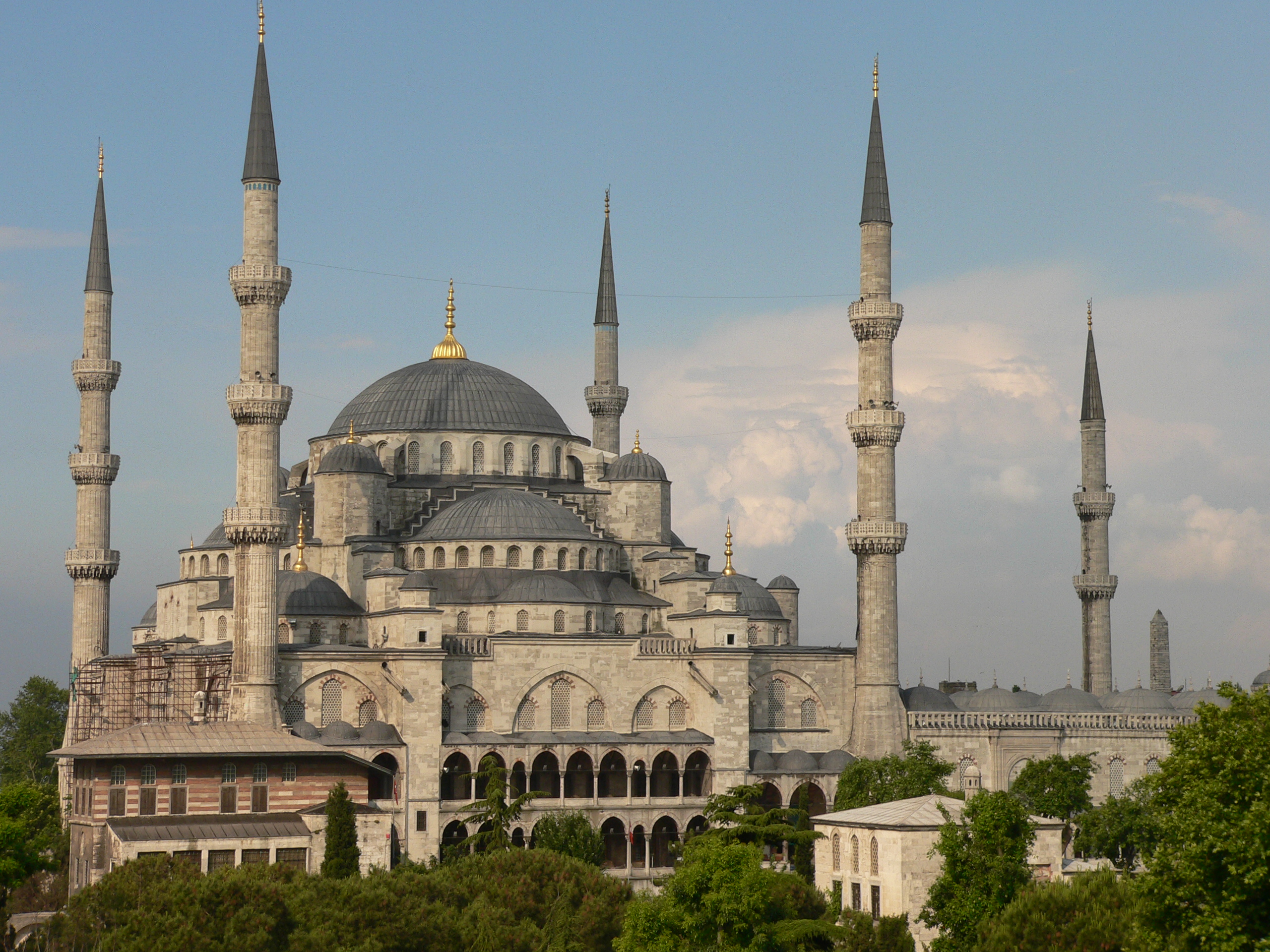
Blue Mosque, Istanbul
An architect, the story goes, misheard. The young sultan had asked for altın minareler - golden minarets. The architect heard altı minare - six minarets. By the time anyone realized the mistake, the building was rising and the scandal was unstoppable. Six minarets meant rivalry with the Great Mosque of Mecca itself, the only mosque on earth that had ever had so many. Whether the misunderstanding really happened or whether Sultan Ahmed I knew exactly what he was doing has been argued for four centuries. The architect Sedefkar Mehmed Agha did not get fired. The minarets stayed. And a seventh minaret, the resolution went, was added in Mecca to put things right.
A Sultan with Something to Prove
Ahmed I was nineteen years old when he came to the Ottoman throne in 1603, and he inherited an empire whose recent setbacks had embarrassed it. The Peace of Zsitvatorok with the Habsburgs in 1606 ended the Long Turkish War without the Ottomans winning - the first treaty in which the sultan no longer demanded Habsburg tribute. To restore prestige and earn divine favor, Ahmed decided to build an imperial mosque in his capital. He had reasons beyond piety. No sultan since Selim II - dead since 1574 - had built one. Both Murad III and Mehmed III had skipped the tradition. Ahmed wanted to mark his reign in stone, and he picked a site that announced ambition: the southeast side of the old Byzantine Hippodrome, directly across from Hagia Sophia, the Christian basilica turned imperial mosque whose dome had crowned Constantinople for a thousand years.
The Controversy
Building anywhere on this site required tearing down the palaces of several Ottoman viziers, including that of the legendary Sokollu Mehmet Pasha. The expropriations were expensive and unpopular. So was the funding. Ottoman religious tradition held that imperial mosques should be paid for with spoils of conquest, and Ahmed I had won no major wars from which to draw spoils. He pulled the money from the imperial treasury instead, at a moment when the empire was already under economic strain. The ulema - the senior Islamic scholars - protested loudly. Some declared Ahmed had violated tradition so badly that Muslims should not even pray in the new mosque. The young sultan went ahead anyway. Construction started in 1609. He was twenty-three. By the time it finished in 1617 he was thirty and dying.
What Mehmed Agha Built
Sedefkar Mehmed Agha had trained under Mimar Sinan, the genius who had defined Ottoman classical architecture in the previous generation. He took Sinan's earlier Sehzade Mosque as a starting point and added something his master had largely avoided - decorative excess. The central dome stretches 23.5 meters across, supported by four massive piers and surrounded by four semi-domes, each flanked by smaller exedrae. Inside, more than twenty thousand handmade Iznik tiles in over fifty different tulip designs cover the walls. The blue and turquoise of those tiles, glowing in light filtered through 260 stained-glass windows, gave the mosque the name foreign visitors have used for centuries: the Blue Mosque. Ottomans more often call it the Sultan Ahmed Mosque, after its patron. Architectural historians like Gülru Necipoglu read Mehmed Agha's design as a turning point - the moment when Ottoman building style began moving from Sinan's restraint toward later baroque richness.
Living Building
The Blue Mosque is not a museum. It is, four hundred years after Ahmed I's death, still a working mosque, with five daily calls to prayer rising from minarets a muezzin once climbed by spiral staircase. Worshippers kneel on a vast carpet under that 23.5-meter dome alongside tourists in modesty robes lent at the door. The hunkar mahfil, the sultan's loge in the southeast corner, sits empty now - its gold leaf and jade rose long stripped, its private mihrab a relic of imperial Friday prayer. During the suppression of the Janissary corps in 1826, those quiet retiring rooms became the headquarters of the grand vizier directing the slaughter of the empire's old elite military caste. Pope Benedict XVI prayed inside in 2006, only the second papal visit in history to a Muslim place of worship. From 2018 to 2023 the building closed for comprehensive restoration; it reopened with the tilework cleaner and the calligraphy newly clear, the central dome's painted decoration once again something close to what Ahmed I and Mehmed Agha had imagined.
Six Minarets, Still
The minarets are fluted columns capped with slender conical lead roofs. The four at the corners of the prayer hall each carry three balconies; the two at the outer corners of the courtyard carry two each, for a total of sixteen balconies in all. From any of them, a muezzin once stepped out five times a day to chant the call to prayer that announced the rhythms of the city. Today the calls play through speakers and the minarets have become silhouette - the shape Istanbul shows the world, six pencils against the sky above Sultanahmet Square. Ahmed I died young, in 1617, possibly before the building was fully complete. He is buried in a turbe just outside the mosque he built, alongside his sons. The scandal of the six minarets is a story locals tell tourists. The mosque underneath remains exactly what Ahmed wanted: the answer he gave to a doubting empire about who he was.
From the Air
Located at 41.005 N, 28.977 E, on the historic peninsula of Istanbul (Sultanahmet district) opposite Hagia Sophia. The six minarets are an unmistakable visual landmark; the building sits on the western edge of the Sultanahmet Square (the old Hippodrome), about 500 m from the Bosphorus. Best viewed at 1,500-4,000 feet altitude. Nearest airport is Istanbul Airport (LTFM); Sabiha Gokcen (LTFJ) is on the Asian side.