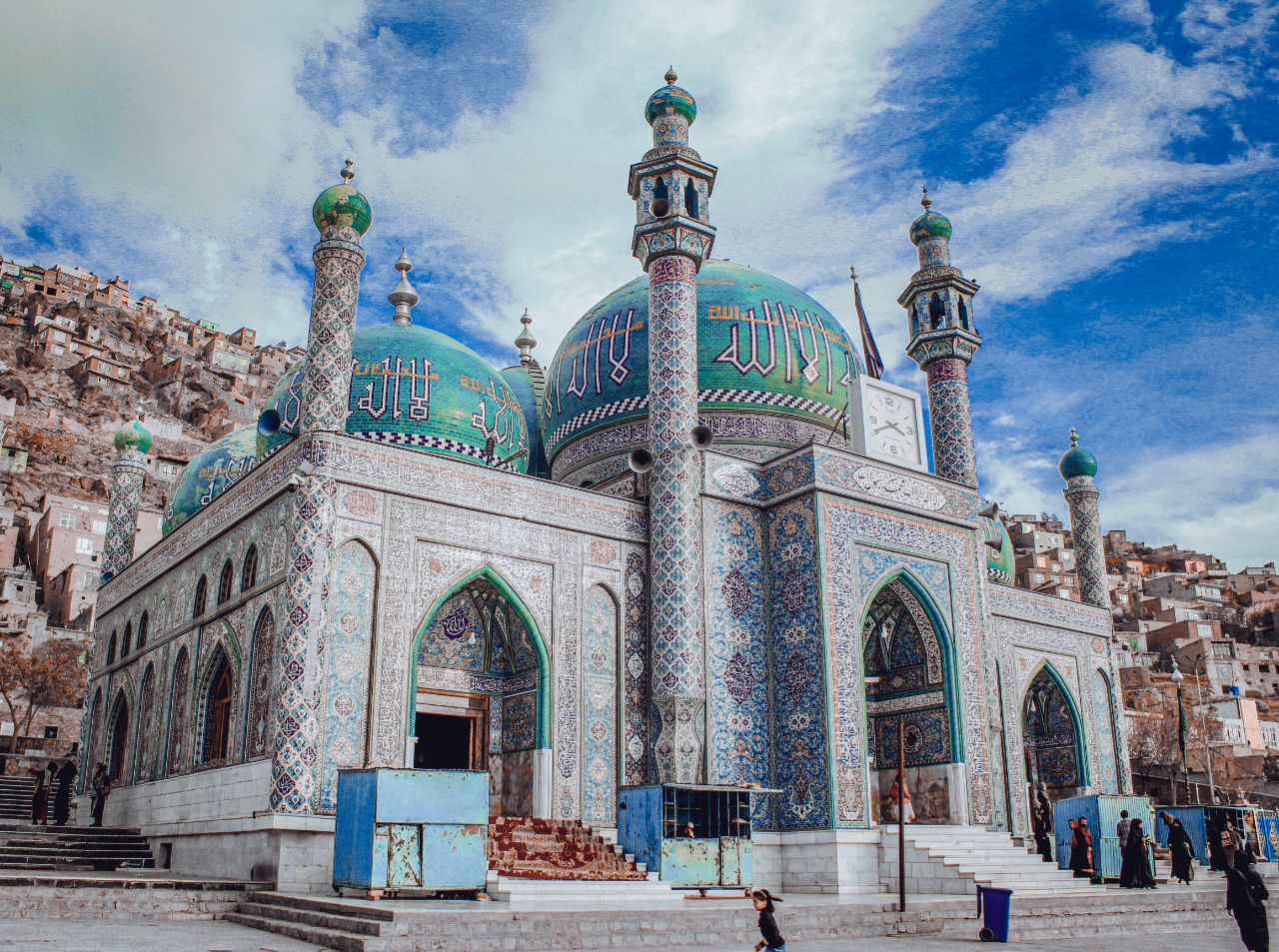
Blue Mosque, Kabul
The rock is still there, beneath the domes. According to the faithful, it is the stone where Imam Ali set down Zulfiqar, his legendary double-tipped sword, during a dream visitation to the men transporting the Prophet Muhammad's cloak south to Kandahar. Whether the dream happened as tradition holds is a question of faith. That a shrine was built over that rock, and that people have venerated it for centuries at the foot of what Kabul now calls Television Hill, is simply fact. The Blue Mosque -- formally the Sakhi Shah-e Mardan Shrine -- stands in the Karte Sakhi neighborhood with its glazed neo-Safavid tiles catching the light, a Shia landmark in a city that has not always been kind to its Shia residents.
The Cloak's Long Road
The story of the shrine begins not in Kabul but in the Cave of Hira, on Jabal al-Nour, where Muhammad received his first revelation. According to tradition, Muhammad bequeathed his cloak to Uwais al-Qarani, who carried it to that cave. The garment's subsequent journey reads like a map of Central Asian power: Baghdad, then Samarkand under Timur, then India, then Balkh in western Afghanistan, where the governor Mir Yar Beg built a fort in Juzgun to house it. The settlement grew around the cloak and became known as Fayzabad. For seventy-nine years, it stayed. When Ahmad Shah Durrani decided to move the relic to his capital of Kandahar, the group of devout men transporting it stopped to rest near the edge of Kabul. Local people came to view the cloak. And somewhere in those days, the vision of Imam Ali and his sword transformed a rest stop into holy ground.
Domes Rising, Century by Century
Ahmad Shah patronized the first structure -- a single dome built over the rock where Ali was said to have placed Zulfiqar. The cloak remained beneath that dome for eight months before continuing its journey to Kandahar, where it remains today at the Shrine of the Cloak. (It was displayed publicly only once in modern history, when Mullah Omar held it aloft before a crowd in Kandahar in 1996 -- though whether he actually wore it remains disputed by eyewitnesses.) The mosque itself grew slowly. In 1919, the mother of King Amanullah Khan added a second dome. Nearly a century later, between 2008 and 2016, four additional domes were added during extensive renovations. The building now bears inscriptions in layers -- Quranic excerpts, Hadith, poetry, and dedicatory texts -- each generation adding its voice to the walls. On the women's side, a tight staircase cut into the bedrock descends to a small underground chamber where women leave petitions and votive offerings. On the men's side, a hand-print relic draws its own line of pilgrims.
Nowruz and the Standard-Bearer
Every spring, the shrine becomes the center of Kabul's Nowruz celebrations. A large banner is raised outside in remembrance of Imam Ali, who tradition holds was Muhammad's standard-bearer. The festival draws the Hazara community in particular -- Shia Muslims who form one of Afghanistan's most recognizable and most persecuted ethnic groups. For the Hazaras, the Blue Mosque is not merely a place of prayer but a statement of presence. In a city where their neighborhoods have been targeted by bombings and their people subjected to systematic discrimination, gathering at the shrine each Nowruz is an act of both devotion and defiance. The celebration is joyful and crowded, a flash of color against the brown hills, the kind of public gathering that marks a community's refusal to disappear.
A Shrine Under Threat, Under Guard
The Hazara connection that gives the Blue Mosque its community has also made it a target. The shrine has suffered multiple attacks, the most devastating being the March 2018 Kabul suicide bombing. The Islamic State, which considers Shia Muslims apostates, has repeatedly struck Hazara gatherings, mosques, and schools across Afghanistan. The fall of Kabul to the Taliban in August 2021 introduced a strange new chapter. In late 2021, New York Times journalists embedded with a six-man Taliban unit assigned to protect the shrine from Islamic State attacks. The reporters noted how seriously the men appeared to take their assignment -- Sunni fighters guarding a Shia holy site against a common enemy. It was a scene that would have been unthinkable a generation earlier, when the Taliban's own record toward the Hazara community included the massacres at Mazar-i-Sharif. At the Blue Mosque, history does not resolve into simple narratives. It accumulates, layer upon layer, like the inscriptions on the walls.
From the Air
Located at 34.52N, 69.15E at the foot of Asamayi Hill (Television Hill) in western Kabul. The shrine complex with its six domes is visible from moderate altitude against the hillside. Nearest airport is Kabul International Airport (OAKB), approximately 8 km east. Elevation roughly 1,800 meters (5,900 feet). The Sakhi Cemetery extends to the north and west of the shrine.