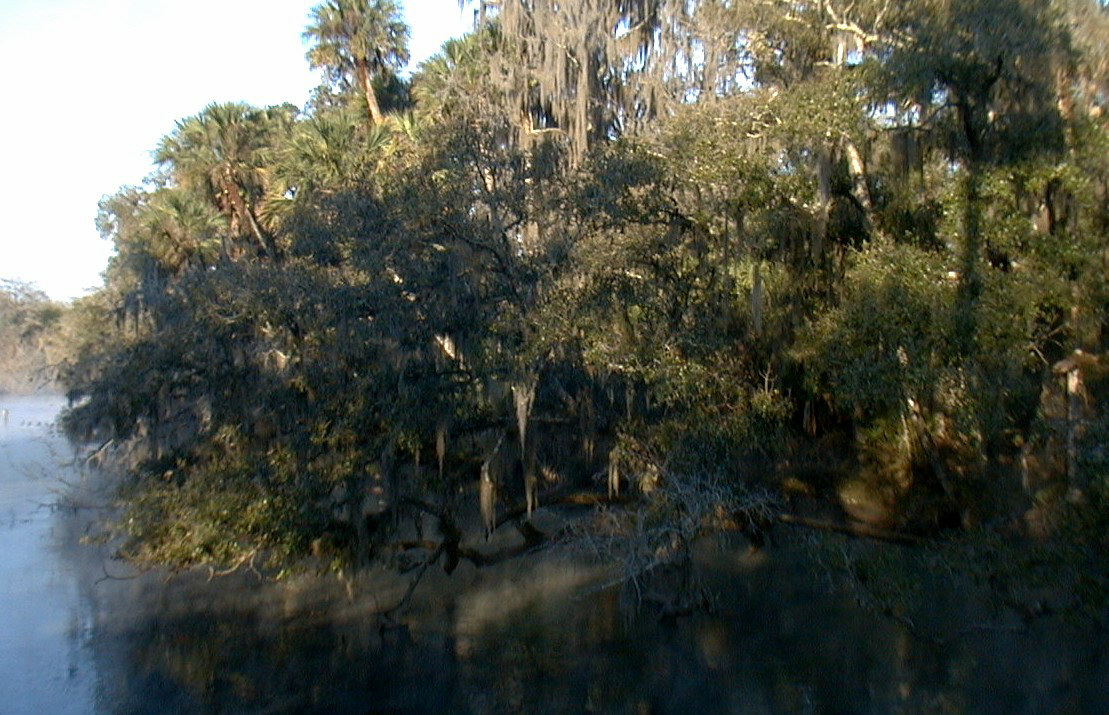
Blue Spring State Park
Every winter, a quiet migration unfolds in the waters west of Orange City, Florida. As temperatures drop across the state, hundreds of manatees leave the cooling St. Johns River and funnel into a single spring run, drawn by water that holds steady at 72 degrees Fahrenheit year-round. Volusia Blue Spring, the largest spring feeding the St. Johns River, becomes one of the most remarkable wildlife gatherings in the eastern United States. The massive, scarred bodies of these marine mammals crowd the crystalline run so densely that from the boardwalk above, the water itself seems to move in slow, gray undulations.
From Citrus Groves to Sanctuary
Long before the manatees drew crowds, the spring drew a different kind of visitor. Botanist John Bartram documented the spring in 1766, one of many natural wonders he cataloged across the colonies. By the mid-nineteenth century, the Weismore family had acquired the land, and the Thursby family built a large plantation-style home atop an ancient shell mound overlooking the water. Citrus seemed destined to define this place. A small railway linked Orange City to the dock at Blue Spring, and the Florida East Coast Railway laid tracks nearby to move fruit north. Then the Great Freeze of the 1890s destroyed the groves and drove the citrus industry south. The Thursbys adapted, pivoting to the tourist trade, offering visitors fishing, hunting, and the spring itself as the attraction. That plantation house still stands in the park, maintained with historical displays that trace these shifting fortunes.
The Scar Catalog
Since 1978, researchers at Blue Spring have tracked individual manatees by the one thing that makes each animal unique: its scars. Boat strikes leave the most visible marks, but fishing-line entanglements, cold lesions, and fungal infections all leave their signatures on manatee skin. Every returning animal is photographed, identified, and logged. Births, deaths, family relationships, and migration patterns accumulate year after year in what has become one of the world's longest-running and most comprehensive manatee databases. Several government agencies collaborate on a Manatee Individual Photo-Identification System, and live video streaming from the spring allows remote researchers to contribute observations. The data paints a picture of loyalty: manatees return to the same warm spring each winter, generation after generation, as predictable as the water temperature itself.
A Spring Under Pressure
The very popularity that protects Blue Spring also threatens it. More human visitors and more manatees together increase the environmental load on the spring's ecosystem. Water pollution from both species has fueled the growth of filamentous algae in the spring area, clouding what was once pristine water. A deeper problem lies underground: groundwater pumping from nearby cities has steadily reduced the spring's flow over recent decades. The spring that once defined abundance now faces the tension between the communities that depend on its water and the ecosystem that depends on its flow. From mid-November through March, all water-related activities are prohibited in the spring run. Swimmers, kayakers, and scuba divers must wait for the manatees to depart before the spring opens again to recreation.
Where the River Widens
Outside manatee season, Blue Spring State Park reveals its other dimensions. The spring run stretches several miles, with a boardwalk covering a third of a mile from the St. Johns River to the headspring, where qualified scuba divers can descend into the spring cave itself. The park holds 51 campsites and six rental cabins. Canoes and kayaks glide the spring run into the broad, tea-colored St. Johns, where alligators bask on the banks and great blue herons stand motionless in the shallows. Bears, raccoons, and a rich variety of birds inhabit the surrounding woods. A short paddle downstream leads to Hontoon Island State Park, accessible only by water, extending the wilderness experience deeper into the river corridor. The blend of crystal spring water meeting the dark tannins of the St. Johns creates a visible boundary where two worlds collide.
From the Air
Located at 28.95N, 81.34W in Volusia County, Florida, west of Orange City. From altitude, look for the dark ribbon of the St. Johns River with a distinct light-blue spring run feeding into it from the west. The spring run contrasts sharply with the tannin-stained river water. Nearby airports include Daytona Beach International (KDAB) approximately 25 nm to the east and Orlando Sanford International (KSFB) about 18 nm to the south. The park sits in flat, heavily forested terrain typical of central Florida. Best viewed at 2,000-3,000 feet AGL for spring detail.