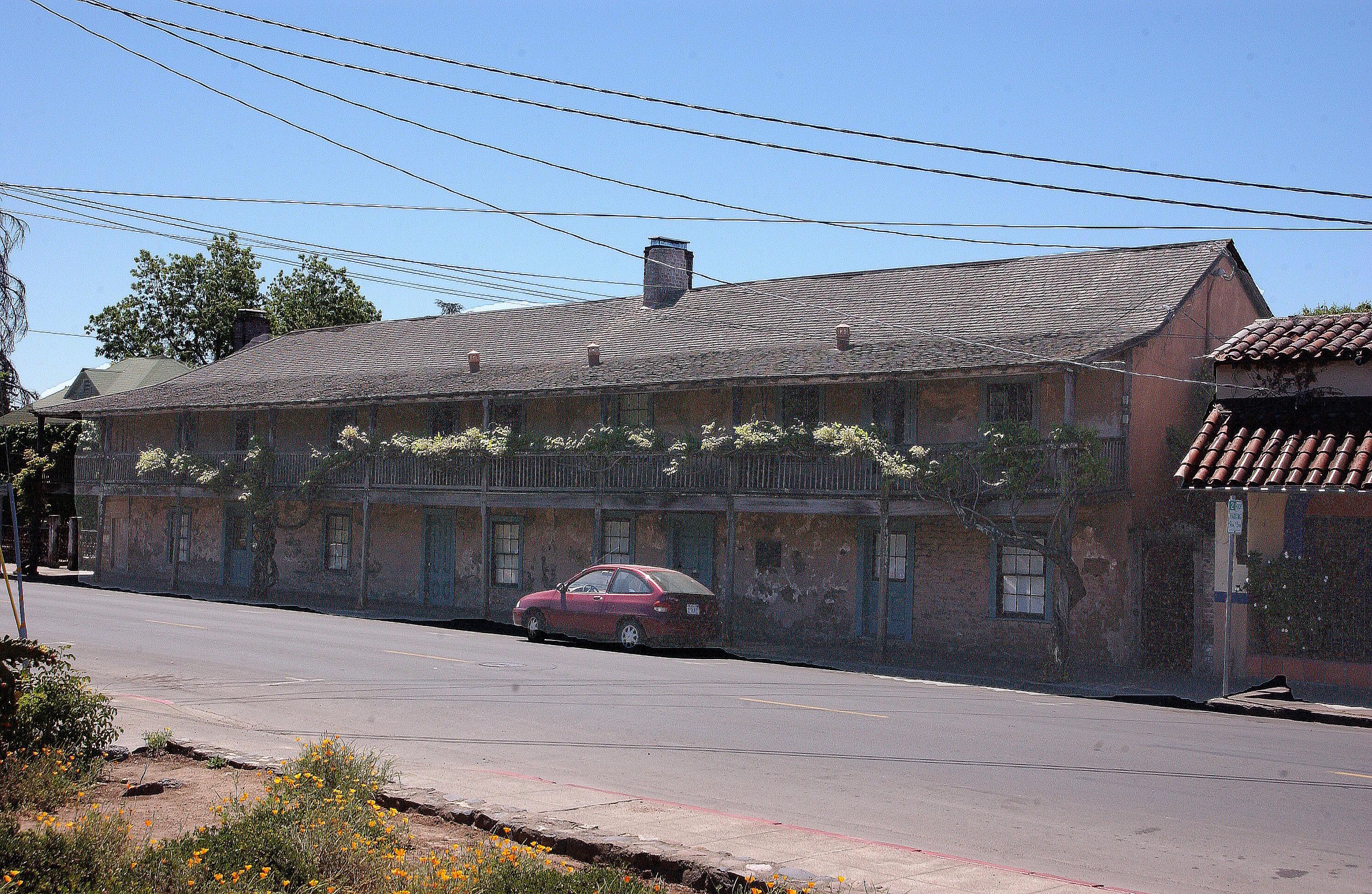
The Adobe Where Generals Drank
The guest list reads like a Civil War reunion that happened fifteen years early. Ulysses S. Grant, William T. Sherman, Joseph Hooker, Philip Kearny -- all future generals, all reportedly drinking and gambling under the same adobe roof in a dusty California plaza town before the war that would define them. Whether every name on that list actually walked through the door is debatable; the Blue Wing Inn in Sonoma has always been better at generating legends than keeping records. What is certain is that this stubborn little building, the first property ever transferred in the new Pueblo de Sonoma, has survived Gold Rush rowdiness, near-demolition, a fire fought with wine, and nearly two centuries of California's restless reinvention.
The Majordomo's Adobe
The Blue Wing's story begins not with hospitality but with the dismantling of a mission. In the mid-1830s, Mariano Vallejo was appointed to oversee the secularization of Mission San Francisco Solano, the northernmost and last of California's Franciscan missions. With the help of William A. Richardson, Vallejo laid out the streets and lots of the new Pueblo de Sonoma according to the Spanish Laws of the Indies. The first recorded property transaction in the new town was Vallejo's grant of half of lot 35 to Antonio Ortega, his majordomo -- the man tasked with the day-to-day work of closing the mission. Ortega's tenure was troubled. The parish priest complained about his treatment of Native Americans, and by 1837, Vallejo removed him over scandals and poor accounting. Ortega stayed in the adobe anyway, opening a tavern -- a pulqueria -- that operated until 1848.
Gold, Cards, and Famous Faces
In August 1849, with the Gold Rush flooding California with fortune seekers, James C. Cooper and Thomas Spriggs bought the property and transformed it. They added a gambling hall, a saloon, and a second story with a wood-frame balcony in the Monterey Colonial style. By 1852, they had expanded with a two-story adobe addition. The dining room occupied the east ground-floor room; the central room held the gambling tables; the west room served as saloon and business office. Overnight guests slept upstairs. After Spriggs died in May 1851, Cooper renamed the establishment the Blue Wing Inn, possibly borrowing cachet from a popular San Francisco saloon of the same name on Montgomery Street. The roster of famous visitors -- Grant, Sherman, Hooker, Kearny, the explorer John C. Fremont, child actress Lotta Crabtree, and the legendary bandit Joaquin Murrieta -- has been repeated so often it has hardened into received fact, though the evidence for each visit varies from solid to wishful.
Saved by Wine, Saved by a Socialite
The Blue Wing passed through a parade of owners after Cooper's death. Patrick Hayne ran it as the Blue Wing Tavern until 1863; John Tivnen took over in 1867; the Pinelli family held it into the twentieth century. In 1911, when fire swept through Sonoma, Agostino Pinelli reportedly used the contents of his wine tank -- stored in a cellar next door -- to help fight the blaze. The Blue Wing escaped with only a scorched roof, saved, at least in legend, by wine. By the 1930s, the building was crumbling. A Federal Writers' Project author described it as "shabby" in 1939, noting a museum inside with a music box that "still tinkles when fed coins" and Sonoma's first fire engine, its painted birds and flowers fading. The Pinelli family considered tearing the whole thing down. Then, in 1941, San Francisco socialite Alma de Bretteville Spreckels and her second husband Elmer Awl paid $2,500 to buy it. The local paper ran the headline: "Sonoma's Old Landmark is Saved by Elmer Awl."
Adobe, Stucco, and the Long Refusal to Die
The Awls repaired the building and demolished a later wooden addition, but their marriage did not outlast the renovation. After their divorce, the property passed to the Murphys in 1945 and then to William and Eleanora Black in 1948. The Blacks spent twenty years on restoration: patching missing adobe bricks, applying stucco and whitewash, adding concrete slab floors, converting windows to doors and doors to windows with a logic all their own. They turned the second floor into apartments and the ground floor into retail space. In 1968, the California Department of Parks and Recreation acquired the Blue Wing, intending to create a house museum. Funding never materialized. The state re-roofed it in 1984 and waited. In 2010, the Blue Wing Adobe Trust was founded, and the following year it partnered with Parks and Recreation to plan a full restoration. As of the 2020s, the building remains part of Sonoma State Historic Park, still under study for its best future use -- an adobe that has outlasted its every intended purpose and seems determined to outlast a few more.
From the Air
Located at 38.29N, 122.46W on the northeast corner of the Sonoma Plaza in downtown Sonoma, California. The plaza is easily identifiable from the air as a large rectangular green space at the center of town. The Blue Wing Inn sits on East Spain Street, directly across from Mission San Francisco Solano. Nearest airports: Sonoma Skypark (0Q9) approximately 2 nm southeast, Schellville (private strips nearby). Napa County Airport (KAPC) is 12 nm east, and San Francisco International (KSFO) is 40 nm south. Best viewed at 1,500-2,000 ft AGL to appreciate the historic plaza layout.