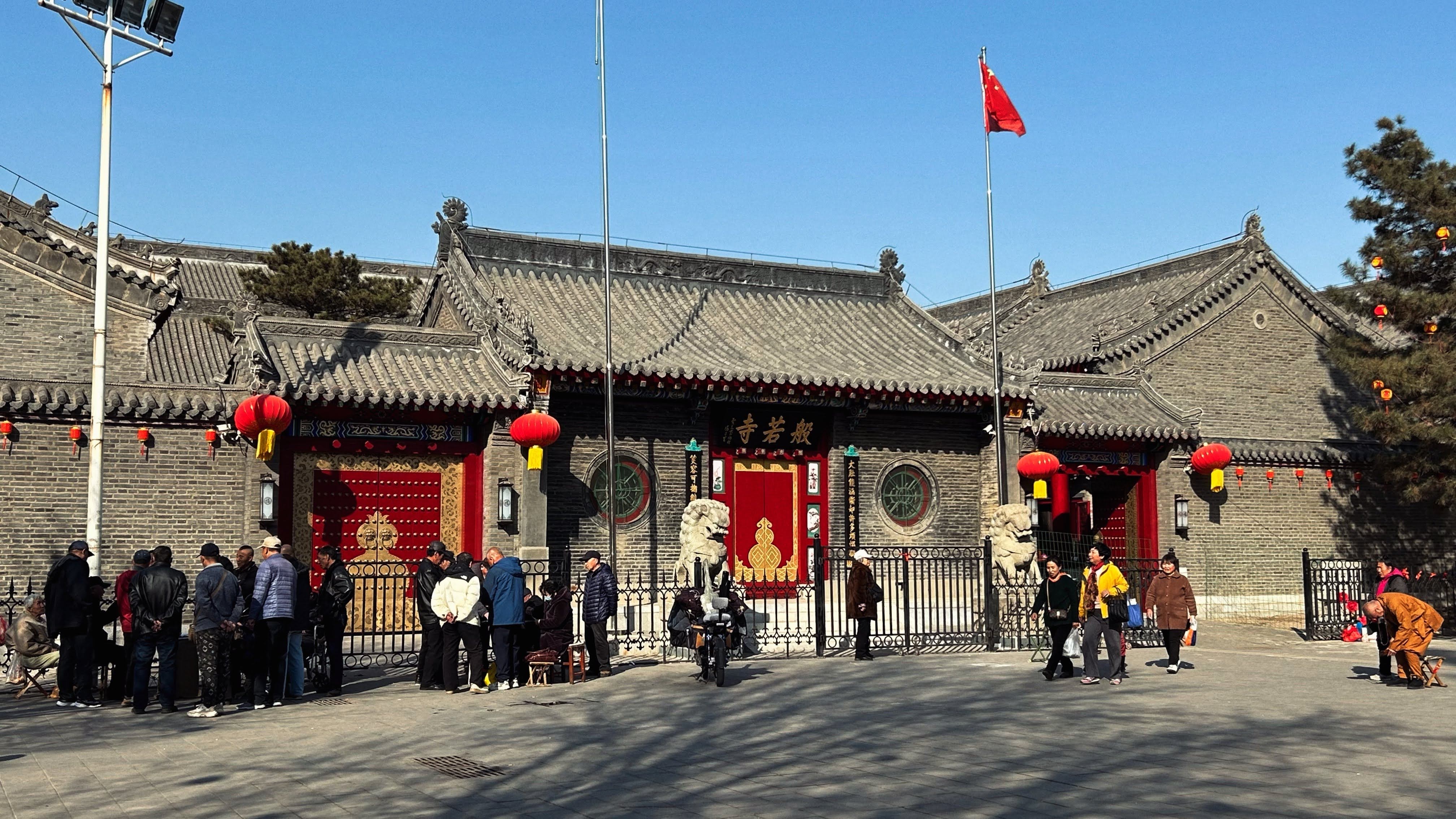
Bo're Temple (Shenyang)
The monk Shi Gulin founded Bo're Temple in 1684, during the reign of the Kangxi Emperor, when the Qing dynasty was barely four decades old and Shenyang was still better known as Mukden, the Manchu ancestral capital. Three and a half centuries later, the temple still stands in the Shenhe District, a compact complex of courtyards and prayer halls occupying just over 3,600 square meters in a city that has grown to more than eight million people. It has been rebuilt twice, damaged by Red Guards, and designated a national treasure. Through it all, the incense has kept burning.
Three Lives of a Temple
Bo're Temple has been rebuilt twice since its founding, first in 1909 during the last years of the Qing dynasty, and again in 1924, during the chaotic warlord era when Manchuria was effectively an independent state under Zhang Zuolin. The Cultural Revolution brought a third crisis. When Mao Zedong launched the campaign in 1966, Red Guards attacked religious sites across China, and Bo're Temple suffered damage, though not the complete destruction that befell many other temples. After the political thaw that followed the 3rd Plenary Session of the 11th Central Committee, the temple reopened for worship. In 1983, the State Council designated it a National Key Buddhist Temple in Han Chinese Area, one of the most significant recognitions a Buddhist site can receive in China.
Two Courtyards Facing South
The temple faces south, in accordance with traditional Chinese geomancy, and is divided into two courtyards. Visitors enter through the Shanmen, the mountain gate, where a plaque bearing the Chinese characters for "Bo're Temple" was inscribed by the calligrapher Feng Ri'an. Beyond the gate stands the Hall of Four Heavenly Kings, where statues of Maitreya Buddha, Skanda, and the four guardian kings greet visitors. The progression from gate to hall follows the standard layout of Chinese Buddhist temple architecture, a spatial sequence designed to prepare the mind for contemplation as the worshipper moves deeper into the complex.
The Mahavira Hall
At the heart of Bo're Temple sits the Mahavira Hall, the most important structure in the complex. Three Buddhas preside over the central altar: Sakyamuni in the middle, Amitabha to the left, and Bhaisajyaguru, the Medicine Buddha, to the right. Behind their statues, paintings depict Guanyin, Manjushri, and Samantabhadra. Ananda and Kassapa Buddha flank Sakyamuni. Stone rubbings of the Sixteen Arhats hang on both walls, and above the entrance, a plaque inscribed by calligrapher Huo Anrong identifies the hall. The accumulation of devotional art within this single room speaks to the temple's long history as an active place of worship rather than a museum.
Older Than the Temple Itself
The Hall of Guru predates the rest of the temple complex by eight years, having been built in 1676. Its paintings of 28 Buddhas represent some of the oldest surviving religious art in the complex. The hall's existence before Shi Gulin's formal founding in 1684 suggests that Buddhist worship on this site may have predated the temple's official establishment. Today, Bo're Temple functions as both a protected cultural heritage site and an active Buddhist center in a city better known for its heavy industry and Qing-dynasty imperial palaces. It was designated a municipal-level cultural relic in 1985 and elevated to provincial-level key cultural heritage in 2015, adding layers of secular protection to a place whose primary purpose remains spiritual.
From the Air
Located at 41.79°N, 123.47°E in the Shenhe District of Shenyang. The temple occupies a small footprint in the dense urban fabric of the city center and is not easily distinguishable from the air. Shenyang Taoxian International Airport (ZYTX) is approximately 20 km to the south. The nearby Mukden Palace and Shenyang's grid street layout are more visible landmarks from altitude.