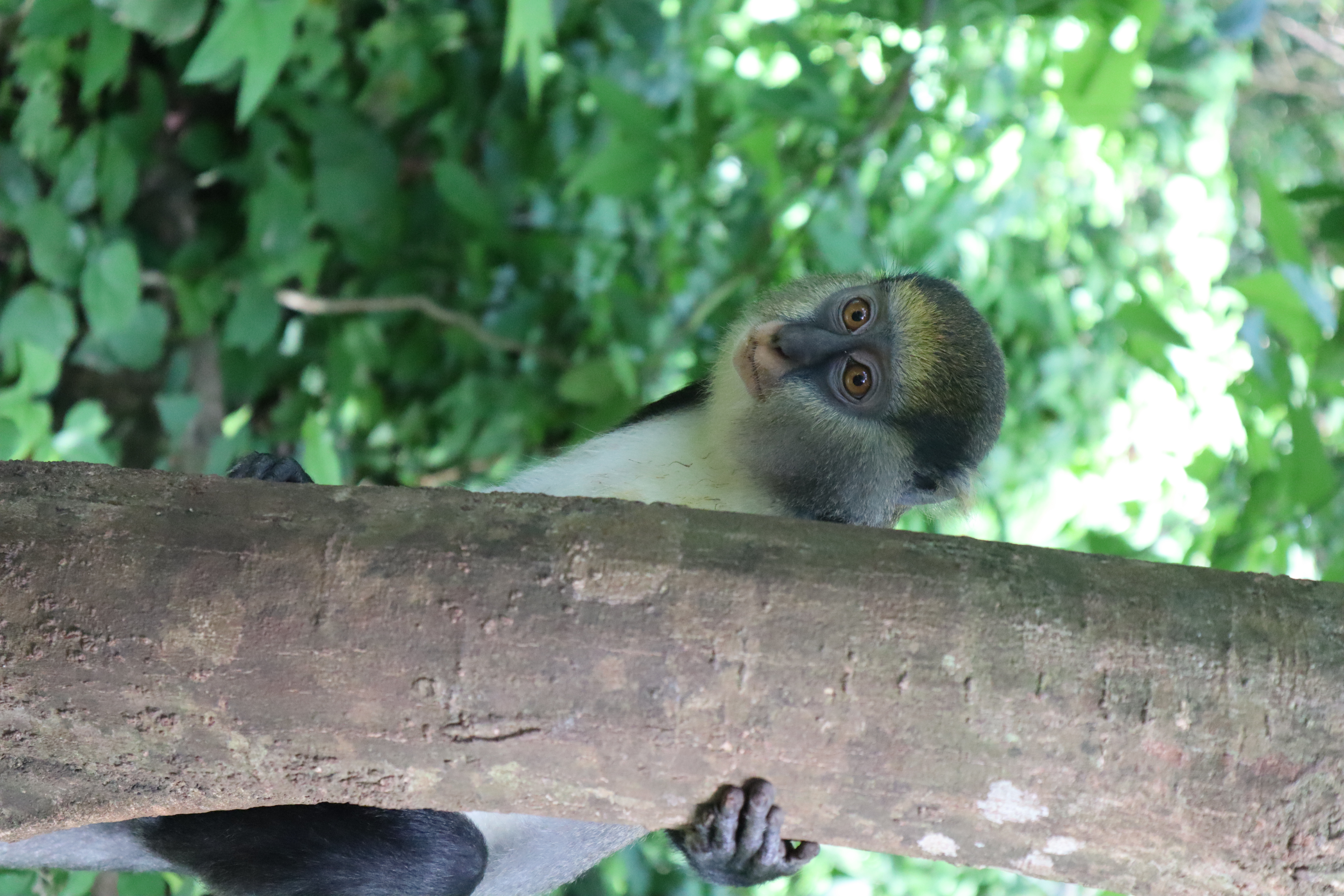
Boabeng-Fiema Monkey Sanctuary
When a monkey dies at Boabeng-Fiema, the fetish priest of Daworo provides a coffin. The animal is wrapped in calico, laid inside, and given burial rites. Mourning follows. This is not metaphor or tourist embellishment. In the twin villages of Boabeng and Fiema, tucked into the forest-savanna transition zone of Ghana's Bono East Region, monkeys are not wildlife to be observed from a distance. They are family, declared so by an oracle generations ago, and the relationship has shaped every aspect of daily life ever since.
Children of the Fetish
The sanctuary's origin traces to a discovery by Nana Kwabena Amoah of Boabeng, who found a fetish called Daworo in mysterious circumstances. Two monkeys accompanied the fetish: a mona monkey named Kwakuo and a colobus named Efoo. When Nana Kwabena Amoah brought Daworo back to his village, the monkeys followed. An oracle was consulted about the relationship between fetish and primates, and the declaration was unambiguous: the monkeys were Daworo's children. Harming or killing them was forbidden. That prohibition has held for generations, enforced not by rangers or fences but by belief. The roughly 700 Campbell's mona monkeys and 300 Geoffrey's pied colobus that inhabit the 4.4-square-kilometer forest today are living proof of its durability.
Neighbors, Not Specimens
Walk through Boabeng or Fiema and the coexistence is immediately visible. Residents leave food outside their homes for the monkeys. The brown-furred mona monkeys range at lower heights, eating a wide variety of food including offerings from visitors, comfortable enough to approach within arm's reach. The black-and-white colobus, more reserved, keep to the high canopy where they feed exclusively on leaves, their dramatic pelts visible against the green. Neither species fears humans. The monkeys move through the villages as though the houses were simply oddly shaped trees in their territory, which in a sense they are. This cohabitation long predates the formal establishment of the sanctuary in the 1970s. The forest itself, along with the taboo against harming its residents, sustained the population through centuries when no government designation existed.
A Forest Between Worlds
The sanctuary sits in a landscape where forest meets savanna, a transitional ecology that supports remarkable biodiversity. Beyond the monkeys, the 4.4-square-kilometer reserve shelters birds, reptiles, deer, and a canopy dense enough to create its own microclimate. The colobus depend on this forest structure entirely; without tall, closely spaced trees, they cannot travel, feed, or escape predators. The mona monkeys are more adaptable but still rely on the forest-edge habitat where fruit and human offerings converge. This ecological fragility makes the traditional protections more than spiritual custom. The taboo against killing monkeys has functioned for centuries as a de facto conservation policy, preserving habitat that might otherwise have been cleared for farming in a region where agricultural pressure on forest margins is constant and increasing.
The Weight of Modern Pressures
Protecting monkeys through spiritual authority works best when the surrounding world remains stable. It works less well when roads deteriorate, tourist numbers fluctuate, and young people leave for cities. The sanctuary has faced periods of neglect, with poor road access limiting the visitors whose entrance fees help fund maintenance. A 2016 report warned that the sanctuary was collapsing under the weight of infrastructure decay. The challenge is a familiar one across West Africa: how to sustain community-based conservation when the communities themselves are under economic strain. Yet the core relationship endures. The annual purification ceremony, performed by the fetish priest of Daworo to pacify ancestral spirits and ensure the wellbeing of both people and monkeys, continues to draw the villages together around a shared obligation that is older than any government program.
From the Air
Located at 7.72N, 1.69W in the Bono East Region of Ghana. The sanctuary occupies a 4.4 km2 patch of forest visible as a green island in the surrounding savanna-agricultural mosaic. Nearest significant town is Nkoranza, about 22 km away. The closest airport is Sunyani Airport (DGSN), approximately 100 km to the southwest. From altitude, look for the forested patch amid cleared farmland near the twin villages.