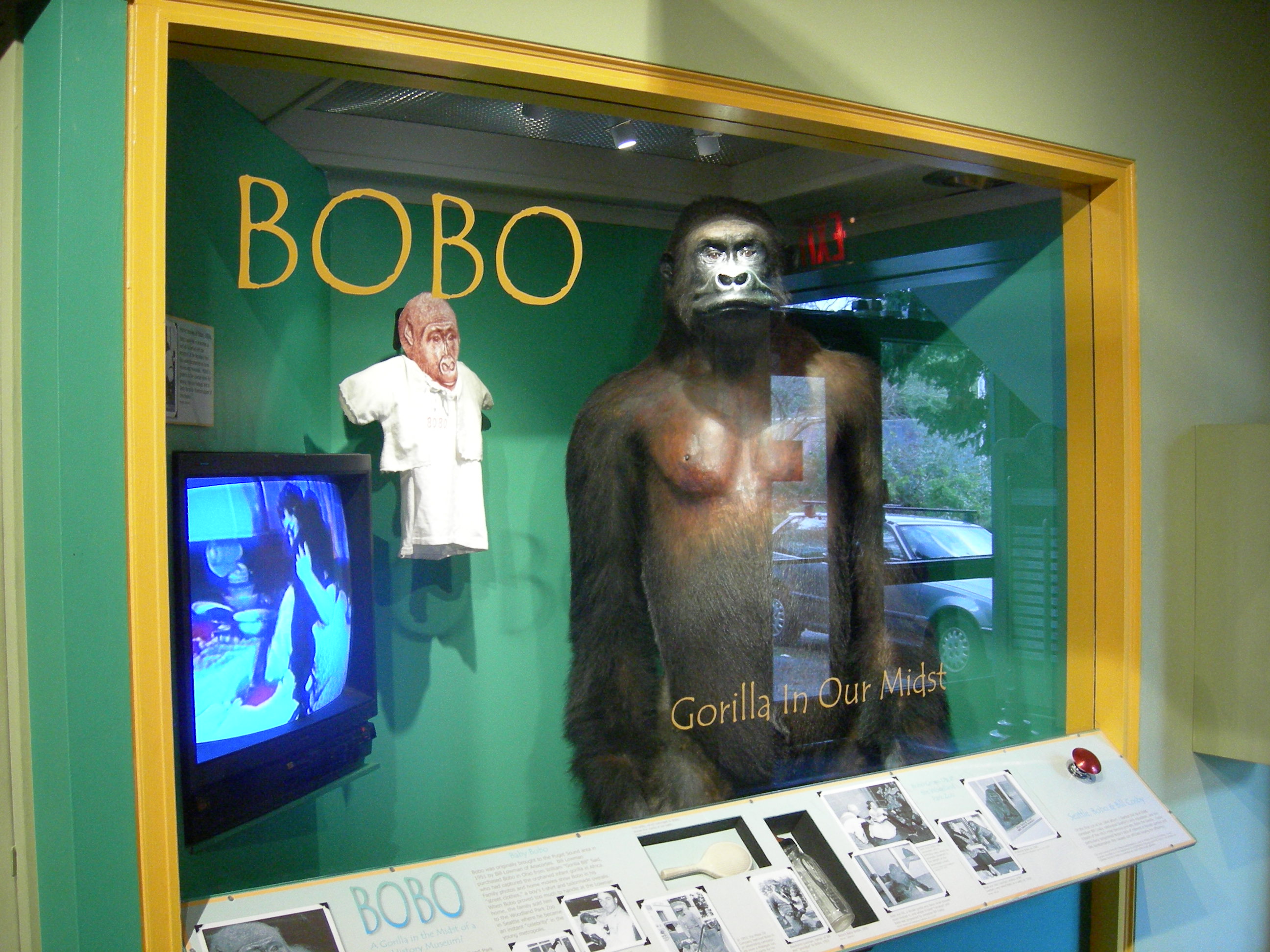
Bobo (gorilla)
Before the Space Needle, before the Seahawks, before Microsoft put the city on the technology map, Seattle's most famous resident was a 350-pound gorilla named Bobo. From 1953 until his death in 1968, Bobo drew more visitors to Woodland Park Zoo than any exhibit in its history, his daily routine front-page news, his moods the subject of civic concern. He arrived as a frightened infant who had been torn from the forests of French Equatorial Africa, was raised in a family home on Fidalgo Island, and died young in a concrete cage. His story is one of celebrity, captivity, and a skull that vanished for nearly four decades.
From Africa to Anacortes
Bobo was born in French Equatorial Africa sometime in 1951. William "Gorilla Bill" Said captured him as an infant, the youngest gorilla ever taken from the wild at the time. No zoo would buy him. Said brought the tiny ape home to Columbus, Ohio, where his mother cared for the animal like a human baby. Months later, Bill Lowman, a fisherman from Washington state who had come looking for a chimpanzee as a gift for his parents, purchased Bobo instead. Lowman's aunt drove the gorilla across the country to the family home in Anacortes, a small town on Fidalgo Island in Skagit County. For the next two years, Raymond and Jean Lowman raised Bobo in their house. He wore clothes, sat at the dinner table, and played with neighborhood children. But gorillas grow fast, and by age two Bobo's strength made domestic life untenable. The Lowmans sold him to Woodland Park Zoo in 1953.
King of the Great Ape House
At the zoo, Bobo became an instant sensation. This was the 1950s, and America's fascination with gorillas ran deep, fueled by decades of King Kong mythology. Here was a real gorilla, accessible and charismatic, in a city that had yet to build its iconic Space Needle or field a professional sports team. Bobo was, for fifteen years, arguably Seattle's most recognizable figure. The zoo used his celebrity to build public support for a new primate house. In 1956, keepers introduced a female gorilla named Fifi, hoping the pair would mate. They never did, though Fifi remained Bobo's companion until his death. Visitors flocked to the Great Ape House to watch him, and generations of Seattle children grew up treating a trip to see Bobo as a rite of passage. His appeal transcended novelty. People felt they knew him.
A Death and Its Controversies
On February 22, 1968, Bobo was found dead in his cage. He was seventeen years old, less than half the normal lifespan for a western lowland gorilla. The official autopsy attributed his death to pulmonary embolism, but the finding satisfied almost no one. At seventeen, Bobo should have had decades left. Questions swirled about his care, his diet, the stress of captivity. The controversy deepened when a taxidermist preserved Bobo's skin for display at the Museum of History and Industry, while the remainder of his body went to the University of Washington's Burke Museum for research. Bobo's stuffed form, fixed rigid behind glass with artificial eyes, became its own strange attraction for years. The taxidermy preserved his image but stripped away everything that had made him compelling.
The Vanishing Skull
Shortly after the autopsy, a graduate student opened the Burke Museum's cold-storage locker and discovered that Bobo's skull was missing. Museum director Daris Swindler investigated but got nowhere. In 1978, word surfaced that the skull might be in the possession of Merrill Spencer, a physician who had attended the autopsy. When a Seattle Weekly reporter contacted Spencer, the doctor admitted he "might" have it and even allowed a photograph, but refused to return it to the Burke. And there the matter sat for nearly three decades. Spencer died in 2006, and his employees, aware of the skull's history, arranged its return. In 2007, Bobo's skull was finally reunited with the rest of his skeleton at the Burke Museum, closing one of Seattle's most peculiar unsolved mysteries. The gorilla who had captivated the city in life managed, even in death, to generate one last strange chapter.
From the Air
Woodland Park Zoo is located at 47.661N, 122.310W in Seattle's Phinney Ridge neighborhood. From the air, the zoo appears as a large green expanse north of the Fremont neighborhood and west of Green Lake. The Burke Museum, where Bobo's remains are held, sits on the University of Washington campus approximately 3 miles southeast. Nearest airports: Boeing Field/King County International (KBFI) 7nm south, Renton Municipal (KRNT) 10nm southeast, Seattle-Tacoma International (KSEA) 13nm south. Best viewed at 2,000-3,000 feet approaching from the west over Puget Sound.