Bochum Dahlhausen Railway Museum
The depot was built between 1916 and 1918 to service steam locomotives, and for 51 years it did exactly that, until diesel won and the building emptied in 1969. Most retired engine houses become parking lots. This one became a museum the size of seven football fields, with 200 locomotives parked under its 14-track shed and a turntable that still spins, watering and coaling and sanding stations still in operation. The volunteers, 130 of them, wear historical uniforms not for the tourists but because that is what you wear when you run a steam engine.
Founding a Place for Iron
The DGEG - the German Railway History Company - took over the 46,000-square-meter depot site in 1977 and converted it into the country's largest railway museum. The vehicle collection had actually started a decade earlier, in 1967, when a handful of enthusiasts began rescuing engines that the modernizing Deutsche Bundesbahn was scrapping. By the time DGEG had the buildings, it had the rolling stock. Today the stars of the exhibition are heavy locomotives - the DRG Class 01 passenger express, the DRG Class 44 freight monster, the workhorse Class 50, the elegant Prussian P 8 from 1918, the wartime Wehrmacht WR 360 C 14. The museum sits on the Industrial Heritage Trail (*Route der Industriekultur*), the curated 400-kilometer loop of Ruhrgebiet sites that turns post-industrial decay into a tourable itinerary.
Steam, the First Sunday
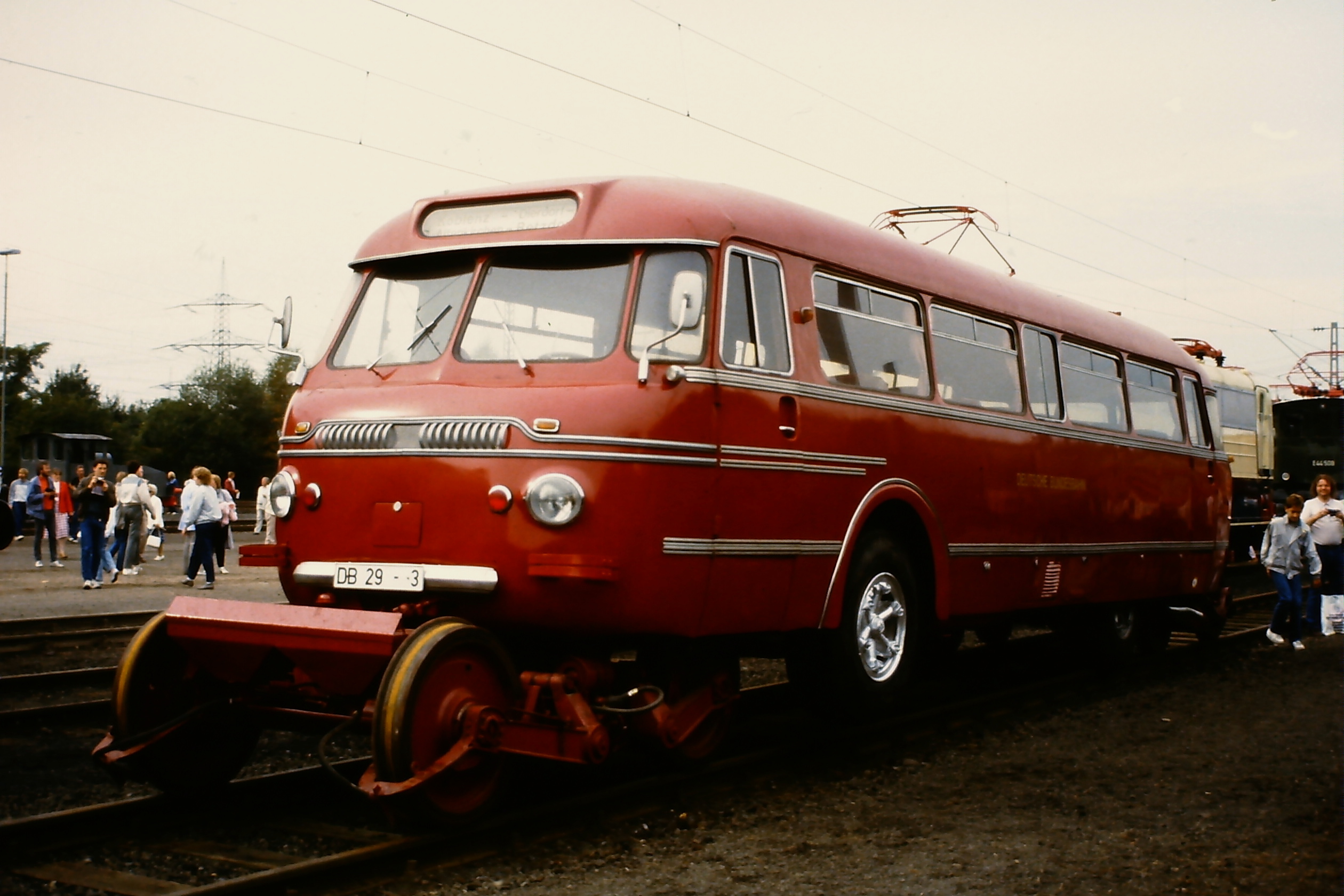
On the first Sunday of each summer month, the museum fires up a Prussian P 8 - locomotive number 38 2267, built in 1918 and still in service - and runs steam excursions along the Ruhr Valley Railway down to Hagen. The line follows the river bank, past Hattingen and the ruined Henrichshuette steel works, through fields and beech woods, into territory the trains used to serve as a coal artery and now serve as a tourist ride. On the days when the steam runs the Ruhr line, the museum's Uerdingen railbus takes over a different abandoned route, the Teckel from Hagen down to the Klutert cave at Ennepetal. Since 2009 the museum has also run trips north to the Zollverein coal mine via Muelheim and Essen, a 50-kilometer journey from one UNESCO industrial landmark to another, all under steam.
The Signal Box and the Pig
Among the 200 vehicles is one detail that captures the museum's character: a working Prussian signal box that stood at Cologne-Muelheim until 1982, dismantled, transported, and reassembled track-side. The levers still throw. The mechanical interlocking still locks. Visitors can operate it. There is also a restored MAN passenger coach from 1921, owned by the Essen Model Railway Club founded in 1949, which runs as part of the Hagen excursion. The museum's railway scenes have appeared in German films - a long sequence of *Das Wunder von Bern*, the 2003 film about the 1954 World Cup, was shot at Dahlhausen. The big anniversary moment came in 1985, when the museum hosted the central celebration of 150 years of German railways. They are currently raising donations to refurbish locomotive 66 002, a DB Class 66 - one of only two ever built.
Volunteer Country
The 130 volunteers do everything. They drive the trains. They polish the brass. They restore wrecks pulled out of scrapyards and rust-out sidings. They wear the uniforms of the era they are operating - if it is a 1920s Prussian P 8 day, the conductor's cap is from 1925. The museum runs on this. Steam locomotives are stubbornly labor-intensive machines - water and coal and ash and grease, and someone has to do all of it - and a place like Dahlhausen survives only because retired engineers and rail-mad teenagers and amateur historians keep showing up. The starlight-pink Prussian T 9.1, by the way, is not currently in the museum - it lives next door at the Starlight Express musical hall in Bochum, where it is part of the longest-running musical in Germany. Same industry, different roles.
Why Here
Dahlhausen sits in the southern corner of Bochum where the city presses against the Ruhr River. The depot existed because the Ruhr Valley Railway needed somewhere to service the engines that hauled coal out of the mines and steel down to the river ports. When the coal industry collapsed, the depot lost its purpose. The DGEG saw what it could become - not a frozen relic but a working machine shop, a place where the locomotives are not stuffed and posed but fueled and run. On a steam Sunday in summer, you can stand on the platform and watch a 100-year-old Prussian engine pull out under its own power, and the only differences between today and 1925 are the cell phones in the passengers' hands.
From the Air
Located at 51.43 N, 7.12 E, in the Dahlhausen district at the southwestern edge of Bochum, on the north bank of the Ruhr River. From altitude, look for the 14-track engine shed and adjacent turntable - the long roof of the locomotive depot is the unmistakable signature. The Ruhr Valley Railway curves along the river immediately south. Nearest major airport: Duesseldorf (EDDL), 35 km southwest. Steam runs are concentrated on first Sundays in summer, when you may see a plume of locomotive smoke tracking along the river bend.