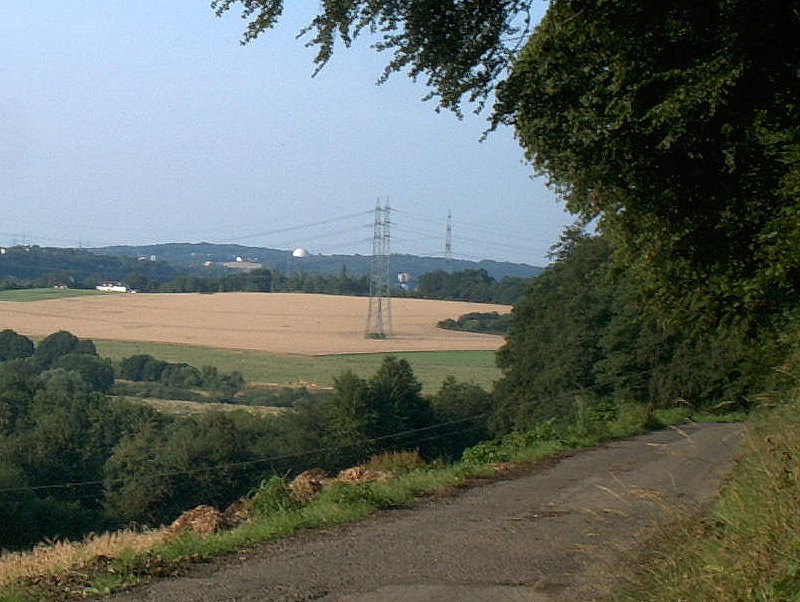
Bochum Observatory
The signal came in at 20.005 MHz, a thin electronic chirp on a frequency the Soviets had announced in advance but which most Western institutions had not bothered to tune. Heinz Kaminski did. He was a professor at the local adult-education college, the Volkshochschule, and he had been running a small popular observatory in Bochum since 1946. On the night of 4 October 1957, while Washington and London were still scrambling to confirm what the Soviets were claiming, Kaminski's receiver in Bochum locked onto the beep of Sputnik 1. The Cold War's first big surprise reached the West through a hobbyist's antenna on a German hilltop.
Cape Kaminski
Locals took to calling the place Cape Kaminski, which is funny on a couple of levels - the original Cape Kennedy was where the Americans were trying very hard to launch things, and Cape Kaminski in Bochum was where the Germans had quietly listened to what the Americans missed. After Sputnik, the observatory transformed almost overnight. The Volkshochschule project became the Institute for Space Research / Observatory Bochum. Newspapers ran Kaminski's name daily. West German radio carried his updates on each successive Soviet launch - Sputnik 2, Sputnik 3, the Luna probes, Vostok 1 with Yuri Gagarin. For a few years in the late 1950s and early 1960s, a popular observatory in the Ruhr was one of the most reliable space-news sources in West Germany, simply because it was listening when no one else was.
The Radome
What you see from a distance today is the Radome - a 40-meter inflatable dome held up by internal air pressure, glowing white against the green hillside south of Bochum. Inside the dome is a 20-meter parabolic dish weighing over 220 tonnes, balanced on a positioning system accurate to one-thousandth of a degree. The dome was originally a piece of Cold War surplus, designed to keep weather off a sensitive antenna while letting radio waves pass through. In October 1999, a long tear opened in the polyester skin and the entire dome collapsed in on the dish. The director, Thilo Elsner, led the multi-year rebuild. Heinz Kaminski lived just long enough to see it underway - he had nominated Elsner as his successor in 1999, and died in 2002, three years before the rebuilt dome was fully operational.
Hello, Venus
In March 2009, the rebuilt 20-meter dish did something no civilian Western European facility had done before: it sent a radar pulse to the planet Venus and received its own echo back, 84 million kilometers round trip. This was planetary radar - active radio astronomy, not just listening but pinging - and Bochum was the first in the Western half of Europe to pull it off. NASA noticed. The agency offered to start routing relevant deep-space data to Bochum, and the observatory's role evolved from listener to participant. The dish has since been prepared to help navigate the AMSAT P5A Mars mission, an amateur-radio satellite project that would send a probe to Martian orbit on a budget orders of magnitude smaller than any space agency's.
Cosmos, Communism, Cold War
The exhibition under the dome carries the title *Cosmos, Communism, Cold War - Sputnik 50*. It opened for the satellite's 50th anniversary in 2007, supported by the Federal Foundation for Studying the SED Dictatorship - the German body that researches the legacy of East German communist rule. The framing matters: the space race was a contest between two political systems, and both produced staggering science and staggering human costs. Soviet engineers built rockets while their colleagues went to gulags. American engineers raced to the Moon while their colleagues marched for civil rights. The exhibition does not pick a side; it documents the instrumentation that listened to both. Many of the original artifacts came from across Germany, gathered into the dome because the dome is where the story actually began for German audiences.
Still Listening
The institute renamed itself in 1982 to the Institute for Environment and Future Research - *Institut fuer Umwelt- und Zukunftsforschung*, the IUZ - signaling that radio astronomy was now only part of the work. The dish receives data from geostationary weather satellites, orbiting Earth-observation craft, and interplanetary spacecraft. A mobile observatory unit carries equipment to schools across the Ruhr. The lecture hall under the dome seats 160 and is busy almost every week. The institute is now also one of the official adult-education centers of North Rhine-Westphalia, which means a teenager from the Ruhrgebiet can take a free evening course on satellite tracking from the same institution that heard the first satellite tracked. That is a rare kind of continuity.
From the Air
Located at 51.43 N, 7.19 E, on the southern ridge of Bochum at roughly 196 meters elevation - the highest ground in the city. The 40-meter Radome is the visual signature: a white inflatable dome on a green hillside, visible for miles. From altitude, scan for the dome south-southeast of central Bochum, with the Ruhr Valley running south behind it. Nearest major airport: Dortmund (EDLW), 30 km east. The hill blocks low-elevation views from the north; best aerial sightlines are from the south, looking up the slope.