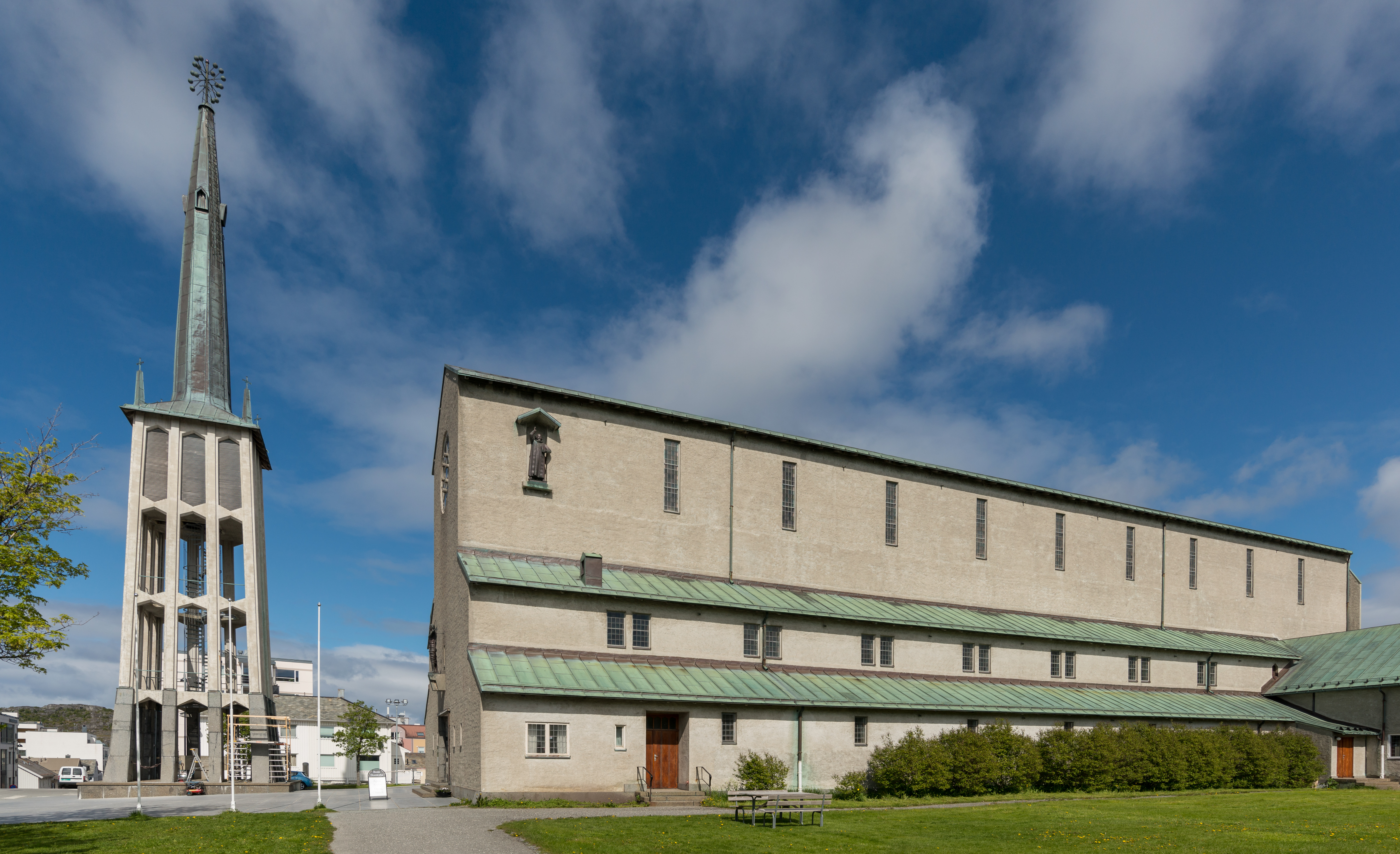
Bodø Cathedral
The inscription on the memorial inside the bell tower reads: 'Til de fra Bodø, som gav sitt liv for Norge under krig og okkupasjon 1940-1945. Ingen nevnt, ingen glemt.' -- In memory of those from Bodø who gave their lives for Norway during war and occupation. No one named, no one forgotten. Bodø Cathedral is itself a monument to that same principle. The original church, a yellow wooden neo-Gothic building consecrated in 1888, was destroyed on May 27, 1940, when German bombers flattened the entire city center. What rose in its place sixteen years later was not a replica but a declaration -- a modernist concrete cathedral that refused to pretend the war had not happened.
A Town That Waited for Its Church
Bodø was established as a town in 1816, but it spent decades without its own place of worship. The nearby Bodin Church, an older structure serving the surrounding area, handled religious duties for the growing settlement. It was not until 1887 that construction began on a church within the town itself, designed by architect Jacob Wilhelm Nordan. Consecrated on January 6, 1888, the building was a yellow wooden long church in the neo-Gothic style, with a tower anchoring its western end. For half a century, this was the spiritual center of Bodø -- a modest but handsome structure befitting a small northern Norwegian town that was still finding its identity at the edge of the Arctic. That church and the community it served would last exactly fifty-two years before fire from the sky erased both.
May 27, 1940
The German bombing of Bodø was thorough. On that single day in May, the Luftwaffe destroyed the entire city center, and the wooden church burned with it. Bodø was not unique in this -- the German campaign in Norway destroyed several towns -- but the completeness of the destruction meant that postwar reconstruction was not a matter of patching damage. It was a matter of building a city from nothing. An architectural competition for a new church was held in 1946, won by the partnership of Gudolf Blakstad and Herman Munthe-Kaas, two architects whose modernist sensibility would shape the building that emerged. The foundation stone was laid in 1954. By the time the church was consecrated on October 14, 1956, by Bishop Wollert Krohn-Hansen, the ecclesiastical landscape had shifted: the Diocese of Sor-Halogaland was established in 1952, and the new building became its cathedral -- an elevation the original wooden church had never held.
Concrete and Light
Blakstad and Munthe-Kaas designed the cathedral in a basilica plan, built entirely of concrete -- a deliberate departure from the wooden tradition of Norwegian church architecture. The sanctuary seats approximately 890 people. The most striking interior feature is the 12-meter-high stained glass window over the altar on the east wall, designed by Åge Storstein and constructed by Borgar Hauglid. The window floods the concrete interior with color that shifts through the day as the Arctic light moves across it. Outside, a sculpture of Petter Dass -- the celebrated 17th-century Norwegian poet and priest of Nordland -- stands as a reminder that this region's spiritual life predates both the cathedral and the town. The building's 36-meter free-standing clock tower holds three bells and houses the war memorial. The tower stands apart from the main structure, a vertical accent against the horizontal sweep of the northern coastline, visible from the harbor and from approaching aircraft alike.
A Cathedral at the Edge
Bodø sits just north of the Arctic Circle, and its cathedral serves the Diocese of Sor-Halogaland -- one of the northernmost dioceses in the world. The city has grown substantially since 1956, becoming the largest city in Nordland county with a population that would have been unimaginable to the 1888 congregation. The cathedral anchors a city center that is entirely postwar, a fact that gives Bodø a different character from older Norwegian towns. There are no medieval lanes or centuries-old timber buildings here. Everything dates from the reconstruction, and the cathedral is the spiritual cornerstone of that rebuilt community. It stands as evidence that destruction does not have to mean erasure -- that a place can acknowledge what was lost while building something that belongs fully to its own time. The memorial inscription captures this precisely. The names are not listed because no one should be singled out; everyone who was lost matters equally. No one named, no one forgotten.
From the Air
Located at 67.28°N, 14.38°E in the center of Bodø, Nordland county, Norway. The cathedral and its distinctive free-standing 36-meter clock tower are visible in the compact city center on the Bodø peninsula, which juts into the Norwegian Sea. Bodø Airport (ENBO) is immediately adjacent to the city, less than 2 km from the cathedral. The city sits just north of the Arctic Circle. From the air, look for the harbor, the airport runway parallel to the coast, and the cathedral's concrete form and tower in the rebuilt city grid. The Lofoten Islands are visible to the west across the Vestfjorden.