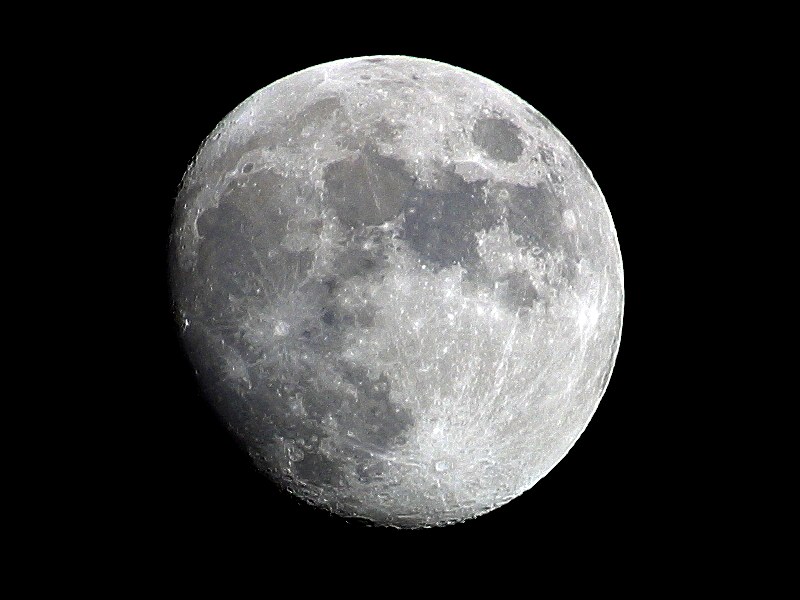
Bode Crater
Johann Elert Bode never saw the Moon through anything grander than the instruments of 18th-century Hamburg, yet his name endures on its surface. Bode crater sits near the center of the Moon's near side, a modest bowl carved by ancient impact into the highlands between three lunar seas. It is a small feature -- just under 15 kilometers across -- but its position at the junction of Mare Vaporum, Sinus Aestuum, and Sinus Medii makes it a landmark for anyone scanning the central lunar terrain through a telescope or from orbit.
The Man Behind the Name
Born in Hamburg in 1747, Johann Elert Bode became one of the most influential astronomers of his era without ever discovering a single new object in the sky. His genius was organizational and mathematical. In 1772, he popularized the relationship between planetary distances that became known as Bode's Law, a pattern so tidy it seemed to reveal the architecture of the solar system. When William Herschel discovered the seventh planet in 1781, Bode proposed its name -- Uranus -- arguing that as Saturn was the father of Jupiter, the next planet should bear the name of Saturn's father. The name stuck. He later directed the Berlin Observatory for nearly four decades and in 1801 published the Uranographia, a celestial atlas so meticulously beautiful it remains one of the finest examples of European star cartography.
A Bowl at the Crossroads
The crater itself is unassuming by lunar standards. Bowl-shaped, with a small flat interior floor and a subtle ridge running along its northeastern inner wall, Bode lacks the terraced ramparts of larger impacts. What it does possess is a minor ray system -- bright streaks of ejected material fanning outward for 130 kilometers, evidence that the impact was energetic enough to throw debris across the surrounding plains. To the west lies a network of fractures called Rimae Bode, sinuous rilles etched into the basalt that hint at ancient volcanic plumbing beneath the surface. The crater sits on a raised patch of terrain surrounded by darker lowlands: Mare Vaporum to the northeast, the broad curve of Sinus Aestuum to the west, and Sinus Medii stretching toward the equator to the southeast.
Neighbors and Context
Bode keeps interesting company. To its southeast lie the paired craters Pallas and Murchison, their rims overlapping in a geologic embrace that speaks to sequential impacts over deep time. The region is a palimpsest of volcanic floods and bombardment scars, where ancient highland crust meets the basaltic seas that filled enormous impact basins billions of years ago. During the Lunar Orbiter missions of the 1960s, cameras captured Bode and its surroundings in oblique photographs that revealed the subtle topography invisible from Earth -- the faint shadows of the inner ridge, the texture of the ray deposits, the way the terrain rises gently from the surrounding maria like a continental shelf emerging from the ocean floor.
A Legacy Written in Regolith
The International Astronomical Union officially assigned Bode's name to this crater in 1935, more than a century after the astronomer's death in 1826. It is fitting that a man who spent his career cataloging and naming celestial objects should himself be remembered through lunar geography. An asteroid, 998 Bodea, also carries his name. The crater endures as a quiet monument: too small to dominate the landscape, too well-placed to ignore. For observers on Earth, it marks the central near side of the Moon like a period at the center of a sentence, a small punctuation in the vast text of the lunar surface.
From the Air
Bode crater is a lunar feature located at selenographic coordinates 6.70 degrees N, 2.40 degrees W on the Moon's near side. The terrestrial coordinates assigned to this article (6.70N, 2.40W) place it in the Brong-Ahafo region of Ghana, which reflects the pipeline's mapping of lunar coordinates to Earth. From the air over central Ghana, the terrain below is West African savanna and tropical forest. The nearest major airport is Kumasi (DGSI), approximately 80 km to the southeast.