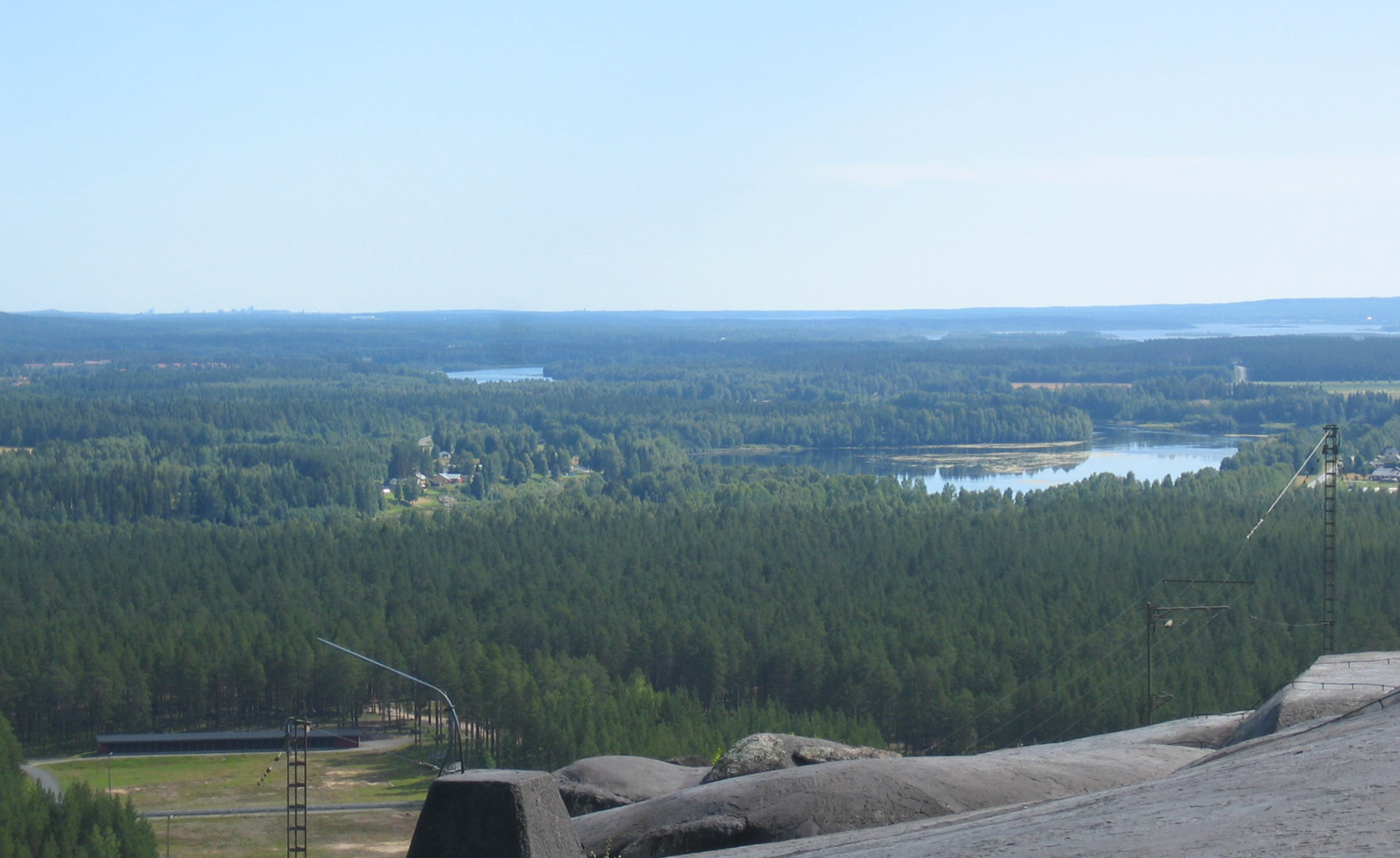
Boden Fortress
For nearly a century, Sweden kept one of its biggest secrets buried inside a mountain 30 kilometers from the Arctic Circle. A third of the nation's gold reserve -- roughly 90 tonnes of bullion disguised as ammunition crates -- sat in the depths of Degerberget Fort from 1941 until armored cars finally hauled the last ingots away in 1982. The gold was just one layer of secrecy surrounding Boden Fortress, a sprawling defensive complex of five forts, dozens of bunkers, and kilometers of dragon's teeth that rings the garrison city of Boden in Norrbotten, northern Sweden. Built to repel a Russian invasion that never materialized, the fortress shaped Swedish military history for a hundred years without ever firing a shot in anger.
Iron, Rails, and the Fear of Russia
The story of Boden Fortress begins not with military strategy but with iron ore. In the 1880s, railway lines pushed northward through Sweden to connect the rich mining fields around Kiruna and Gallivare to the coast at Lulea. On the other side of the Gulf of Bothnia, Finland's main railway was simultaneously reaching toward Oulu, giving Russia a corridor toward the Swedish border. Axel Rappe, chief of the Swedish General Staff, traveled to Norrbotten in 1887 and recognized what the converging rail networks meant: northern Scandinavia had become strategically valuable overnight. The Lule River crossing at Boden, where the main north-south line intersected with the iron ore railway to Narvik, was the obvious choke point. After years of political wrangling -- the Prime Minister and War Minister both threatened to resign if funding was denied -- the Riksdag voted on 7 May 1900 to begin construction.
Blasted from Bedrock
What makes Boden Fortress remarkable is its construction method. Rather than building forts on top of mountains, Swedish engineers blasted them into the bedrock itself, a technique pioneered at Vaberget Fortress near Karlsborg in the 1890s. Workers armed with pinch bars, sledgehammers, and black powder carved ditches nine meters wide and six meters deep around each mountain summit, then bored horizontally into the rock to hollow out the fort interiors. No powered machinery existed on site until 1909. An estimated 300,000 cubic meters of bedrock was excavated by hand across five forts: Degerberget, Mjosjoberget, Gamllangsberget, Sodra Aberget, and Rodberget. The armored turrets, some weighing 100 tonnes, arrived by rail and were dragged up frozen mountain roads on sleighs pulled by teams of 16 to 30 horses. By 1908, all five forts were defensible, their guns ranging from 8.4 cm quick-firing cannon to 15 cm howitzers supplied by Bofors.
The Fortress That Never Fought
Sweden has remained neutral since 1814, so Boden Fortress never faced the Russian assault it was designed to repel. Finland's independence in 1917 created a buffer state that diminished the immediate threat, and during the interwar years the fortress received only bare-minimum maintenance. The Second World War changed that calculus. After the Soviet attack on Finland in 1939 and Germany's invasion of Norway in 1940, intensive construction resumed. Triple rows of dragon's teeth -- massive stones and reinforced concrete blocks -- were laid in continuous defensive lines around the city, backed by anti-tank gun bunkers and machine-gun nests. At peak wartime strength the garrison held 12,000 to 13,000 soldiers, though military planners estimated 25,000 to 40,000 would be needed to withstand a genuine siege. The fortress was tested in a 1913 exercise, when a hussar regiment seized the railway station, waterworks, and headquarters building in a single day, exposing chronic understaffing.
Spies, Pigeons, and Radio Waves
Secrecy bred espionage. Russian sawfilers traveling through Norrland in the early 1900s were widely suspected of working for the Okhrana, the Russian secret police. A Danish ex-lieutenant named Fredrikssen was dispatched by Russia's military attache to Boden in 1913 but achieved little before his correspondence gave him away. Two brothers named Hiukka, serving in the Norrland Artillery Regiment, proved more successful before their extravagant spending exposed them. During the Cold War, Fritiof Enbom -- a railway worker turned communist newspaper editor -- passed fortress secrets to the Soviets for eight years before drunken boasting led to his arrest in 1952. The fortress also pioneered Swedish communications: its radio station south of Degerberget transmitted the first radio broadcast in Swedish history, and at the end of the Second World War some 280 homing pigeons were stationed in Boden alongside a hydrogen-filled observation balloon 27 meters long.
From Battlements to Tourism
Cruise missiles and precision-guided munitions rendered Boden's static defenses obsolete. Mjosjoberget Fort was decommissioned in 1979, and the remaining four forts followed over the next two decades. Rodberget Fort fired its last round at 14:11 on 31 December 1997. A year later it was formally decommissioned after ninety years of service. All five forts and several supporting structures were declared historic buildings by the Swedish government in 1998. Today Rodberget is open for guided tours, drawing over 10,000 visitors a year, and Boden Fortress remains one of Sweden's official salute batteries, firing 21-gun salutes on the national holiday and royal birthdays from four cannon at Kvarnanagen in central Boden. Whether the fortress was, as some call it, a boastful waste or the silent deterrent that helped keep Sweden out of two world wars remains an open question -- but its tunnels, turrets, and dragon's teeth endure as monuments to a century of Arctic vigilance.
From the Air
Located at 65.79°N, 21.66°E in Norrbotten, northern Sweden. The five forts are spread across mountains surrounding the city of Boden. Nearest major airport is Lulea Airport (ESPA), approximately 30 km southeast. From the air, look for the distinctive mountain-top clearings and ditches ringing each fort summit. The dragon's teeth defensive lines are visible at lower altitudes. The Lule River bisects the fortress area, with forts on both sides. Boden Army Air Base (ESPG) is nearby but closed. Recommended viewing altitude: 3,000-5,000 ft for fort layout; lower for individual fortifications.