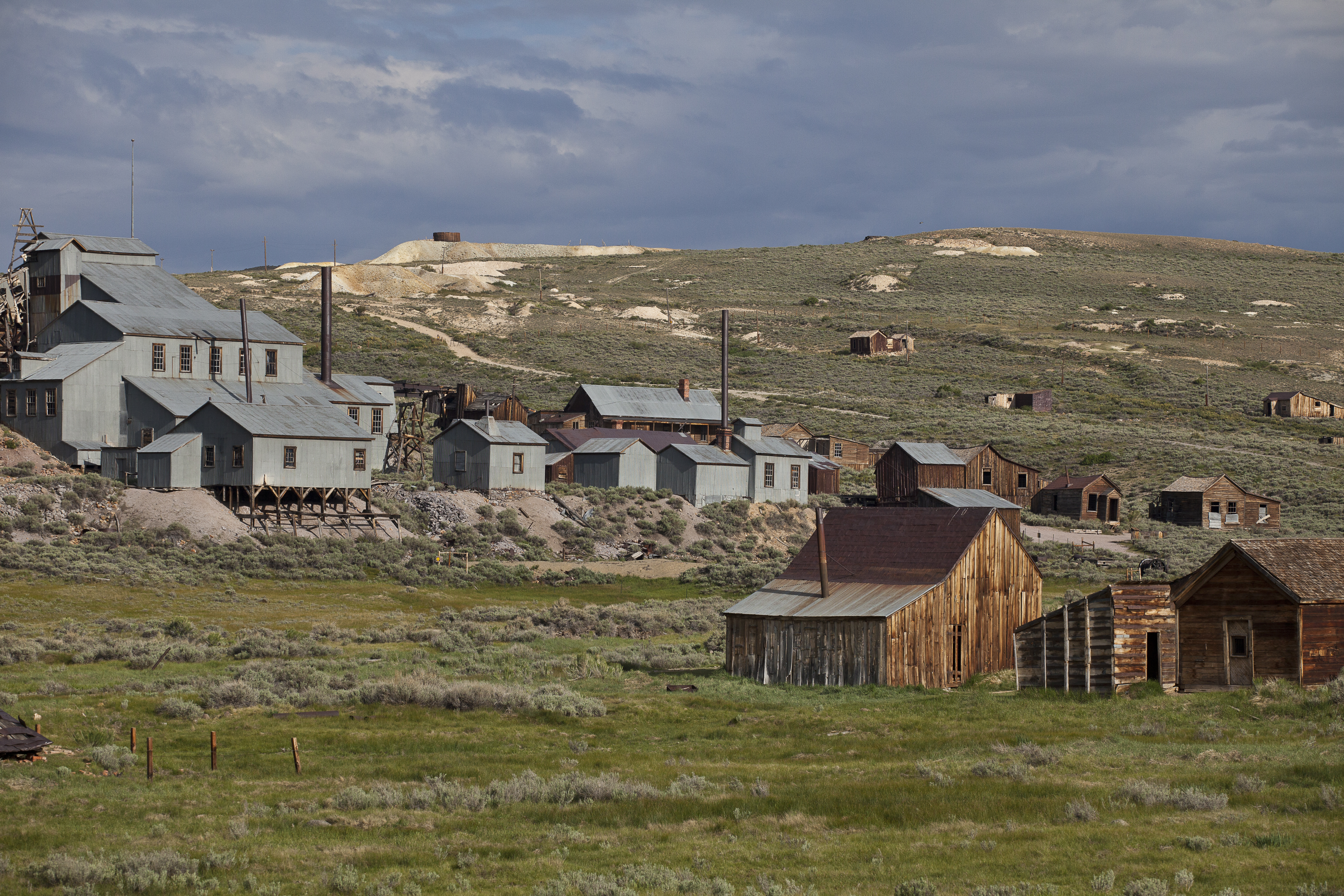
Bodie Ghost Town
Bodie lies at 8,375 feet in the eastern Sierra Nevada, a collection of weathered buildings preserved exactly as its last residents left them. In 1879, it was a roaring gold camp of 10,000 people, with 65 saloons, a red-light district, and a murder rate that reportedly averaged one per day. 'Goodbye, God. I'm going to Bodie,' a young girl supposedly wrote in her diary, terrified of the move to a town notorious even by Wild West standards. The gold played out; the population dwindled; a 1932 fire destroyed much of the downtown. But 170 structures survived, frozen in 'arrested decay' as a state historic park. Today, visitors walk streets where dishes remain on tables, products sit on store shelves, and the only sounds are wind and the occasional creak of old wood. Bodie is the ghost town as time capsule - a place abandoned but not destroyed.
The Boom
Gold was discovered in Bodie in 1859 by William Bodey, who died in a blizzard that winter and never saw the town that mangled his name. For nearly two decades, Bodie remained a minor camp. Then, in 1878, a mining accident exposed a rich vein, and the rush was on. Within a year, Bodie had 10,000 residents, 2,000 buildings, and a reputation for violence and vice that spread across the country. The town had a Chinatown, a red-light district, and a main street lined with saloons and gambling halls. The Standard Mine produced roughly $15 million in gold and silver. The town was so notorious that 'the bad man from Bodie' became a common phrase.
The Decline
By 1881, the richest ore was exhausted, and the population began to fall. A fire in 1892 destroyed much of the business district. Mining continued intermittently into the twentieth century, but Bodie was becoming a ghost town. The last mine closed in 1942 when World War II made gold mining a non-essential activity. The remaining residents drifted away. In 1962, Bodie became a state historic park, preserved in what officials called 'arrested decay.' The buildings were stabilized but not restored - roofs were patched, windows secured, but interiors left exactly as found. The result is eerie: a town frozen at the moment of abandonment.
The Preservation
Bodie's high, dry climate helped preserve what remains. Wood doesn't rot as quickly at 8,000 feet with minimal rainfall. The state park maintains the buildings in their discovered condition - a philosophy of arrested decay rather than restoration. Walking through Bodie, visitors see interiors through dusty windows: a schoolhouse with books on desks, a general store with goods on shelves, a mortuary with caskets ready. About 5% of the original town survives - 170 buildings, including a church, a schoolhouse, the Miners' Union Hall, and the notorious red-light district cribs. The Methodist church's interior is intact, hymn numbers still displayed.
The Curse
Rangers tell visitors about the 'Curse of Bodie' - bad luck that supposedly follows anyone who removes artifacts from the town. The park office has binders full of letters from people returning stolen items: rocks, nails, bottle fragments, with confessions of illness, accidents, and misfortune that followed their thefts. Whether supernatural or psychological, the curse serves a practical purpose: it discourages looting at a site where every remaining artifact contributes to the atmosphere of abandonment. The curse is probably legend, but the letters are real.
Visiting Bodie
Bodie State Historic Park is located 13 miles east of Highway 395, north of Lee Vining, California. The access road is partially unpaved and can be impassable in winter; the park is typically accessible from late April through October, weather permitting. There are no services at Bodie - no food, water, gas, or restrooms beyond outhouses. Visitors should bring everything they need. Rangers offer guided tours in summer; self-guided tours are always available when the park is open. Photography is excellent in the golden light of early morning or late afternoon. The nearest services are in Bridgeport or Lee Vining. Reno-Tahoe International Airport (RNO) is 120 miles north. The experience is unique: 170 buildings, a main street of false-fronted stores, and the wind carrying memories of 10,000 people who once called this place home.
From the Air
Located at 38.21°N, 119.01°W in the eastern Sierra Nevada of California, at 8,375 feet elevation, about 13 miles east of Highway 395. From altitude, Bodie appears as a collection of weathered wooden buildings on a high sagebrush plateau. The surrounding terrain is stark - the Great Basin meets the Sierra. Mono Lake is visible to the south; the High Sierra to the west.