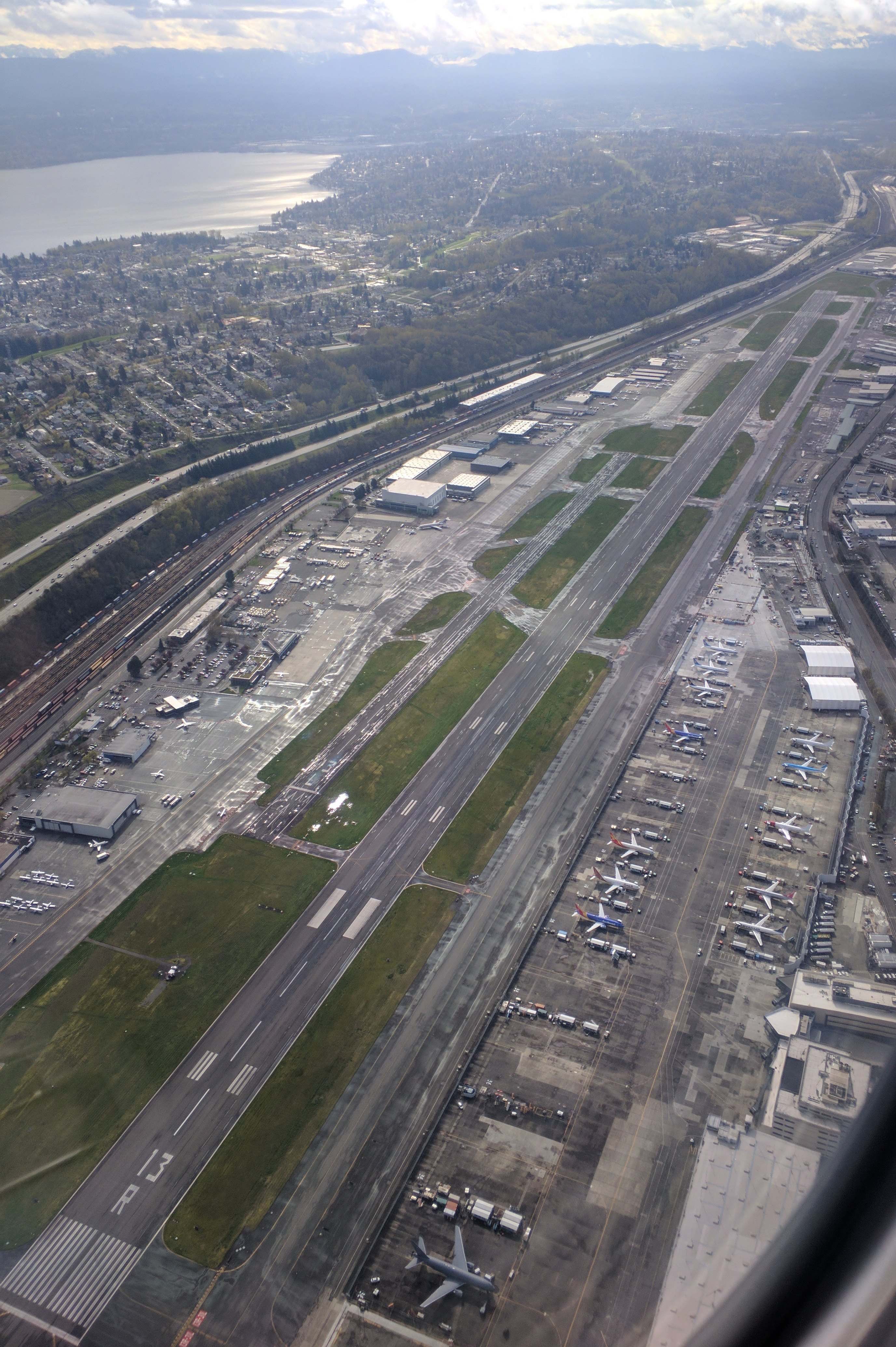
Boeing Field
Every Boeing 737 ever built takes its first breath of open sky over the same stretch of runway where the whole story began. Boeing Field -- officially King County International Airport, but nobody calls it that -- sits just south of downtown Seattle, its 10,000-foot main runway aligned with the Duwamish River valley. Construction started on March 28, 1928, the runway surface literally dredged from the riverbed below. Named for its proximity to the Boeing Airplane Company and the Pacific Air Transport mail planes that used the strip, this airport has witnessed nearly a century of aviation history: from Northwest Airlines DC-3s flying to New York in 1945, to a British Airways Concorde touching down on its first Seattle visit in 1984, to the world's first Boeing 747 now resting permanently at the Museum of Flight on the field's southwest corner.
Dredged From the River
In 1928, the site that would become Boeing Field was swampland along the Duwamish, served by three railroad lines and Highway 99 but hardly fit for aircraft. Workers dredged material from the river bottom to create a usable runway surface -- a literal act of building ground where none existed. The Boeing Airplane Company was already established nearby, and Pacific Air Transport ran regular airmail service through the area, giving the new field both its name and its purpose. By the mid-1930s, the U.S. Bureau of Air Commerce was already worried about safety, investigating construction of a replacement airport due to the high ridge east of the field that created turbulence and obstacles for approaching aircraft. That investigation would eventually lead to the creation of Seattle-Tacoma International Airport. But Boeing Field never went away. It simply evolved.
When Seattle Flew From Here
For decades, Boeing Field was Seattle's primary commercial airport. In 1945, Northwest Airlines operated DC-3 service from the field to Minneapolis, Chicago, Detroit, and New York, passengers hopping through stops at Spokane, Great Falls, and Helena along the way. By 1947, United Airlines was running twenty nonstop flights daily to Portland and a flagship DC-6 service to San Francisco called "The California." Pan Am flew DC-4s nonstop to Fairbanks and Ketchikan, linking Seattle to the Alaskan frontier. West Coast Airlines, headquartered in Seattle, made Boeing Field its home base for years, eventually merging into Air West and then Hughes Airwest. When Hughes Airwest finally moved its passenger jets to Sea-Tac in 1971, the golden age of commercial service at Boeing Field came to an end. But the field's identity had already shifted to something more significant -- it had become the proving ground for the machines that changed how the world flies.
Where 737s Take Flight
The Boeing Company's presence at the field goes beyond the name on the sign. The first 271 Boeing 737s were assembled right here in the 1960s, because the main factory in Renton was at capacity building 707s and 727s. Production moved to Renton in late 1970, but Boeing Field remained the delivery center -- the place where every newly built 737 undergoes its final preparations after its maiden test flight before being handed over to the airline that ordered it. Boeing's facilities at the field include paint hangars and flight test operations. On any given day, fresh 737s in various airline liveries line the taxiways, waiting for their delivery flights. The field also serves as a major cargo hub, handling overflow from the increasingly congested Sea-Tac. Kenmore Air runs daily passenger flights to the San Juan Islands from here, and proposals by Southwest Airlines and Alaska Airlines to move operations to the field -- rejected in 2005 -- speak to its enduring strategic value.
A Museum on the Runway
The Museum of Flight occupies the southwest corner of Boeing Field, and it is not a museum that keeps its distance from the thing it celebrates. Aircraft on the active runway are visible from the galleries. Among the collection sits the very first Boeing 747 ever built, the prototype that inaugurated the age of widebody travel. Nearby is the third Boeing 787 Dreamliner and a retired British Airways Concorde -- the supersonic airliner that made its first Seattle appearance on November 15, 1984, landing at Boeing Field to enormous fanfare. The museum's location is no accident. It sits on hallowed ground for aviation, a field where test pilots first pushed the limits of new designs, where barnstormers gave way to mail planes, mail planes to airliners, and airliners to the jets that connected Seattle to the world. At 21 feet above sea level, hemmed by the Duwamish to the west and the ridge to the east, Boeing Field remains exactly what it has been since 1928: the runway where Seattle's relationship with flight began.
From the Air
Boeing Field (KBFI) is located at 47.53°N, 122.30°W, approximately 5 miles south of downtown Seattle at 21 feet elevation. Two asphalt runways: 14R/32L (10,007 x 200 ft) and 14L/32R (3,709 x 100 ft). The field is easily identifiable in the Duwamish River valley -- look for the long main runway oriented NW/SE with Boeing Company facilities and fresh 737s on the east side, and the Museum of Flight's distinctive angular buildings on the southwest corner. Georgetown neighborhood lies to the east, the Duwamish Waterway to the west. Seattle-Tacoma International (KSEA) is approximately 6nm to the south. Note the high terrain to the east (Beacon Hill ridge) which historically caused concerns for approaching aircraft. Active controlled airfield with Class D airspace; check NOTAMs for Boeing delivery and test flight activity.