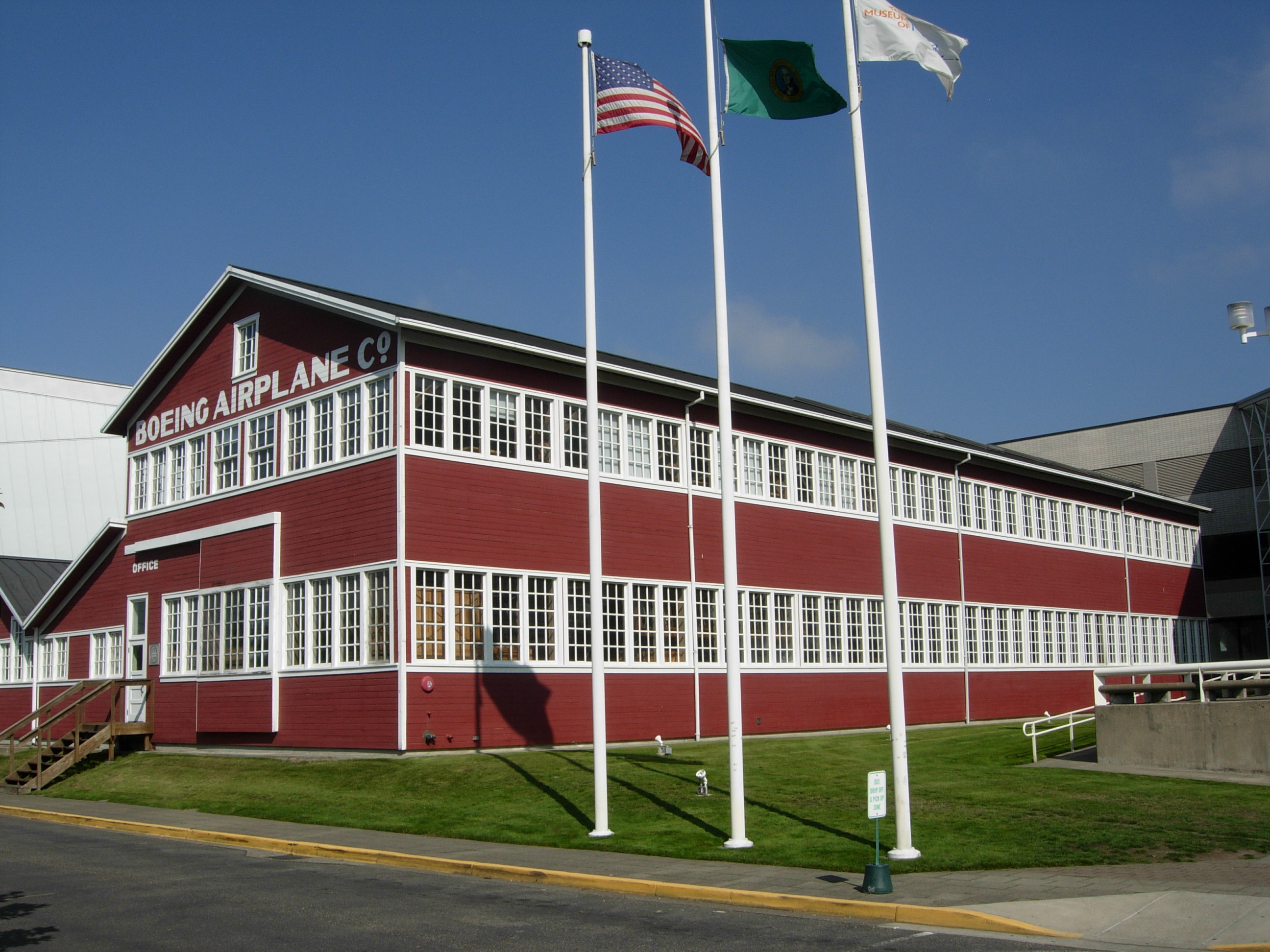
Boeing Plant 1
William Boeing bought a bankrupt boatbuilder's shipyard for ten dollars. It was 1909, the deal was structured to settle Edward Heath's debts, and the property sat on an oxbow meander of the Duwamish River in Seattle. Boeing had originally hired Heath to build a yacht, but what he got instead was a patch of waterfront land that would become the birthplace of one of the largest aerospace companies in history. The wooden barn where Heath had once shaped boat hulls would soon echo with the whine of propellers and the smell of aircraft dope, launching an industry that would reshape global transportation.
From Seaplanes to Furniture
Boeing had been fascinated with flight since 1909, and in 1915 he purchased a Martin seaplane that he and pilot James Floyd Smith assembled on the shore of Lake Union. When the plane was damaged and Martin's repair parts took too long to arrive, Boeing decided he could do better. With naval engineer George Conrad Westervelt, he built two B&W seaplanes at the Heath facility in 1916 and incorporated the Pacific Aero Products Company on July 15 of that year. By 1917, with America entering World War I and the Navy hungry for seaplanes, the renamed Boeing Company consolidated operations at the Heath Shipyard. The site was ideal: the Duwamish channelization had just been completed, giving the company waterfront access for building, launching, and flight-testing seaplanes all in one location. But peace brought a brutal reckoning. After the war, surplus military aircraft flooded the market and demand for new planes collapsed. Boeing slashed its workforce and, to keep the lights on, the factory that had built warplanes started building furniture.
The Red Barn's Golden Age
The airmail boom of the 1920s revived Boeing's fortunes. New machine shops, paint facilities, and testing buildings expanded the Plant 1 campus through the decade. The factory thrived while Boeing produced seaplanes that could be assembled and launched directly into the Duwamish Waterway. Land planes were another matter entirely: they had to be built on site, disassembled, barged across the river to Boeing Airfield, flight tested, taken apart again, and shipped to buyers. When Boeing introduced larger all-metal airframes in the 1930s, this cumbersome process became untenable. Plant 2 opened on the east side of the Duwamish in 1936 with direct airfield access. The last aircraft fully assembled at Plant 1 was the magnificent Boeing 314 Clipper, a massive seaplane that Pan American Airways used to inaugurate the first scheduled transatlantic passenger service. Those Clippers slid into the Duwamish from the Plant 1 launching quay, carrying the dreams of a shrinking world.
Turbines, Torpedoes, and Decline
During World War II, Plant 1 shifted to producing components for warplanes and greatly expanded its static test facilities. In the postwar years, the site became a testing ground for engines, fuel systems, and armaments. From the 1950s until 1967, the Boeing Turbine Division occupied the plant, designing and manufacturing gas turbine engines ranging from 100 to 300 horsepower. These engines found their way into unexpected places: an entry in the Indianapolis 500, drone torpedo helicopters, fire trucks, Swedish S tanks, and Korean War minesweepers. But by the 1960s, the facility was decaying. The Boeing Bust -- the devastating economic downturn that prompted someone to post a billboard reading 'Will the last person leaving Seattle please turn out the lights?' -- sealed Plant 1's fate. The site was sold to the Port of Seattle in 1970.
Saving the Red Barn
Most of Plant 1's twenty-plus buildings were demolished between 1970 and 1976 to make way for Terminal 115. The original Red Barn, Building No. 105, where the entire Boeing Company had once fit within its walls, was slated for the same fate. Instead, preservationists placed it on the National Register of Historic Places. In 1975, the barn was loaded onto a barge, floated down the Duwamish River, and trucked to its current home at the Museum of Flight, where it now houses exhibits on Boeing's earliest years. Only one other original structure survives: a 1929 administration building still standing at 200 Southwest Michigan Street, just south of Terminal 115. The rest of Plant 1 lives on in every Boeing aircraft that has taken to the sky since those first B&W seaplanes splashed into the Duwamish over a century ago.
From the Air
Boeing Plant 1's former site lies at 47.53N, 122.31W along the Duwamish Waterway in south Seattle, now occupied by Port of Seattle Terminal 115. The Red Barn is visible at the Museum of Flight, adjacent to Boeing Field/King County International Airport (KBFI). Look for the cluster of museum buildings on the west side of the airfield at approximately 1,500-2,000 feet AGL. Seattle-Tacoma International (KSEA) is 5nm south. The Duwamish Waterway's channelized course is unmistakable from altitude, running north-south through the industrial district.