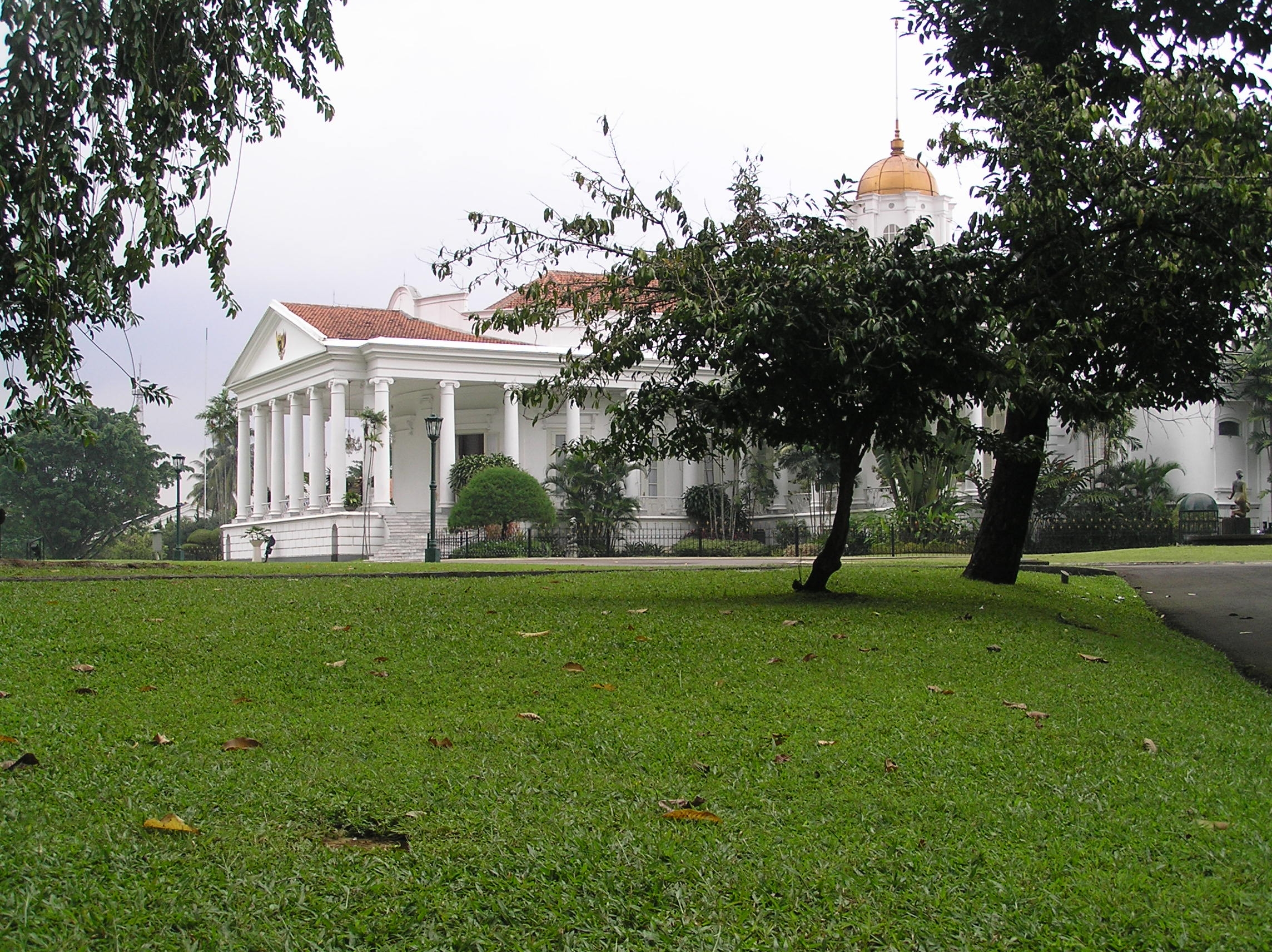
Bogor Palace
The Dutch called it Buitenzorg -- 'without a care.' In 1745, when the governors-general of the Dutch East Indies needed to escape the stifling heat and rampant disease of Batavia, they built a country mansion in the cooler highlands of Bogor, 60 kilometers to the south. Nearly three centuries later, the building they founded is still a seat of power. Bogor Palace is one of seven presidential palaces of Indonesia, and since February 2015 it has served as the working office of the president, a role it has played on and off since the republic's founding. What began as colonial comfort became, through earthquake, war, and revolution, a symbol of Indonesian sovereignty.
A Governor's Retreat
Baron van Imhoff discovered the site on August 10, 1744, in a village called Kampong Baroe. He ordered a mansion built, but his term as governor-general ended in 1750 before the work was finished, and his successor Jacob Mossel completed it. The estate earned its name -- Buitenzorg, the Dutch equivalent of the French Sans Souci -- and for the next century and a half, successive governors-general shaped it to their tastes. Herman Willem Daendels expanded the palace to two stories between 1808 and 1811, adding wings to the east and west. Baron van der Capellen, serving from 1817 to 1826, placed a dome atop the main building and established what would become one of the world's great botanical gardens on the adjacent grounds. The palace became the preferred colonial residence, chosen over the grand buildings of Batavia for Bogor's cooler climate and cleaner air. Then, in 1834, an earthquake triggered by an eruption of nearby Mount Salak brought the two-story structure crashing down.
Rebuilt to Endure
The ruined palace was demolished and reconstructed in 1856 in its present form -- a single story this time, a pragmatic concession to the seismic reality of West Java. That same year, the Dutch government built a guesthouse nearby, originally called the Dibbets Hotel after its founder. The hotel would pass through many names and many hands: the Binnenhof, the Bellevue, and during the Japanese occupation from 1942 to 1945, headquarters of the Kempetai military police. After independence, it was renamed Hotel Salak The Heritage, after the mountain that had once shaken the palace to rubble. The palace grounds expanded over the decades. Six pavilions were added, each named from Javanese tradition -- Dyah Bayurini, Jodipati, Amarta, Madukara, Pringgondani, and Dwarawati. The gardens grew to cover 28.4 hectares, blending seamlessly with the botanical garden next door. Art accumulated in the palace's collection: a 9th-century Dhyani Bodhisattva from Central Java, a replica of Carl Milles' Hand of God gifted by the Swedish government, a copy of Copenhagen's Little Mermaid, and a reproduction of The Archer by Hungarian sculptor Zsigmond Kisfaludi Strobl.
From Colony to Republic
When Indonesia won its independence, Bogor Palace passed from Dutch governors-general to Indonesian presidents. Sukarno, the republic's founding president, made it his favorite residence and effective seat of government until his fall from power in 1967. Under Suharto, who succeeded him, the palace was opened to organized tour groups beginning in 1968 -- though individual visitors were not admitted. For decades after Sukarno's departure, the palace saw relatively little official use, its grand halls and gardens maintained but quiet. That changed in February 2015, when President Joko Widodo moved the presidential office from Merdeka Palace in Jakarta to Bogor, restoring the building to its historical role as a working center of executive power. The shift was practical as much as symbolic: Bogor's distance from the congestion of Jakarta offered a measure of the same relief that had drawn the Dutch governors-general southward centuries before.
The Garden and the Museum
The botanical garden adjoining the palace is among the oldest and most important in Southeast Asia, tracing its origins to Baron van der Capellen's tenure in the early 19th century. Within the palace complex itself, a newer institution preserves a different kind of heritage. The Balai Kirti Presidential Museum, conceived by President Susilo Bambang Yudhoyono in 2012 and inaugurated on October 18, 2014, houses artifacts from the tenures of all Indonesian presidents. The name translates roughly as a building that safeguards the historical record of national leadership -- the personal effects, gifts, documents, and photographs that trace the arc from revolutionary republic to modern state. Walking its halls, visitors move through the ideological intensity of Sukarno's guided democracy, the authoritarian efficiency of Suharto's New Order, and the democratic reforms that followed. Each room is a compressed era, the accumulated objects of power laid out for reflection.
The View from Above
Bogor sits in the shadow of Mount Salak, the same volcano whose 1834 eruption flattened the original palace. The city receives some of the highest rainfall in Java, earning it the nickname Kota Hujan -- Rain City. From the air, the palace grounds appear as a green island within the dense urban fabric of Bogor, the 28-hectare garden a dark canopy of tropical trees distinct from the surrounding rooftops. The white single-story palace stands at the garden's northern edge, its cautious architecture -- low and broad rather than tall -- a permanent record of the lesson Mount Salak taught in 1834. Deer roam freely on the lawns, a tradition dating to the colonial era. To the south, Mount Salak rises through its habitual veil of cloud, a reminder that in this part of Java, the land is always negotiating with the forces beneath it.
From the Air
Bogor Palace is located at 6.598S, 106.797E in the city of Bogor, West Java, approximately 60km south of Jakarta. The palace and its 28-hectare botanical garden are visible as a large green area within Bogor's urban fabric. Mount Salak (2,211m) rises prominently to the south. Nearest major airports include Soekarno-Hatta International (WIII) approximately 70km northwest and Halim Perdanakusuma (WIHH) approximately 50km north. Best viewed from 3,000-5,000 feet; look for the distinctive green rectangle of the palace gardens against the surrounding city.