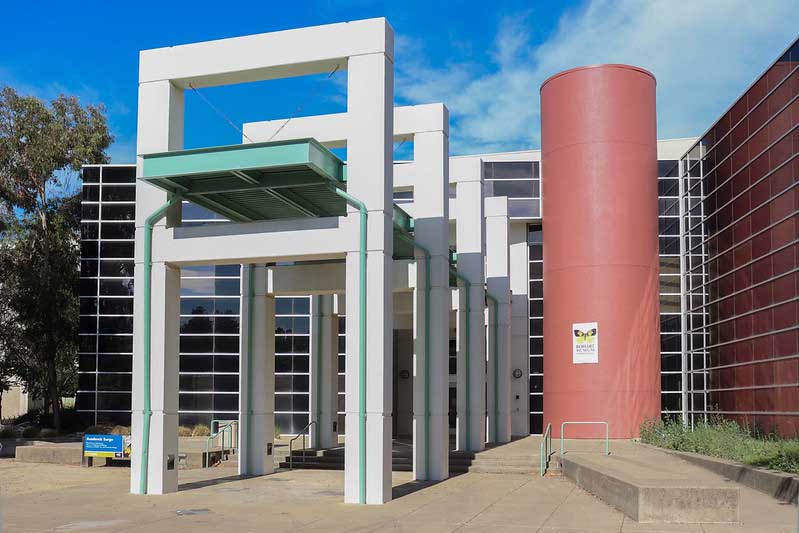
Seven Million Specimens: The Bohart Museum of Entomology
Seven million insects fill the drawers of a single building on the UC Davis campus, and most people in Davis have never heard of it. The Bohart Museum of Entomology is not a place that announces itself. There are no grand columns, no sweeping entrance halls. What it offers instead is staggering in a different way: row after row of meticulously pinned specimens, from iridescent beetles the size of a fingernail to Atlas moths with wingspans wider than a dinner plate. Founded in 1946, the collection has grown into the seventh largest insect repository in North America, a working research archive where the boundary between museum and laboratory disappears entirely.
A Life Spent Pinning Wings
Richard M. Bohart spent decades building what would become his namesake institution. A professor emeritus of entomology at UC Davis, Bohart founded the collection in 1946 and served as its principal contributor for years, amassing specimens with the methodical devotion of someone who understood that taxonomy is built one pinned insect at a time. The museum was named in his honor in 1986. His particular expertise lay in the order Hymenoptera, the vast group encompassing bees, wasps, and ants, and the collection reflects that passion. Today the museum's Hymenoptera holdings are among its strongest, complemented by extensive freshwater arthropod collections and a deep archive of California insect fauna. Since 1989, director Lynn Kimsey has continued Bohart's legacy, guiding the museum through decades of growth and expanding its role as both research hub and public resource.
A Collection That Never Stops Growing
Each year, approximately 30,000 newly acquired specimens join the Bohart's holdings. They arrive from museum-sponsored field studies, faculty research projects, student collections, and donations from the Bohart Museum Society and the wider entomological community. The scale is difficult to grasp: at least 90 percent of the seven million specimens are insects, with the remainder comprising other terrestrial and freshwater arthropods. The geographic scope is global, though the Western Hemisphere, Indonesia, and Australasia are particularly well represented. At any given time, roughly 7,400 specimens are on loan to domestic and international researchers, feeding at least 18 publications per year. The museum is less a static display than a circulating library of preserved life, its contents constantly being borrowed, studied, described, and returned.
Where Research Meets the Public
The Bohart sits at the intersection of serious science and genuine public wonder. It is closely tied to the UC Davis Entomology Department, providing critical research support for faculty working in biological control and medical entomology. Undergraduate students use its teaching collections for coursework. It houses the California Insect Survey, a systematic effort to document the state's insect diversity. But it also welcomes roughly 12,000 visitors each year, many of them children encountering their first Atlas moth or walking stick. The museum runs public events, open houses, and educational programs that translate the precision of entomological research into something accessible and occasionally thrilling. Holding a drawer of perfectly arranged specimens, each one labeled and cataloged, you begin to understand that classification is not bureaucracy. It is a form of attention.
Small Building, Outsized Significance
What makes the Bohart remarkable is the disproportion between its physical modesty and its scientific weight. This is not a natural history museum with dioramas and gift shops. It is a working collection housed in a building you could walk past without noticing, yet it ranks among the most important entomological repositories on the continent. The specimens within have described new species, tracked the spread of agricultural pests, informed biological control strategies, and documented how insect populations shift as landscapes change. In an era when insect populations worldwide are declining at alarming rates, collections like the Bohart become more than academic resources. They are baselines, records of what once existed, evidence of abundance that future researchers may find difficult to replicate in the field.
From the Air
Located at 38.535N, 121.753W on the UC Davis campus in the Sacramento Valley. The university campus is visible as a dense cluster of buildings west of downtown Davis. Nearest airport is University Airport (KEDU) less than 2 miles to the west. Sacramento Executive Airport (KSAC) lies approximately 15 miles to the east. The flat agricultural landscape of Yolo County makes the campus easy to spot from altitude.