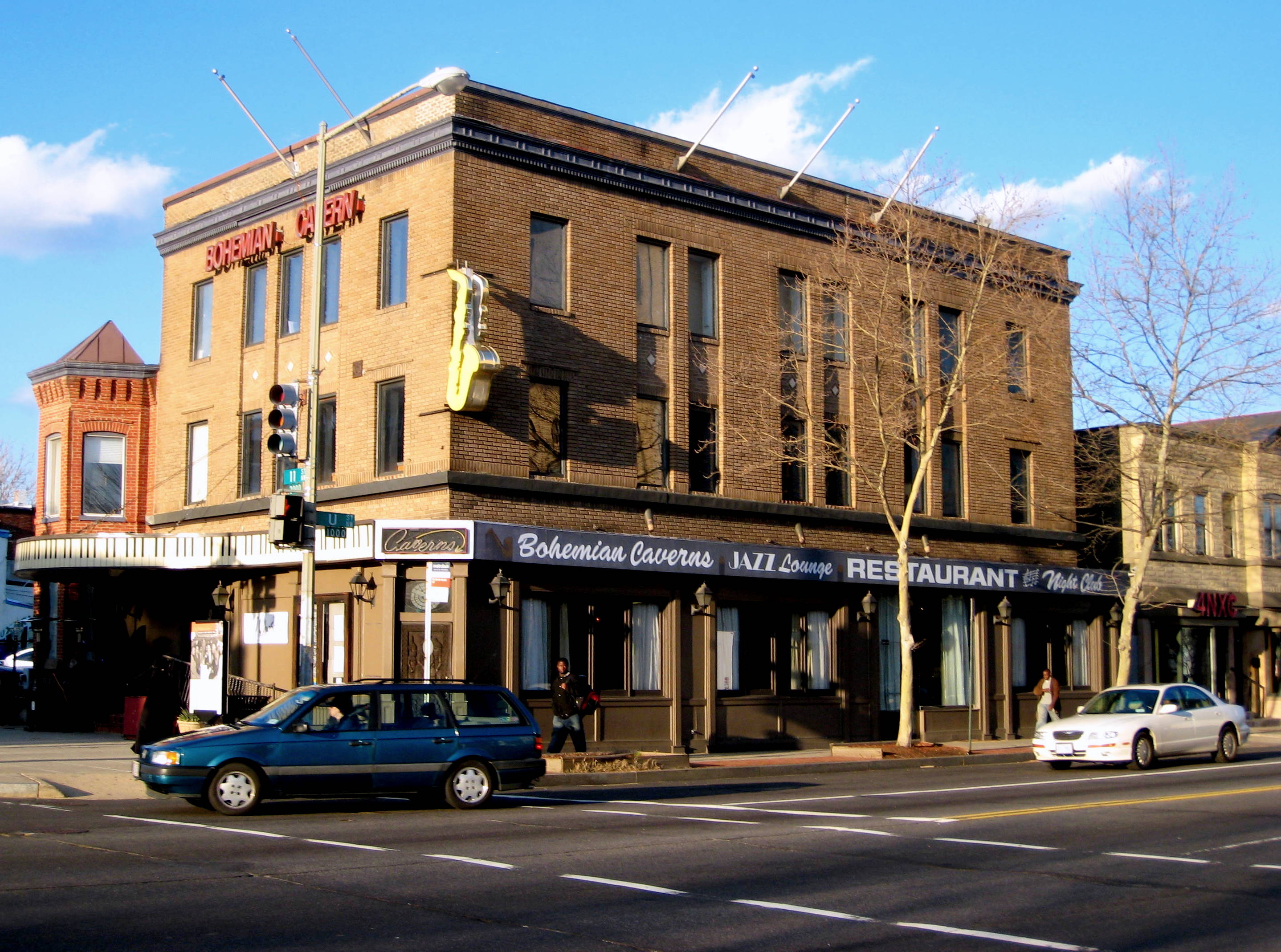
Bohemian Caverns
Descend a narrow staircase at the corner of 11th and U Streets NW in Washington, D.C., and you entered a windowless underworld of plaster stalactites and cave-like walls, where some of the greatest jazz musicians of the twentieth century played for audiences packed shoulder to shoulder. The Bohemian Caverns was born as a Prohibition-era basement club beneath a drugstore in 1926, and for the better part of a century, its artificial grotto hosted the real thing -- raw, live, boundary-pushing jazz on the corridor once known as Black Broadway.
A Speakeasy Finds Its Voice
The club began life as Club Caverns in the basement of a drugstore at 11th and U Streets, in the heart of Washington's thriving African American cultural district. In the 1920s and 1930s, this stretch of U Street was packed with jazz clubs, theaters, and nightlife -- the Green Parrot, Club Bengasi, the Jungle Inn, and Republic Gardens among them. Club Caverns became famous for its floor shows and variety acts, drawing Washington's Black elite to see performers like Duke Ellington, a D.C. native, and Cab Calloway. The club's interior was remodeled in the 1930s to resemble a cave, complete with sculpted plaster stalactites hanging from the ceiling, giving the underground room its distinctive atmosphere. In the 1950s the name changed first to Crystal Caverns, then to Bohemian Caverns.
The Golden Age Underground
In 1959, promoter Tony Taylor and Angelo Alvino purchased the club and transformed it into Washington's premier jazz venue. Taylor had an ear for greatness and the connections to book it. Through the 1960s, the Bohemian Caverns hosted a staggering roster: Miles Davis, John Coltrane, Thelonious Monk, Bill Evans, Charles Mingus, Nina Simone, Eric Dolphy, Shirley Horn, and Bobby Timmons all performed in the intimate underground space. In 1964, the Ramsey Lewis Trio recorded a live album there -- The Ramsey Lewis Trio at the Bohemian Caverns -- released on the Argo label. The record captured the energy of the room, and the success of that recording helped establish Lewis as a crossover star. For the musicians, the Caverns offered something rare: a devoted audience in an intimate setting where the music could breathe.
The Lights Go Out on U Street
By 1968, the Bohemian Caverns was struggling financially. Then, on April 4, Martin Luther King Jr. was assassinated. The civil disturbances that followed devastated the U Street corridor, shattering storefronts and scattering the community that had sustained the neighborhood's cultural life. Tony Taylor and Angelo Alvino closed the club in September 1968. The Caverns went dark, and U Street entered decades of decline. Boarded-up buildings replaced the jazz clubs. The neighborhood that had once been Washington's Harlem became a symbol of urban abandonment. For thirty years, the plaster stalactites gathered dust in the empty basement.
Revival and Final Curtain
In the late 1990s, U Street began to stir again. Redevelopment brought new restaurants, bars, and residents to the corridor, and entrepreneur Amir Afshar purchased the Bohemian Caverns and reopened it. The club found new life as a jazz venue once more, booking contemporary artists and reconnecting with the neighborhood's musical heritage. Beginning in 2006, club manager Omrao Brown guided programming. But the economics of running a jazz club in a rapidly gentrifying neighborhood proved difficult. After a vehicle crashed into the building in early 2016, forcing a six-week shutdown, the Bohemian Caverns could not recover. It closed for good at the end of March 2016, ninety years after its founding.
Echoes in the Grotto
The building at 11th and U Streets still stands. In 2019, Alain Kalantar opened new ventures in the space -- Harlot DC, a lounge bar on the first floor, and Mama 'San in the basement where the Caverns once thrummed. The plaster cave decor is a reminder of what the room once held. The Bohemian Caverns lived through the peak of American jazz, the trauma of the 1968 riots, three decades of silence, a revival, and a final closing. Its story mirrors the arc of U Street itself -- and of the live jazz tradition in American cities, where the music that defined an era now struggles to find a stage.
From the Air
Bohemian Caverns was located at the northeast corner of 11th Street and U Street NW, Washington, D.C. (38.917°N, 77.027°W). From the air, the U Street corridor runs east-west about 1.5 miles north of the National Mall. Look for the intersection of U Street with 11th Street in the Shaw/U Street neighborhood. Nearby airports: Ronald Reagan Washington National (KDCA, 5 nm south) and College Park (KCGS, 9 nm northeast). Best viewed at 1,500-2,500 ft AGL. The green rectangle of Meridian Hill Park is a useful landmark just to the west.