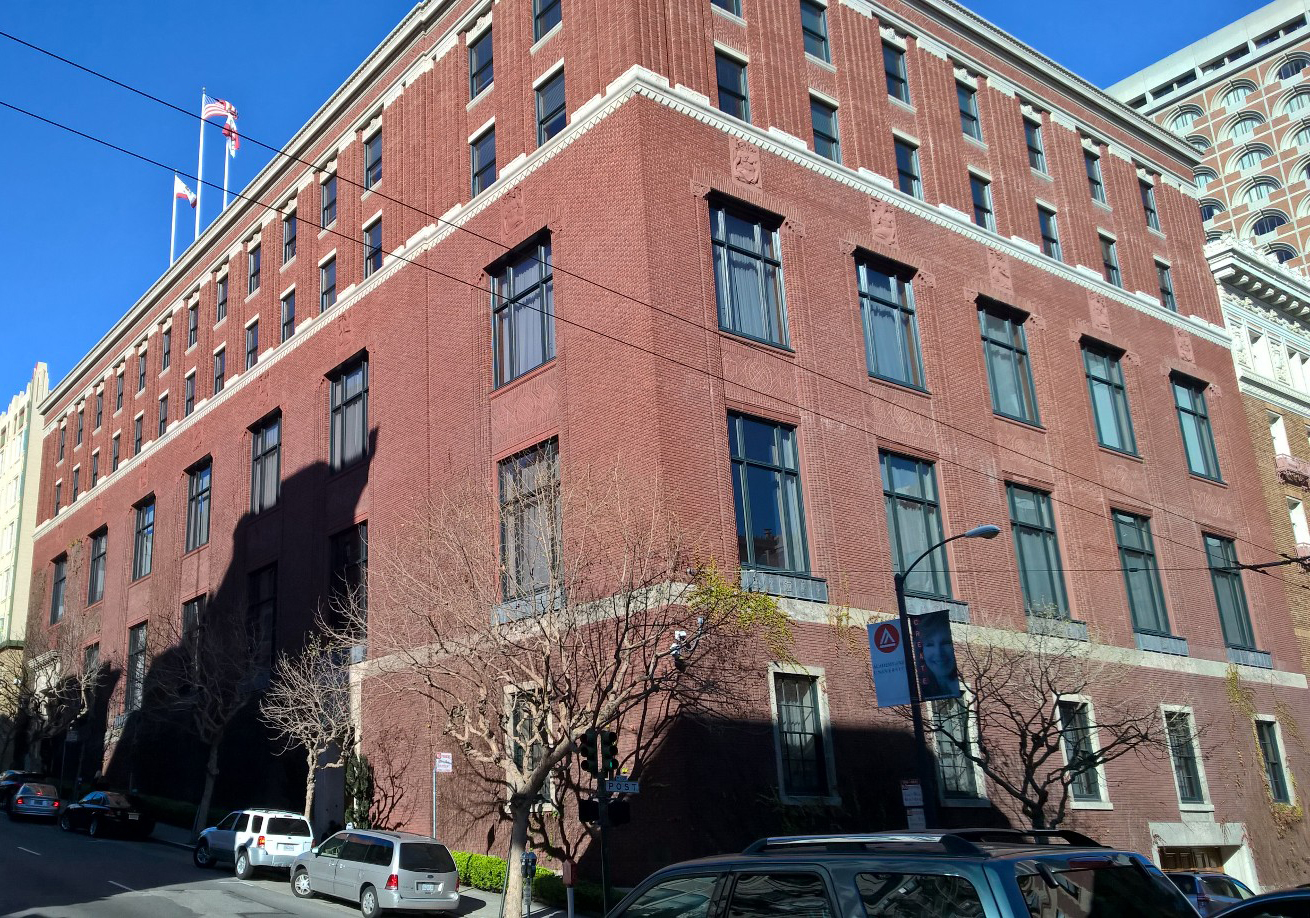
Bohemian Club
"Weaving Spiders Come Not Here" -- the motto, borrowed from Shakespeare's A Midsummer Night's Dream, warns members to leave business at the door. In practice, the Bohemian Club has been weaving power and art together since 1872, when a group of San Francisco journalists founded it as a gathering place for creative minds. Within a decade, the industrialists and politicians showed up, and they never left. The club's Nob Hill headquarters at the corner of Taylor and Post Streets has been the discreet center of this tension ever since: a place where presidents and painters share the same bar, bound by a rule against deal-making that everyone claims to follow.
Artists and Industrialists
The Bohemian Club's founding members were newspaper reporters seeking camaraderie after deadline. They wanted a salon, not a boardroom. But San Francisco in the Gilded Age was a small city with a big economy, and wealthy men who fancied themselves patrons of the arts soon began applying for membership. The resulting chemistry defined the club's character: nationally recognized artists like landscape painter William Keith, muralist Arthur Frank Mathews, illustrator Jo Mora, and Western painter Maynard Dixon mixed with railroad barons and banking magnates. The tension between bohemian ideals and establishment power became not a bug but the club's defining feature -- an identity it has maintained for more than 150 years.
The Grove and the Encampment
Each July, the club decamps to a 2,700-acre redwood grove along the Russian River in Sonoma County for the Bohemian Grove encampment. For two weeks, members and guests camp among the ancient trees, attend theatrical performances written and staged by members, and participate in rituals including the Cremation of Care ceremony, in which a coffin symbolizing worldly worries is burned before a forty-foot concrete owl. Past attendees have included multiple U.S. presidents, secretaries of state, and Fortune 500 executives, making the Grove one of the most talked-about private gatherings in the world. The secrecy has fueled decades of speculation, though members insist the encampment is simply a retreat where powerful men can relax without being photographed.
Bret Harte on the Wall
On the exterior of the club's building, a bronze relief by sculptor Jo Mora memorializes fellow member Bret Harte, the writer whose stories of Gold Rush California helped define the state's literary identity. First dedicated on August 15, 1919, the relief depicts fifteen characters from Harte's fiction. When the club's original building was torn down, the relief was carefully removed and reinstalled on the replacement structure in 1934. It remains one of the few visible public markers of the club's existence -- a quiet acknowledgment on a busy Nob Hill street that behind the facade lies one of the most storied private institutions in American life.
Behind Closed Doors
The Bohemian Club remains men-only, a policy that has drawn legal challenges and public criticism over the decades. Its membership rolls are private, though enough past lists have entered the public domain to confirm what San Franciscans have long assumed: the club counts among its members some of the most influential figures in American business, government, and culture. The building itself is unremarkable from the sidewalk -- a brick facade that could belong to any private club. But the institution it houses has outlasted earthquakes, world wars, and generational shifts in taste, holding fast to the paradox at its core: a club for free-thinking artists that became a citadel of the establishment.
From the Air
Located at 37.7881°N, 122.412°W on Nob Hill in San Francisco. The clubhouse sits at Taylor and Post Streets, in the dense urban grid east of Van Ness Avenue. Best viewed at 2,000-3,000 feet AGL. Nearest airports: KSFO (11 nm south), KOAK (10 nm east). Nob Hill is identifiable by the cluster of large hotels (Fairmont, Mark Hopkins) near the crest.