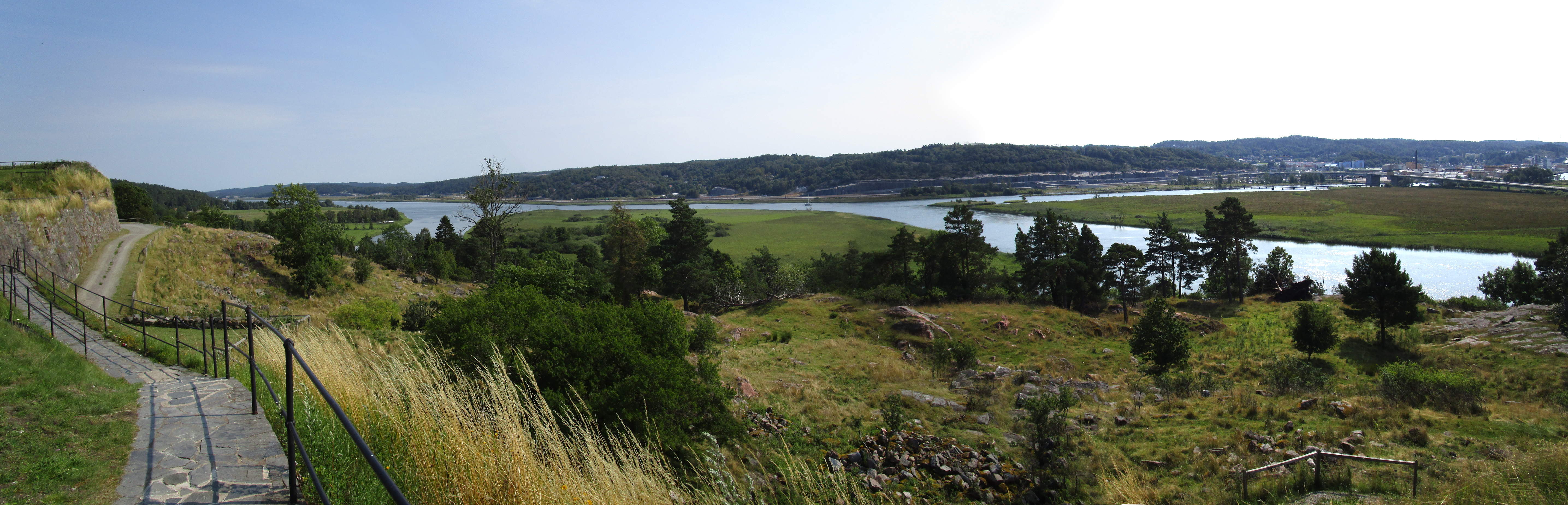
Bohus Fortress
Fourteen sieges. Zero captures. For three and a half centuries, Bohus Fortress stood as Norway's shield against Sweden, a stone fist clenched above the Gota River where it divides into two branches. King Haakon V Magnusson ordered its construction in 1308, choosing a cliff that rises naturally from the water, the river itself serving as a moat. When the fortress finally changed hands, it wasn't through military defeat but diplomatic surrender, signed away in a treaty that made its invincibility irrelevant.
A King's Defensive Line
Haakon V Magnusson understood that Norway's survival depended on fortification. In the same decade he commissioned Bohus, he also ordered the construction of Akershus in Oslo and Vardohus in the far north. These weren't isolated strongholds but a coordinated defensive network against Swedish expansion. Bohus anchored the southern approach, controlling the strategic waterway where ocean-going vessels could reach deep into Scandinavian territory. The fortress rose from a cliff high enough to command the surrounding landscape, its stone walls following the natural contours of the rock. For 350 years, it remained Norwegian, the front line of a border that no longer exists.
Dutch Engineers and Swedish Threats
By the late 16th century, medieval walls couldn't withstand modern artillery. Between 1593 and 1604, Norwegian commanders brought in Dutch expertise to transform Bohus into a bastion fortress, the same style of star-shaped fortification spreading across Europe. Hans van Steenwinckel, who would later become famous for his Renaissance designs in Denmark, oversaw the early construction of new outer walls. The upgrades continued for decades. In 1651, another Dutch engineer, Isaac van Geelkerck, supervised the addition of two corner towers and a ring wall around the arsenal. Each improvement answered the latest Swedish threat. The fortress grew stronger even as the war for its possession intensified.
Traded Away at Roskilde
The Treaty of Roskilde in 1658 accomplished what fourteen military campaigns could not. Denmark-Norway, exhausted by war, ceded vast territories to Sweden: the provinces of Scania, Blekinge, Halland, Trondelag, and Bohuslan, including the unconquered fortress at its heart. Bohus passed from Norwegian to Swedish hands without a shot fired in the actual transfer. The irony was complete. A fortress designed to defend against Sweden now belonged to Sweden, its strategic purpose erased by the very treaty that delivered it.
The Final Test
Norway didn't accept the loss quietly. In 1676, a Norwegian army attempted to recapture Bohus and failed. They returned in June 1678 under Ulrik Frederik Gyldenløve with 16,000 men against 850 defenders. The attackers unleashed an arsenal that reads like an inventory of early modern warfare: 20,000 to 30,000 iron cannonballs, 2,265 chemical and biological bombs, 384 explosive grenades, 161 glowing fire shots, and 600 mortar rounds. Mines exploded beneath the outer walls. After six weeks, 300 defenders lay dead and 120 more had lost limbs. Then a Swedish relief force appeared, and the siege lifted. The 400 survivors held a fortress reduced to rubble but still unbroken.
Ruins Without Purpose
After 1678, Bohus Fortress slowly declined. No longer on any border, it served no strategic function for Sweden. Repairs dragged on for 50 to 70 years with minimal funding, addressing only the most critical damage. The once-mighty walls crumbled into the picturesque ruins that stand today above the town of Kungalv. From the remaining towers, visitors can see the panorama that made this position so valuable: the Gota River splitting into its two branches, the water routes that once connected Norway's interior to the open sea. The fortress that could not be taken became a monument to the wars that eventually made it unnecessary.
From the Air
Located at 57.86N, 12.00E in Kungalv, approximately 15km north of Gothenburg city center. The fortress sits on a cliff where the Gota River splits into the Gota älv and Nordre älv branches, visible as a distinctive river junction from altitude. Nearest major airport is Goteborg Landvetter (ESGG) 30km southeast. The ruins are clearly visible on the promontory overlooking the river confluence. Best viewed from the south, following the river upstream from Gothenburg.