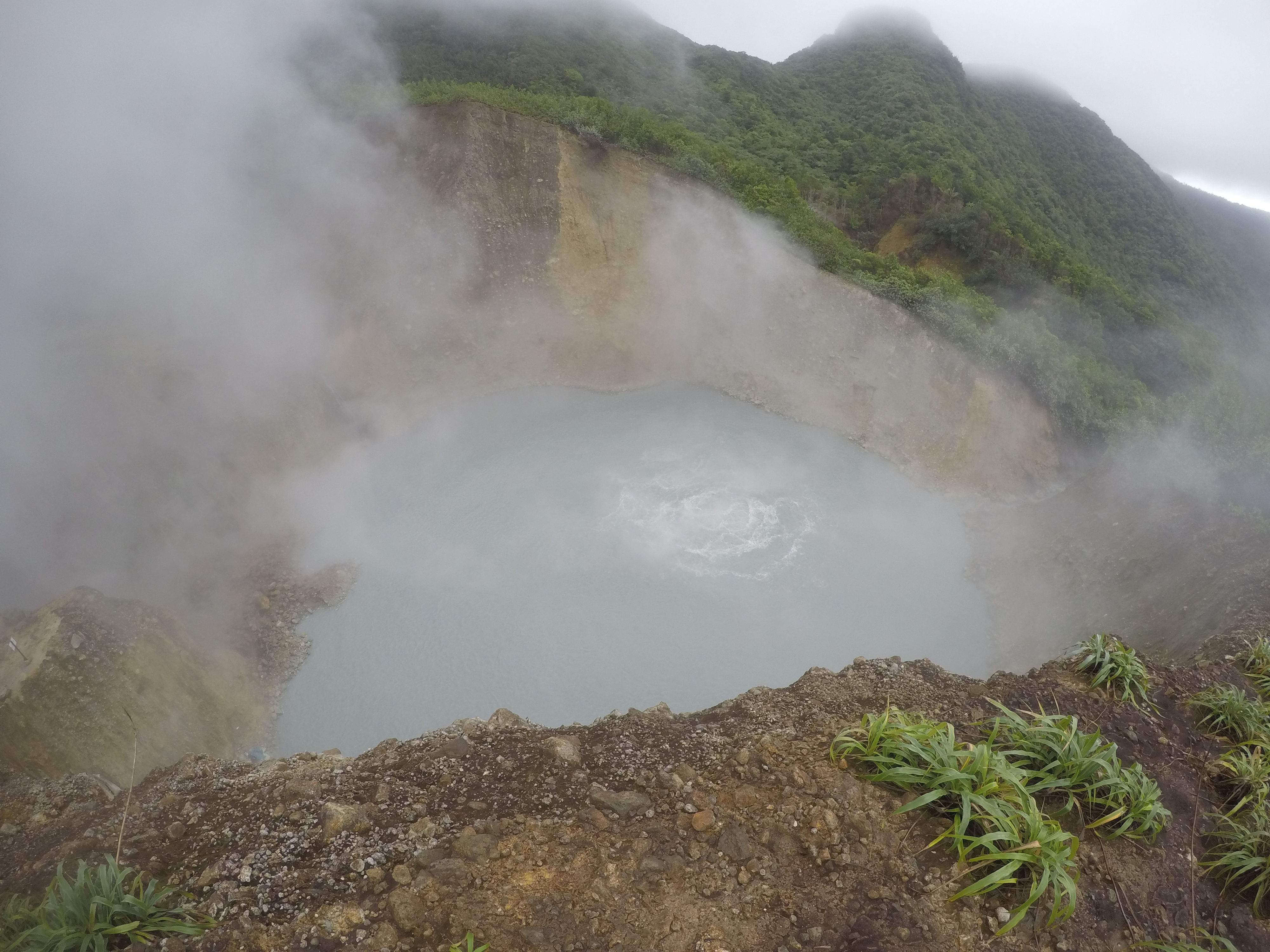
Boiling Lake
In 1870, two Englishmen named Edmund Watt and Henry Alfred Alford Nicholls pushed through the rainforest of Dominica's interior and found something that should not exist: a lake that was boiling. Not warm, not steaming at the edges, but actively churning at its center like a pot left too long on the stove. They had stumbled onto a flooded fumarole, a vent in the earth's crust where magma heats groundwater past its boiling point, and more than 150 years later, nobody has figured out how to make it stop.
A Cauldron with No Off Switch
The Boiling Lake sits at the bottom of a sinkhole-like basin within Morne Trois Pitons National Park, roughly 6.5 miles east of Dominica's capital, Roseau. It measures approximately 200 feet across, making it the second-largest hot lake in the world after Frying Pan Lake in New Zealand's Waimangu Valley. Water temperatures along the edges have been measured at 180 to 197 degrees Fahrenheit. At the center, where the lake rolls in a violent, perpetual boil, the temperature has never been successfully measured because no instrument can be positioned in the churning water safely. The lake's surface is greyish-blue and usually shrouded in a thick cloud of vapor that drifts through the surrounding basin, thinning and thickening with the wind.
The Lake That Disappears
Boiling Lake is not a stable feature. It breathes, drains, and refills on a schedule dictated by the volcanic forces beneath it. In the 1870s, shortly after its discovery, the lake was deep and active. After a phreatic eruption nearby in 1880, it vanished entirely, replaced by a fountain of hot water and steam. It eventually returned. Between December 2004 and April 2005, another eruption drained the lake by roughly 10 meters, only for the water level to rise again and refill the basin in a single day. That dramatic recovery revealed something important about the lake's plumbing: it sits well above the local water table, suspended by a continuous flux of steam and gas from an underlying magma intrusion. The lake exists not because water collects here naturally but because the earth keeps pushing it upward.
Three Hours In, Three Hours Out
There is no road to the Boiling Lake. Reaching it requires a 13-kilometer round-trip hike that most people divide into three roughly hour-long stages. The first begins at the village of Laudat, near Titou Gorge, and ends at Breakfast River, where hikers fill their water bottles from the last clean source. The second stage climbs Morne Nicholls to an altitude of 3,168 feet, reaching the rim of the Valley of Desolation. The third descends into the valley itself, a landscape of sulfur springs, hissing geysers, boiling mud pots, and streams that run hot enough to scald an exposed ankle. The air turns sharp and acrid with sulfur. Small, invisible jets of steam escape from cracks in the ground. When you finally crest the last ridge and look down into the basin, the lake appears through its own vapor, grey and violent.
The Cost of Getting Too Close
The Boiling Lake has claimed lives. In 1900, two members of a three-man hiking party, a visitor and a Dominican guide, died after a sudden release of volcanic gases asphyxiated them, causing them to fall to their deaths in the basin. The danger is not hypothetical or historical; the same volcanic processes that heat the lake also produce toxic gases that can accumulate without warning in the enclosed basin. In 2007, adventure filmmaker George Kourounis became the first person to cross the lake from above, suspended by ropes over the most violently boiling section. The crossing, filmed for the television series Angry Planet, was equal parts scientific curiosity and controlled recklessness. The lake tolerates observation. It does not invite contact.
From the Air
Located at 15.32N, 61.29W in Dominica's volcanic interior, within Morne Trois Pitons National Park. The lake may be identifiable from altitude by its persistent steam plume rising from the dense forest canopy on the eastern slopes. Douglas-Charles Airport (TDPD) is on the northeast coast, approximately 15 nm away. Canefield Airport (TDCF) is on the west coast near Roseau, about 8 nm to the west. From 5,000 feet, the Valley of Desolation is visible as a pale, barren scar amid green forest. The steam plume from the Boiling Lake is most visible in the early morning when air temperatures are cooler.