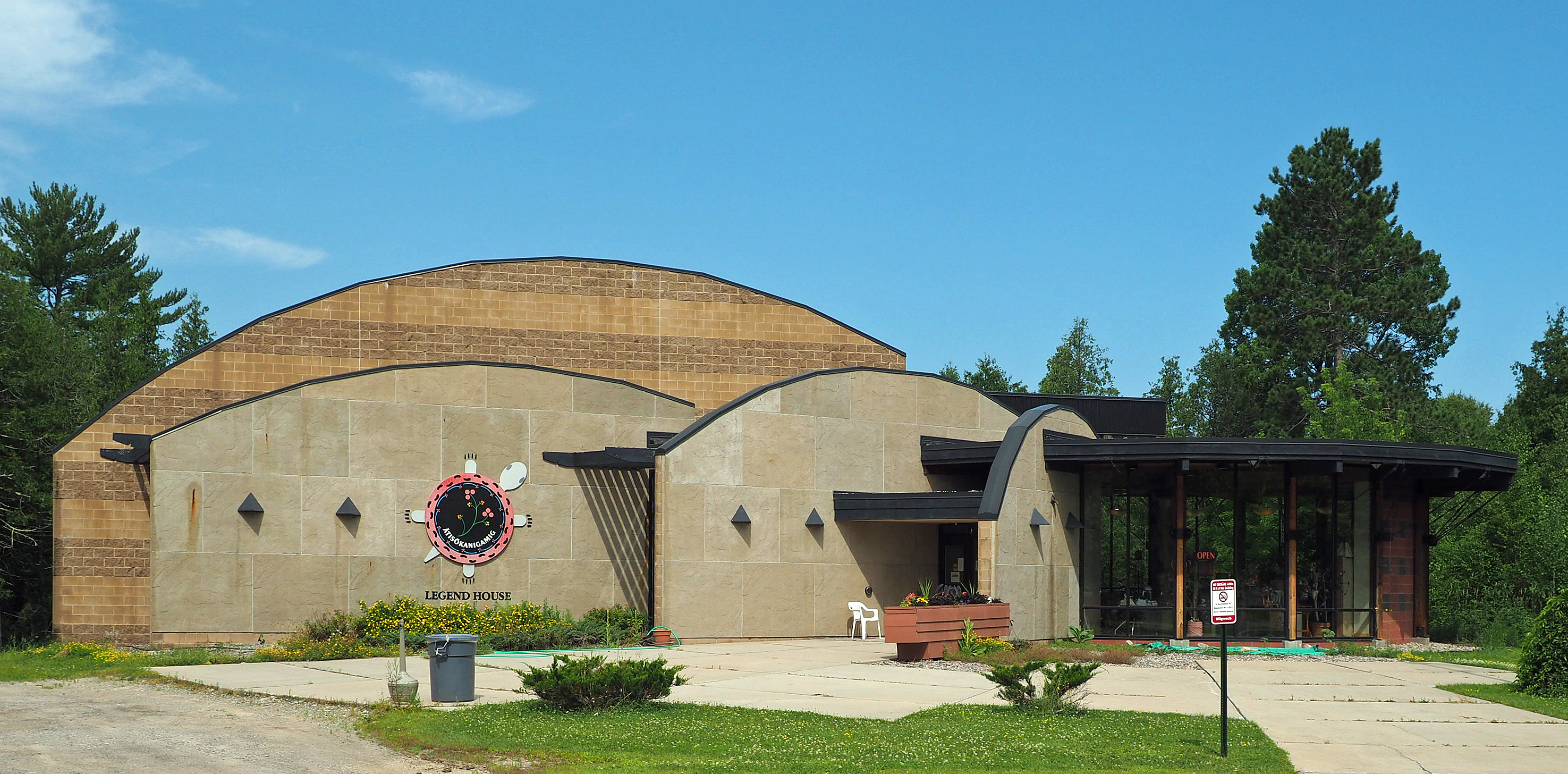
Bois Forte Heritage Center and Cultural Museum
The Ojibwe word for the museum is Atisokanigamig, meaning "Legend House." It is an apt name for a place built not just to display objects behind glass but to pull a scattered history back together. For generations, items belonging to the Bois Forte Band of Chippewa sat in distant institutions, mingled indiscriminately with artifacts from tribes across the country, labeled and catalogued by people who assumed their original owners would not survive to reclaim them. In 2001, the Bois Forte people decided those assumptions were wrong and began building a museum of their own in Tower, Minnesota, on the shores of Lake Vermilion in the heart of the Iron Range.
Keepers of the Path
The museum tour begins with a migration story. A mural by Ojibwe artist Carl Gawboy, titled "Keepers of the Path," traces the Bois Forte people's journey from the East Coast to the Great Lakes region over 500 years. Travelers come to rocky shores, with red lines tracing the shape of the Great Lakes. The painting sets the context for everything that follows: this is not a collection about a people frozen in the past but about a living culture whose arc stretches across half a continent and half a millennium. Exhibits move from this sweeping history into the intimate and specific. A life-size birch bark dwelling called a Waaginogan stands in the gallery. A replica fur trading post represents the first fur post on Lake Vermilion, the point where Ojibwe commerce and European trade first intersected in this region.
The Boarding School and Its Shadow
One of the museum's most powerful exhibits is a replica classroom from the Vermilion Lake Indian Boarding School, which operated from 1899 to 1953 on Sucker Point -- the same site where Bois Forte offices stand today. Documents and photographs tell the story of children separated from their families and forced into an educational system designed to erase their language and culture. The exhibit does not flinch from this history but presents it with the dignity and context that allow visitors to understand both what was endured and what survived. The museum's mission statement commits to preserving and perpetuating Ojibwe culture and to advancing understanding by presenting "with dignity and respect, the accomplishments and evolving history of the Bois Forte people of northern Minnesota." That commitment extends to what the museum chooses not to sell: sweet grass, sage, cedar, drums, and pipes are considered sacred and are never offered as merchandise.
Bringing the Ancestors Home
Rose Berens, the museum's former director, explained the logic that drove 19th-century collectors: museum organizations operated under the belief that "at some time in the future there would be no more Native Americans." They acquired items by buying, trading, or stealing and transported them to institutions far from their origins. The 1990 Native American Graves Protection and Repatriation Act changed the legal landscape, requiring museums to return items to tribes. In 2012, the Minnesota Historical Society returned approximately 7,000 artifacts to the Bois Forte Band. The process continues. Around 160 items taken from Nett Lake in the 1910s -- including ceremonial objects and everyday tools -- remain at the Canadian Museum of History. The Bois Forte Heritage Center is working through the repatriation process, with an anticipated return of those items in 2025. Each object that comes home carries not just cultural significance but proof that the assumptions of extinction were profoundly wrong.
Recognition and Resilience
For a small museum operated by a single band in a town of fewer than 500 people, the Bois Forte Heritage Center has earned remarkable recognition. In 2003, it received a Media Award from the National Association for Interpretation. In 2007, the National Trust for Historic Preservation bestowed its National Preservation Award on the museum, an honor it shared that year with the Bureau of Land Management Eastern States. The recognition reflects what visitors discover when they step through the doors: a place where storytelling is treated as preservation, where a birch bark dwelling and a boarding school desk sit in the same building because both are part of the same unbroken story, and where the act of reclaiming scattered artifacts becomes itself a form of cultural renewal. Atisokanigamig -- the Legend House -- is still writing its legends.
From the Air
Located at 47.83N, 92.35W in Tower, Minnesota, on the south shore of Lake Vermilion in the Vermilion Range of the Iron Range. From the air, Tower is a small community visible along the lakeshore. Lake Vermilion is a large, distinctive lake with a heavily indented shoreline stretching roughly 40 miles. The nearest airport is Tower Municipal Airport/Vermilion Country (unrestricted), with Range Regional Airport (KHIB) in Hibbing about 45 miles to the southwest and Eveleth-Virginia Municipal Airport (KEVM) about 30 miles south. The region is characterized by boreal forest, lakes, and the low ridges of the Vermilion Range. Best viewed at 3,000-6,000 feet for lake and town detail.