Bojjannakonda
The village name gives away the secret. Sankaram -- a corruption of Sangharam, the old word for a Buddhist monastery -- sits quietly about a mile east of Anakapalli in Andhra Pradesh, surrounded by paddy fields. Two modest hillocks rise to the north: Bojjannakonda on the east and Lingalakonda on the west. They look like ordinary features of the coastal Andhra landscape until you climb them. Then the stupas appear -- dozens of them, monolithic and brick-built, crowding the rock-cut platforms like a congregation frozen in stone. The name Bojjannakonda itself is a worn-down echo of its original: Buddhuni Konda, the Hill of the Buddha.
Three Faiths on One Hill
What makes Bojjannakonda rare among Indian Buddhist sites is the layering of history on a single hilltop. When Alexander Rea led excavations here in 1907, the team uncovered evidence of all three major phases of Buddhist tradition: Hinayana, Mahayana, and Vajrayana. That progression spans centuries of doctrinal evolution, and Bojjannakonda preserves them all in stone and brick. The eastern hill is crowned by the Maha Stupa, its dome constructed of brick, surrounded by groups of rock-cut and smaller brick stupas and chaityas. In two of the brick stupas, archaeologists found stone relic caskets shaped like miniature stupas -- containers within containers, each one a declaration that something sacred rested here.
Carved Into the Rock
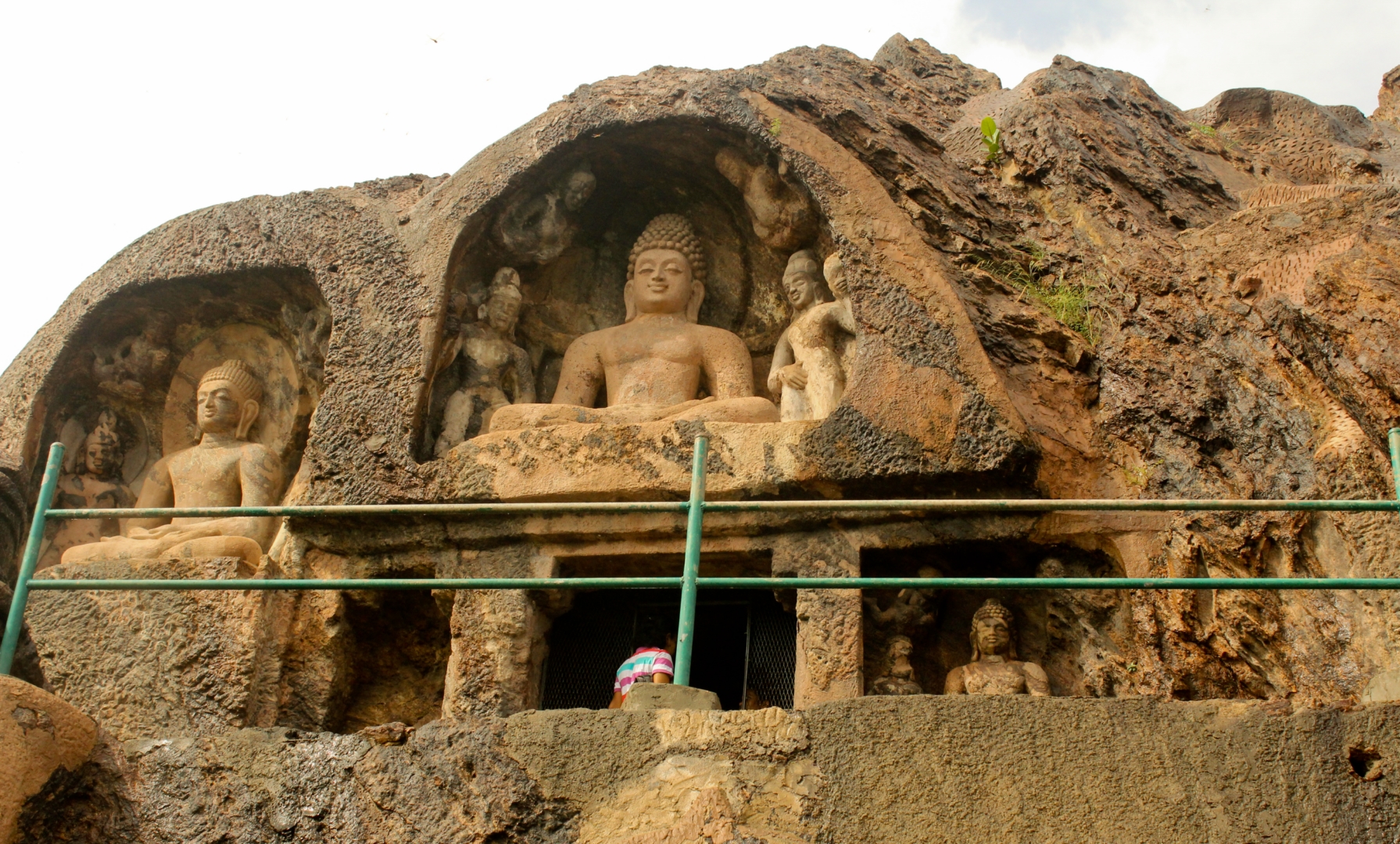
Six rock-cut caves punctuate the hillside, several adorned with sculptured panels. The largest holds sixteen pillars -- five of them now broken -- encircling a monolithic stupa at its center. A pradakshina-patha, the ritual circumambulation path, wraps around the stupa so devotees could walk their prayers into the stone floor. On the ceiling above hangs a carved chhatra, a ceremonial umbrella whose shaft has long since crumbled, though the canopy remains as if still sheltering the sacred below. An upper story houses figures of the Buddha, and carved panels throughout the caves depict a seated Buddha flanked by attendants. At the foot of the hill stands an image of Hariti, the goddess whom Buddhist tradition transformed from a child-devouring demon into a protector of children -- a fitting guardian for a place dedicated to transformation.
Coins and Kingdoms
The real timeline of Bojjannakonda emerged from the soil. Excavations yielded seals, terracotta inscribed tablets, terracotta beads and figurines, copper coins, and a single gold coin bearing the name of Samudragupta of the Gupta dynasty, who ruled Magadha from roughly 340 to 375 AD. Copper coins of the Eastern Chalukya king Vishnuvardhana, surnamed Vishamasiddhi, date to around 633 AD. A lead coin stamped with a horse may belong to the later Satavahanas. Together, these artifacts bracket the Buddhist settlement between the 2nd and 9th centuries AD -- a span of seven hundred years during which monks worshipped on these hillocks, monasteries functioned, and pilgrims climbed the same paths. It was a thriving node in a network of Buddhist learning centers that stretched along the coast near Visakhapatnam, including Thotlakonda, Bavikonda, and Pavurallakonda.
Silence and Revival
Buddhism flourished in this region from the 3rd century BCE through the 3rd century CE, then gradually faded as Hinduism reasserted itself across the subcontinent. The monasteries emptied. The stupas stood unvisited for centuries. Even the name changed -- Buddhuni Konda became Bojjannakonda, the original meaning worn smooth by time and linguistic drift, the way water smooths stone. But the site never fully disappeared from local memory. Today, the festival of Vaisakha Pournami draws large crowds to Bojjannakonda, a celebration of the Buddha's birth that reconnects the present with a past most visitors can sense but not quite see. The Indian National Trust for Art and Cultural Heritage has appealed for Bojjannakonda, along with Bavikonda, Thotlakonda, and Pavurallakonda, to be declared UNESCO World Heritage Sites -- recognition that these quiet hillocks above the paddy fields hold something the world ought to protect.
From the Air
Located at 17.71N, 83.02E near Anakapalli, roughly 25 km west of Visakhapatnam. The twin hillocks are visible from low altitude amid the flat paddy fields north of the village of Sankaram. Visakhapatnam Airport (ICAO: VOVZ) is the nearest major airfield. At 2,000-3,000 feet, the hilltop stupa platforms are distinguishable against the surrounding green fields. The coastal Andhra landscape is flat enough that the twin hills stand out clearly.