The Water God's Last Temple
Every spring, homemade bombs explode above the streets of Marysville, California, launching metal rings into the sky while crowds jostle and shove to catch them. The tradition is older than the Rose Parade. It predates the Statue of Liberty. Since at least 1873, the Chinese community of this small Sacramento Valley town has celebrated Bomb Day -- the birthday of Bok Eye, the water god -- with firecrackers, dragon dances, and a scramble for good fortune rings that can turn a lucky catch into a year of blessings. At the center of it all stands a temple that has survived floods, anti-Chinese violence, and more than a century of demographic upheaval. The Bok Kai Temple, dedicated on March 21, 1880, is the only in situ 19th-century Chinese temple in the United States that remains active.
Third City on the Pacific
Marysville sits at the confluence of the Feather and Yuba Rivers, a geographic advantage that made it one of the most important supply depots of the California Gold Rush. Miners sailed upriver from Sacramento to outfit themselves before heading into the Sierra foothills, and the town they passed through grew so fast it earned the nickname "Gateway to the Gold Fields." Among the tens of thousands who arrived were Cantonese immigrants, mostly from Guangdong Province, who called Marysville Sahm Fou -- Third City -- ranking it behind only San Francisco (Dai Fou, the Big City) and Sacramento (Yee Fou, Second City). By the 1860s, the Chinese population was substantial enough to warrant its own temple, its own businesses, its own social world. Marysville's Chinatown became one of the largest in Gold Country, and unlike many others across California, it was never driven out by mob violence. When Chinese communities elsewhere were being torched and expelled between 1870 and 1900, Marysville became a place of refuge.
A God Who Governs Rain
The temple's principal deity is Beidi -- known in Cantonese as Pak Tai or Bok Tai, and in the Toishanese dialect as Buck Eye or Beuk Aie. In Chinese folk religion, Beidi is the Dark Warrior, ruler of the northern heavens, governor of waterways, irrigation, and rain. For a community built at the meeting point of two rivers, a water god was not an abstraction. Debris from hydraulic mining upstream had raised the riverbeds of both the Feather and the Yuba, making Marysville dangerously vulnerable to flooding during winter storms and spring snowmelt. The city eventually surrounded itself with levees that still stand today. But the temple's main altar faces the river for a reason: Bok Eye watches the water. The faithful credit his protection for keeping the floods at bay since the early 1900s. The temple itself -- rebuilt and dedicated in 1880 after an earlier structure was lost -- served not only as a place of worship but as a meeting hall, a courtroom for community disputes, and a social anchor for a population far from home.
Bombs, Rings, and a Dragon Named Moo Lung
Bomb Day falls on yee yuet yee, the second day of the second month of the lunar calendar, a date observed by a dozen Chinese communities across California in the late 19th century. Only Marysville's celebration has survived. Each bomb is a specially constructed firecracker designed to launch a hand-sized metal ring -- stamped with a number -- high into the air above the crowd. When the ring descends, the scramble begins. Whoever catches it, fights off competitors, and retains full control of the ring all the way to the temple door receives a fortune corresponding to the ring's number. In the 1880s, a dragon named Moo Lung joined the festivities, undulating through the streets on the shoulders of dozens of carriers. By the 1950s, when Marysville was the only community in America still firing these ceremonial bombs, the celebration was renamed the Bok Kai Festival. At 145 years and counting, it is the oldest continuous Chinese American cultural event in the country.
Holding On at the Corner of D and First
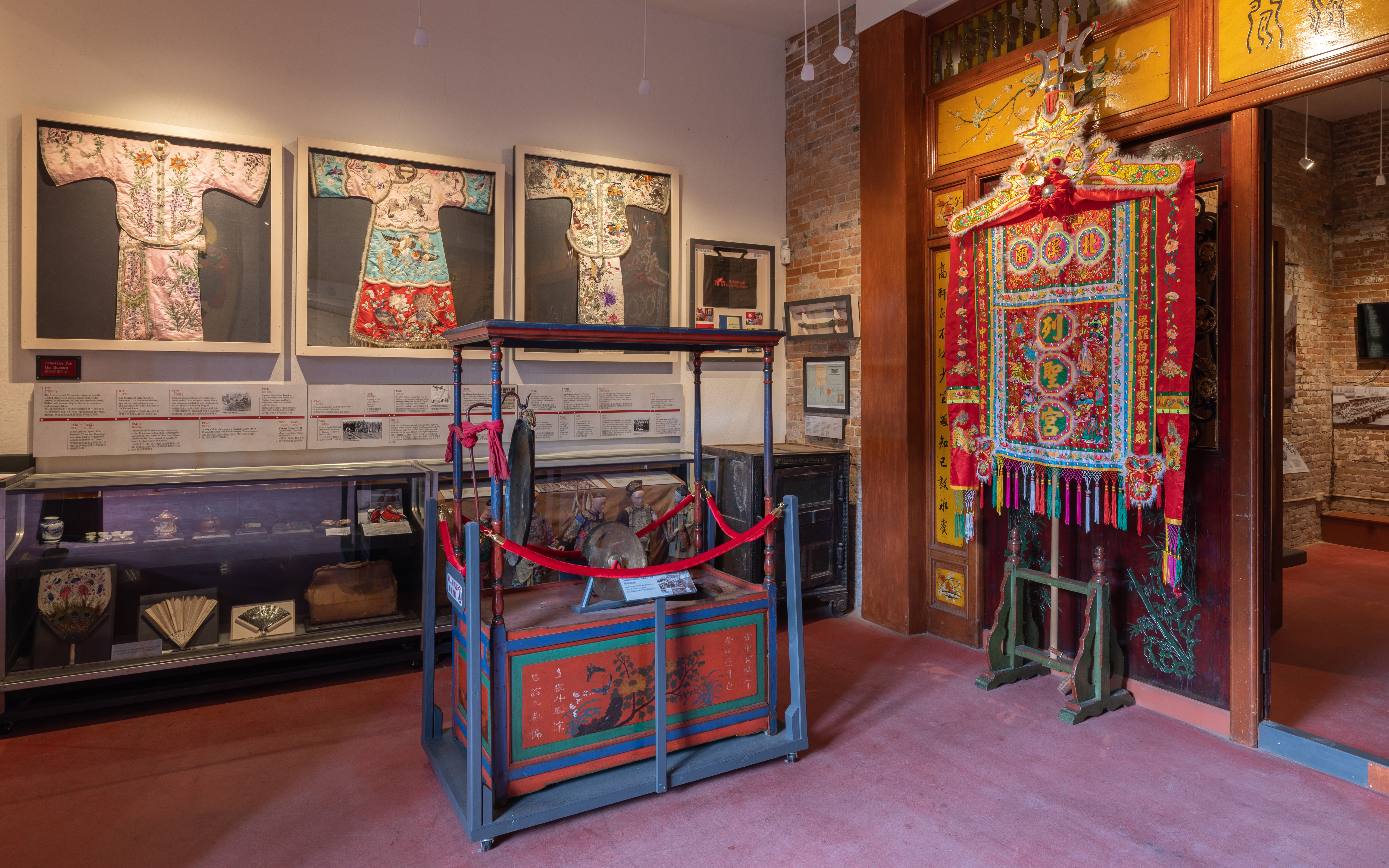
The temple stands at the corner of D and First Streets, a modest building that belies the weight of what it carries. Inside, altars hold offerings and incense. A small sedan chair waits to carry the gods in procession. The space is quiet most of the year -- services are infrequent now, and the once-bustling Chinatown that surrounded it has largely disappeared, its buildings demolished when levees were constructed. But the temple endures as both a California Historical Landmark and a property on the National Register of Historic Places. Each spring, the doors open wide for the Bok Kai Festival, and the neighborhood fills again with drumbeats, firecrackers, and the sinuous form of the dragon. Three active Chinese associations still operate in Marysville. The old Chinese school building still stands. For a community that arrived as miners and laborers in the 1850s, survived decades of exclusion laws and forced displacement elsewhere, and kept their temple and their traditions intact through it all, the Bok Kai is more than a landmark. It is proof of persistence.
From the Air
Located at 39.135N, 121.587W in downtown Marysville, at the corner of D and First Streets, near the confluence of the Feather and Yuba Rivers. The city's distinctive levee system is clearly visible from the air, encircling the town. Yuba County Airport (KMYV) is approximately 4nm south. Sacramento International (KSMF) lies about 35nm southwest. Best viewed at 1,500-2,500 feet AGL; the river confluence and levee ring make excellent visual references for locating the temple in the historic core.