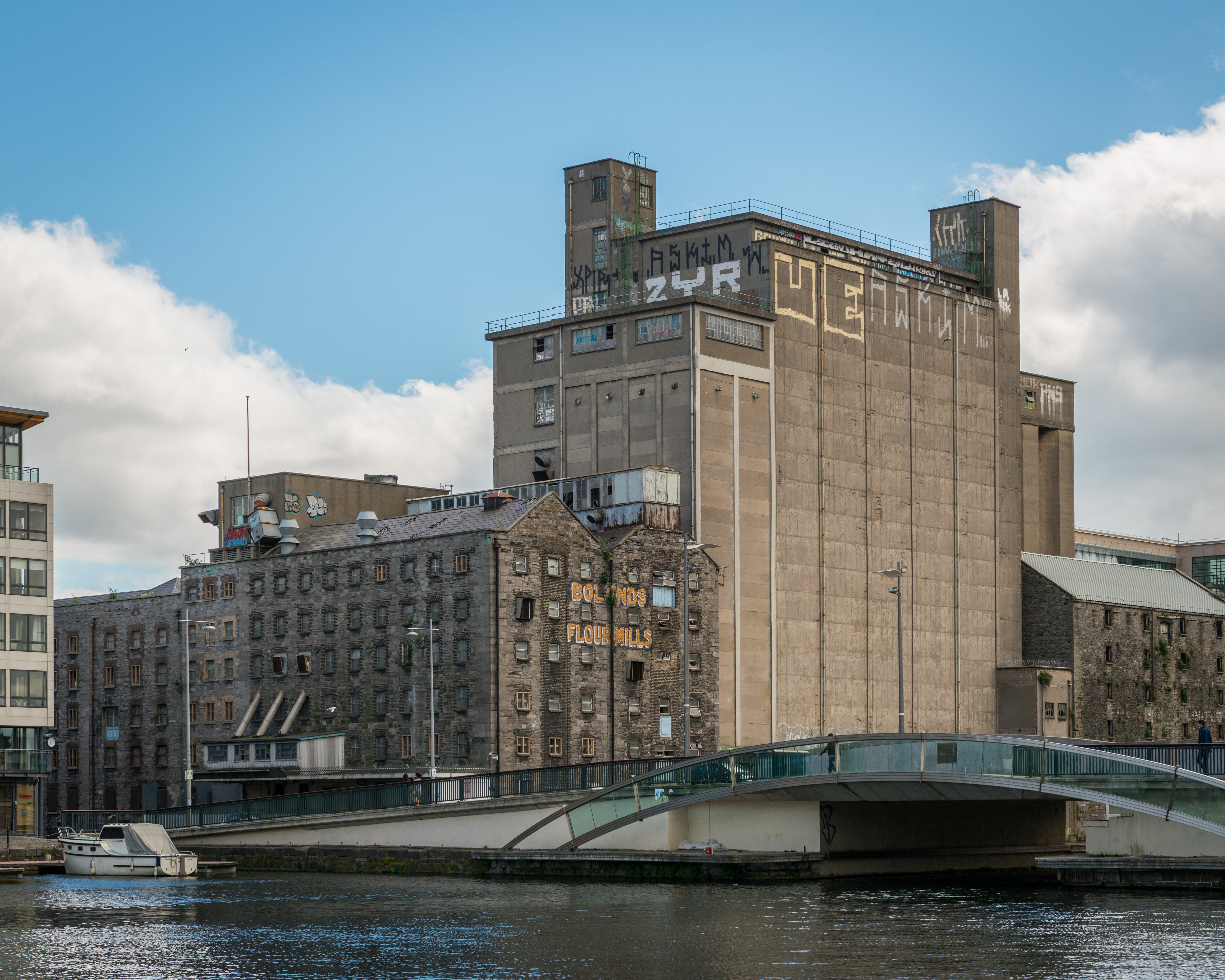
Boland's Mills
On Easter Monday 1916, a tall, bespectacled mathematics teacher named Eamon de Valera raised a green flag with a golden harp over Boland's Mills on Ringsend Road. He was commanding the 3rd Battalion of the Irish Volunteers, and his job was to control the approaches from Kingstown -- now Dun Laoghaire -- toward Dublin's city centre. He held that position for six days. A century later, Google bought the site for approximately 170 million euros and turned it into a tech campus with a food hall, a bakery, and 46 apartments for nurses, teachers, and gardai at discounted rents. No single location in Dublin compresses more history into less ground.
Stone Warehouses on the Canal
The mills began as utilitarian buildings for Boland's Bakery. Two six-storey stone warehouses dating from the 1830s face onto Ringsend Road and the inner basin of Grand Canal Dock, with additional buildings on Barrow Street from the 1870s. For decades before the Rising, the complex operated as a flour mill, its limestone walls darkened by canal soot and the constant dust of grain processing. Concrete silos were added between the 1940s and 1960s. The mills finally stopped production in 2001, and the site lay derelict for fifteen years, its protected limestone structures crumbling beside newer concrete towers that no preservation order covered.
De Valera's Garrison
De Valera's 3rd Battalion occupied not just the mills themselves but the surrounding area including what is now the Treasury Building. Their strategic aim was straightforward: if British reinforcements arrived by sea at Kingstown, they would have to pass through this position to reach the fighting in the city centre. De Valera's garrison exchanged fire with British forces for nearly a week, keeping them at bay until Patrick Pearse's general surrender order was received on 30 April. Patrick Whelan, an Irish Volunteer killed on 26 April, was posthumously awarded the 1916 Medal. After the rising, the British military appropriated the mills. When the owners threatened to close the bakery and put 400 employees out of work over lack of compensation, the authorities relented and paid.
Boom, Bust, and NAMA
The site's post-industrial history mirrors Ireland's economic turbulence. After the mills closed in 2001, the Dublin Docklands Development Authority granted planning permission for a mixed-use development. The site sold for 42 million euros in 2004. By 2007, its value had been assessed at 61 million. Then came the crash. By 2009, the site was worth 9.9 million euros -- an 84 percent collapse. The National Asset Management Agency, the state's "bad bank" created to manage the wreckage of the Celtic Tiger, took control and in 2015 initiated a 150 million euro reconstruction under the name Bolands Quay.
Google's Docklands
Google, which already had a significant office presence on and around Barrow Street, bought the site from NAMA in May 2018. The company opened the first phase -- the Flour Mills building -- as a collaboration space in September 2023. The redevelopment preserved the older nineteenth-century calp limestone warehouses as protected structures while demolishing the concrete silos. By July 2024, the campus comprised 300,000 square feet of office space, ground-floor commercial units, and the residential tower. In summer 2025, local artist Sean Atmos installed "Blathu," a mural of abstract shapes spanning nine storeys and 724 square metres -- Ireland's largest mural at the time.
Key Workers in a Revolutionary Building
Perhaps the most striking element of the redevelopment is the housing. Google leased the 46 apartments in the residential tower to Cluid, an approved housing body, at a nominal fee. The apartments are offered at discounted cost-rental rates to key workers -- nurses, teachers, and gardai -- who live in, work in, or come from the surrounding area. In a city where housing costs have become one of the most politically charged issues, a tech giant providing affordable housing in a building where the future president of Ireland once held a garrison against the British Empire creates an irony that would not have been lost on de Valera, who taught mathematics and appreciated the force of unexpected numbers.
From the Air
Located at 53.34N, 6.24W in Dublin's Docklands district, between Grand Canal Dock and Barrow Street. The modern mixed-use development is visible among the cluster of tech company buildings in the Docklands area. The Grand Canal basin and its distinctive lock gates are nearby landmarks. Nearest airport: Dublin (EIDW) 8km north. Best viewed as part of a Dublin Docklands overflight at 2,000-3,000 feet.