Bolívar Square (Caracas)
On April 19, 1810, a rebellion erupted in this square that would eventually tear an empire apart. The plaza that Caracas had used for centuries as a marketplace, a parade ground, and a place of public execution became the birthplace of Venezuelan independence. Today the trees are older, the marble flooring has replaced the original colorful tiles, and a bronze Bolívar on horseback watches from the center. But the square still occupies the same footprint it was given when Santiago de León de Caracas was founded in 1567 — the original 25-block grid of the colonial city arranged around this one open space.
Blood and Commerce on the Plaza Mayor
For most of its colonial life, Bolívar Square was simply the Plaza Mayor, a trade center where Caraqueños bought and sold goods in the open air. In 1754, Governor Felipe Ricardos ordered arcades built around its perimeter, giving the market some architectural definition. But the square served darker purposes too. The Spanish colonial government used it as a site for public execution, and the most notorious killing happened here in 1799, when the revolutionary José María España was not merely executed but quartered — his body dismembered in the plaza as a warning to anyone who dared challenge the crown. Eleven years later, the warning proved insufficient. The popular rebellion of April 19, 1810, launched from this very square, became the first decisive step toward Venezuelan independence.
A Liberator Returns
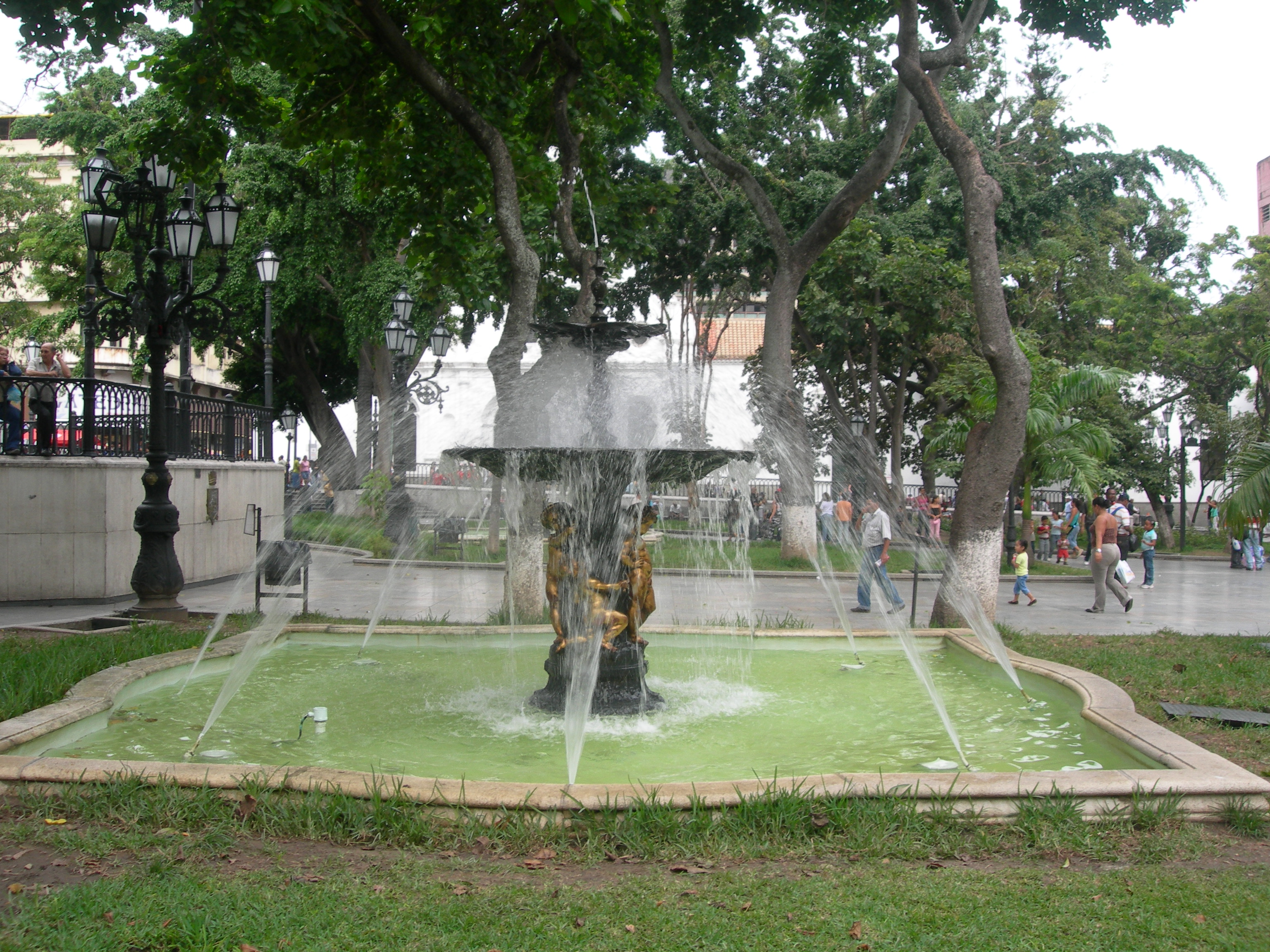
After independence, the square cycled through names: Plaza de Armas, then Plaza del Mercado. It was not until 1842, when the remains of Simón Bolívar were brought to Caracas from Santa Marta, Colombia, where he had died in exile twelve years earlier, that the plaza was formally christened Plaza Bolívar. Even then, the name did not stick in common usage until 1874, when General Antonio Guzmán Blanco ordered a transformation that would make the square unmistakably Bolívar's. He demolished the colonial arcades, expelled the market vendors, and redesigned the entire space in a French style. Four ornamental iron fountains representing the seasons were placed in the corners. Roughly 100 iron posts with decorative details lined the walkways, and metal balusters enclosed the perimeter. The small stairs in the southeast corner gave that area a name it still carries: Gradillas, meaning small terrace.
Bronze on Its Hind Legs
The equestrian statue that now defines the square was inaugurated on November 7, 1874, with the ringing of bells and a 21-gun salute. Standing 4 meters tall, it shows Bolívar astride a horse rearing on its hind legs, balanced on a two-tiered pedestal. The sculpture is a replica of the original by Italian sculptor Adamo Tadolini, which stands in the Plaza Bolívar in Lima, Peru. Cast by the Von Müller Foundry, it became the emotional anchor of the square and, in 1959, was designated a national memorial. Electricity arrived in 1894, and for the next seven decades the square changed little. Between 1908 and 1947, tram terminal stations operated at its corners, threading the plaza into the city's transit network.
Surrounded by Power
What makes Bolívar Square remarkable is not just its history but its neighbors. The Caracas Cathedral rises along one edge. The Archbishop's Palace, the Sacred Museum, and the Chapel of Santa Rosa de Lima cluster nearby. City Hall occupies a facing block. The Yellow House — the seat of foreign affairs — and the Main Theater flank the square, while the Federal Legislative Palace stands to the southwest. Walking the perimeter takes minutes; walking through the layers of power it represents takes considerably longer. In 1967, the original colorful floor was replaced with gray marble, a change that some Caraqueños still mourn. A full restoration in 2003 renewed the gardens, fountains, flooring, and lighting, but the fundamental character of the square — dense with institutional weight, alive with foot traffic — remains unchanged.
From the Air
Located at 10.506°N, 66.915°W in the historic center of Caracas. The square sits in the heart of the original colonial grid, surrounded by identifiable landmarks including the cathedral and legislative palace. Best viewed at low altitude. Nearest major airport is Simón Bolívar International Airport (SVMI/CCS) approximately 21 km to the northwest. The valley setting of Caracas, flanked by Avila mountain to the north, makes the city center easy to identify on approach.