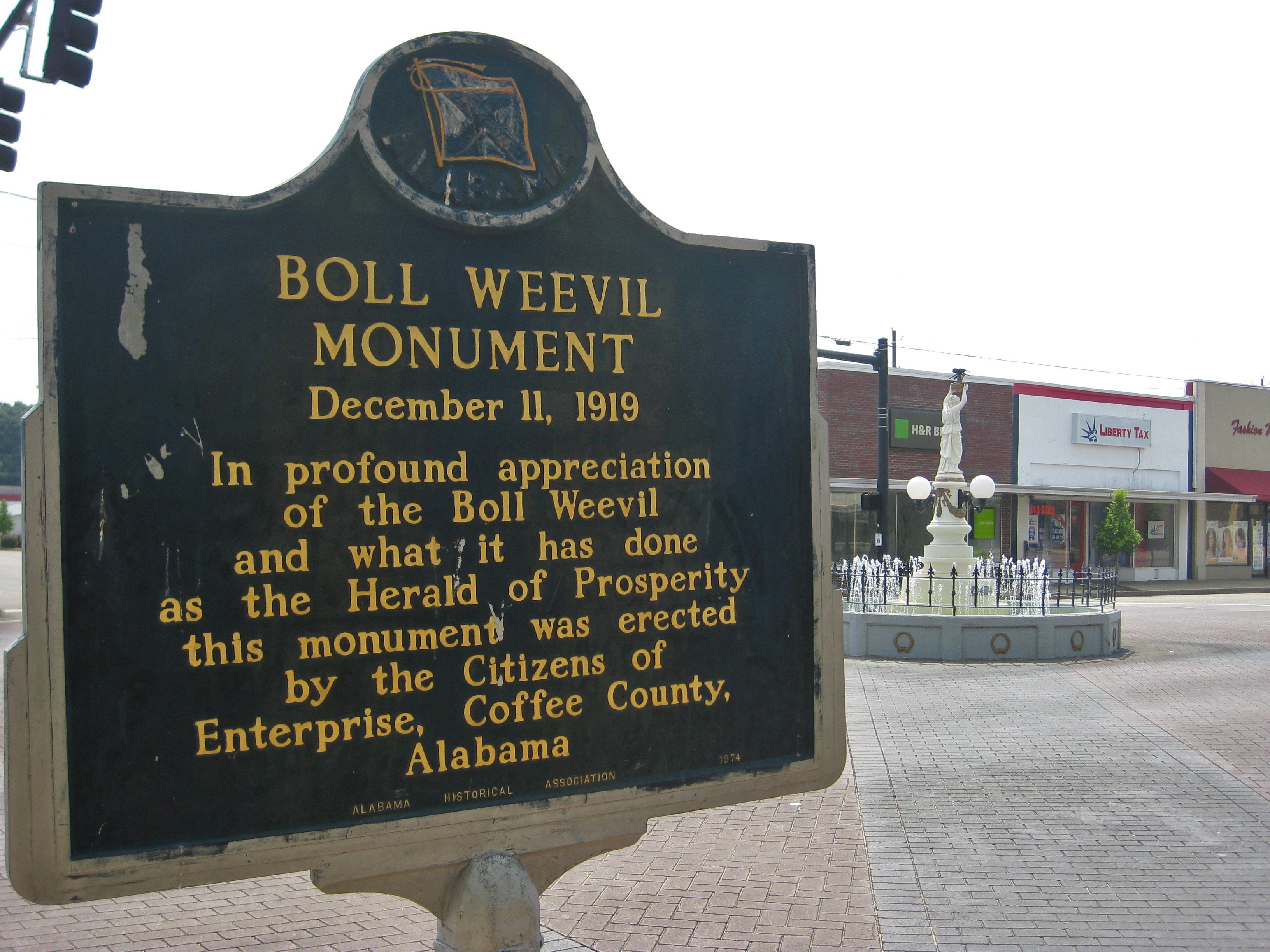
Boll Weevil Monument: The Town That Thanked a Plague
Only one monument on Earth thanks a pest for ruining the local economy. It stands at the intersection of College and Main in Enterprise, Alabama -- a Greco-Roman woman in a flowing chiton, arms raised overhead, hoisting a triumphant boll weevil like a trophy. Dedicated in 1919, the Boll Weevil Monument is the citizens' way of acknowledging a strange truth: the tiny beetle that devoured their cotton fields also forced them to discover something better. The monument's inscription hails the insect as a "herald of prosperity," and Coffee County's farmers would agree. What looked like catastrophe turned out to be the push they needed to break free from cotton's stranglehold on their livelihood.
The Beetle That Ate the South
The boll weevil, Anthonomus grandis, migrated north from Mexico and arrived in Alabama by 1915. The insect bored into cotton bolls to lay its eggs, destroying the fiber from the inside out. By 1918, Coffee County's farmers were watching entire harvests rot in the fields. Cotton had been the region's lifeblood since before the Civil War -- the only cash crop most farmers knew how to grow, the only one their banks would finance, the only one the local gins could process. The weevil did not care about tradition. It ate through field after field with indifferent efficiency, leaving families staring at financial ruin. The monoculture that had defined southeastern Alabama for generations was collapsing, and no amount of spraying or praying could stop it.
A Gamble on Goobers
H. M. Sessions, a local entrepreneur, saw opportunity where others saw disaster. He recognized that the sandy soils and warm climate of Coffee County were ideal for peanuts. In 1916, Sessions convinced C. W. Baston -- a farmer already deep in debt from failed cotton harvests -- to plant peanuts instead. It was a desperate bet. Peanuts had no established market infrastructure in the region, no gin equivalent, no commodity exchange tradition. But the first crop succeeded spectacularly, paying off Baston's debts in a single season. Neighboring farmers took notice. Within a few years, peanut acreage exploded across the county. Cotton eventually returned to Enterprise's fields, but the lesson had been learned: diversification beat dependence. Coffee County's economy grew stronger and more resilient than it had ever been under King Cotton alone.
A Statue and Its Strange History
Local businessman Bon Fleming proposed the monument and helped raise funds for its construction. The female figure was sculpted in Italy in classical style and shipped to Enterprise, where it was dedicated on December 11, 1919, at the town's main crossroads. For thirty years, though, the statue held only an empty pedestal above her head. It was not until the late 1940s that Luther Baker decided the Boll Weevil Monument ought to actually feature a boll weevil. He fabricated an oversized beetle and mounted it in the statue's upraised hands, completing the monument's intended message. The original cost approximately $1,800 -- modest even then, but it became Enterprise's defining landmark, drawing curious visitors who could not quite believe a town would honor a bug.
Stolen, Smashed, and Sudsed
The monument has endured a turbulent life. Pranksters and vandals have stolen the boll weevil figure multiple times over the decades -- sometimes making off with the entire statue. Each time, the city retrieved and restored it. But on July 11, 1998, vandals ripped the boll weevil from the statue's hands so violently that the original figure was permanently damaged. Repair proved too costly, so the city replaced the entire statue with a polymer-resin replica. The battered original was displayed at Enterprise's Depot Museum on Railroad Street, then moved in 2019 to the Pea River Historical and Genealogical Society's gift shop. A security camera now watches over the replica downtown. Even the fountain has not been spared: locals have poured dish soap into it, filling the monument area with cascading suds -- an indignity the old bug has learned to endure.
Legacy of the Little Destroyer
Enterprise still celebrates its unusual relationship with the boll weevil. The monument remains the town's most photographed landmark, a quirky emblem of resilience that captures something deeply American about turning disaster into opportunity. Coffee County went on to become one of Alabama's most productive agricultural regions, its economy built on the diversification the weevil forced upon it. The story resonates beyond farming: the idea that disruption -- even painful, unwanted disruption -- can be the catalyst for reinvention. Other communities hit by the boll weevil simply suffered. Enterprise built a monument to it.
From the Air
Located at 31.31°N, 85.85°W in southeastern Alabama's Wiregrass region. Enterprise Municipal Airport (KEDN) sits three nautical miles west of downtown. From altitude, Enterprise appears as a modest town surrounded by agricultural fields -- peanuts, cotton, and other crops in the sandy Coastal Plain soil. Cairns Army Airfield at Fort Novosel (formerly Fort Rucker) lies roughly 10 nm to the northwest. Dothan Regional Airport (KDHN) is 23 nm to the southeast. The monument itself is at the intersection of College and Main Street in the town center, not visible from cruise altitude but marking the geographic and symbolic heart of Enterprise.