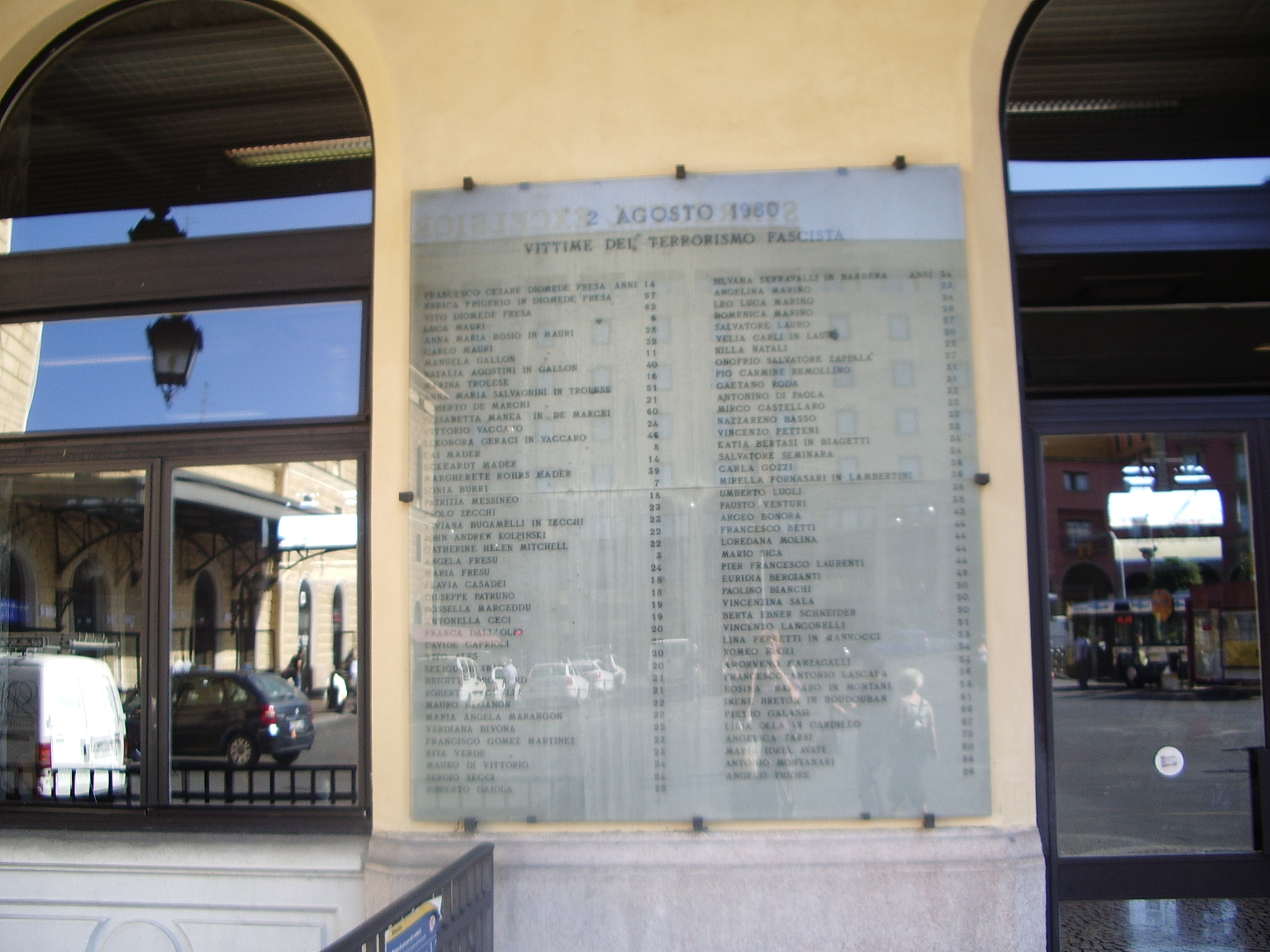
Bologna Massacre
The clock on the facade of Bologna Centrale still reads 10:25. It has read 10:25 since 1996, when the city decided that some moments should never move forward. On the morning of August 2, 1980, a Saturday thick with summer heat, a time bomb hidden inside a suitcase detonated in the station's air-conditioned waiting room. The blast collapsed the roof, gutted the main building, and struck a train waiting at the first platform. Eighty-five people died. Over two hundred were wounded. It remains the deadliest terrorist attack in Italy since the end of World War II, and the decades-long search for accountability became almost as devastating as the bombing itself.
Ten Twenty-Five on a Summer Morning
The waiting room was packed. Travellers had crowded inside to escape the August heat, and the station was full of tourists beginning or ending their holidays. When twenty-three kilograms of explosive -- a mixture of TNT, Composition B, and commercial nitroglycerin -- detonated, the blast did not merely damage the building. It destroyed it. The roof of the waiting room came down on the people sheltering beneath it. Much of the main structure was reduced to rubble. Bologna, unprepared for a disaster of this scale, improvised a response that became part of the story. With ambulances overwhelmed, firefighters pressed city buses, taxis, and private cars into service to transport the injured to hospitals. Doctors and nurses cut short their summer vacations and returned to reopen closed hospital wards. Ordinary passers-by pulled survivors from the wreckage with their bare hands. The #37 city bus, drafted to carry the wounded that morning, became a symbol of the city's refusal to be paralyzed by violence.
A President's Tears
By 5:30 that afternoon, Italian President Sandro Pertini had arrived by helicopter. He wept openly, and when he spoke, he did not reach for diplomatic restraint. "I have no words," he said. "We are facing the most criminal enterprise that has ever taken place in Italy." When funerals were held four days later at the Basilica of San Petronio, thousands gathered in Piazza Maggiore. Government officials who attended were met with harsh criticism and silence. The only applause was for Pertini. Italy's political establishment understood immediately what kind of attack this was. Unlike the targeted assassinations of left-wing terrorism, this was indiscriminate slaughter designed to spread panic -- the signature of right-wing extremism during Italy's so-called Years of Lead, a period of political violence stretching from the late 1960s through the 1980s that left the country scarred and suspicious of its own institutions.
Decades in the Courtroom
The pursuit of justice for the Bologna massacre consumed Italian courts for over four decades. Members of the neo-fascist Nuclei Armati Rivoluzionari were eventually convicted, though they denied involvement. The first trial did not begin until March 1987, nearly seven years after the attack. What followed was a labyrinth of trials, appeals, acquittals, and retrials that tested every assumption about who planned the bombing and why. Italian military intelligence officers were convicted of planting false evidence to divert investigators away from the real masterminds. Generals from SISMI, Italy's military intelligence service, fabricated a dossier and planted a suitcase of explosives to frame other suspects. In 2022, far-right militant Paolo Bellini was convicted and sentenced to life imprisonment for direct involvement. By the 2020s, Italian courts had identified Licio Gelli, head of the secret Masonic lodge Propaganda Due, as the mastermind who financed the attack. The full truth emerged not in a single revelation but through decades of incremental, grinding judicial work.
Shadows Within Shadows
The Bologna investigation exposed something darker than any single act of terrorism: the entanglement of Italy's security services with the very extremists they were supposed to be monitoring. Propaganda Due, the clandestine Masonic lodge led by Gelli, counted among its members intelligence officials, military officers, politicians, and financiers. Its reach extended into the structures of the Italian state itself. Alternative theories multiplied over the years, some pointing toward Palestinian groups, others toward international networks linked to Carlos the Jackal. German terrorists with ties to Carlos were confirmed to have been in Bologna on the day of the bombing. Former President Francesco Cossiga publicly suggested Palestinian involvement as late as 2008. Carlos himself blamed the CIA and Mossad. What makes the Bologna massacre so persistently unsettling is not the lack of answers but the abundance of them -- each pointing in a different direction, each revealing another layer of Cold War-era intrigue that turned Italy into a battleground between forces its own citizens could not see.
A Crack in the Wall, a Clock That Will Not Move
Bologna chose to remember not by building a monument separate from daily life but by preserving the evidence of what happened within it. The station was rebuilt, but the original floor tile pierced by the detonation was left in place. A deep crack in the reconstructed main wall is covered by a glass panel rather than repaired -- a wound made visible and permanent. The station clock, initially fixed after the blast, was deliberately stopped again in 1996 and set permanently to 10:25. Families of the victims organized within a year of the attack, forming an association that grew from 44 members to 300. Every August 2, a concert in Piazza Maggiore commemorates the dead. It is a national memorial day for all victims of terrorist massacres in Italy. The crack, the tile, the frozen clock -- Bologna insists that convenience and normalcy must not be allowed to erase what happened here. The station serves hundreds of thousands of travellers. Among them, the evidence of that August morning remains, asking every passer-by to stop and notice.
From the Air
Bologna Centrale railway station (44.506N, 11.343E) sits in the heart of Bologna, visible from the air as a large rail complex just north of the historic center. Bologna Guglielmo Marconi Airport (LIPE/BLQ) is 6km northwest, with runway 12/30 measuring 2,803m. From altitude, the old town's distinctive red-roofed medieval center is clearly visible, with the station complex at its northern edge. The Apennine Mountains rise to the south and southwest. Weather is continental with hot summers and foggy winters.