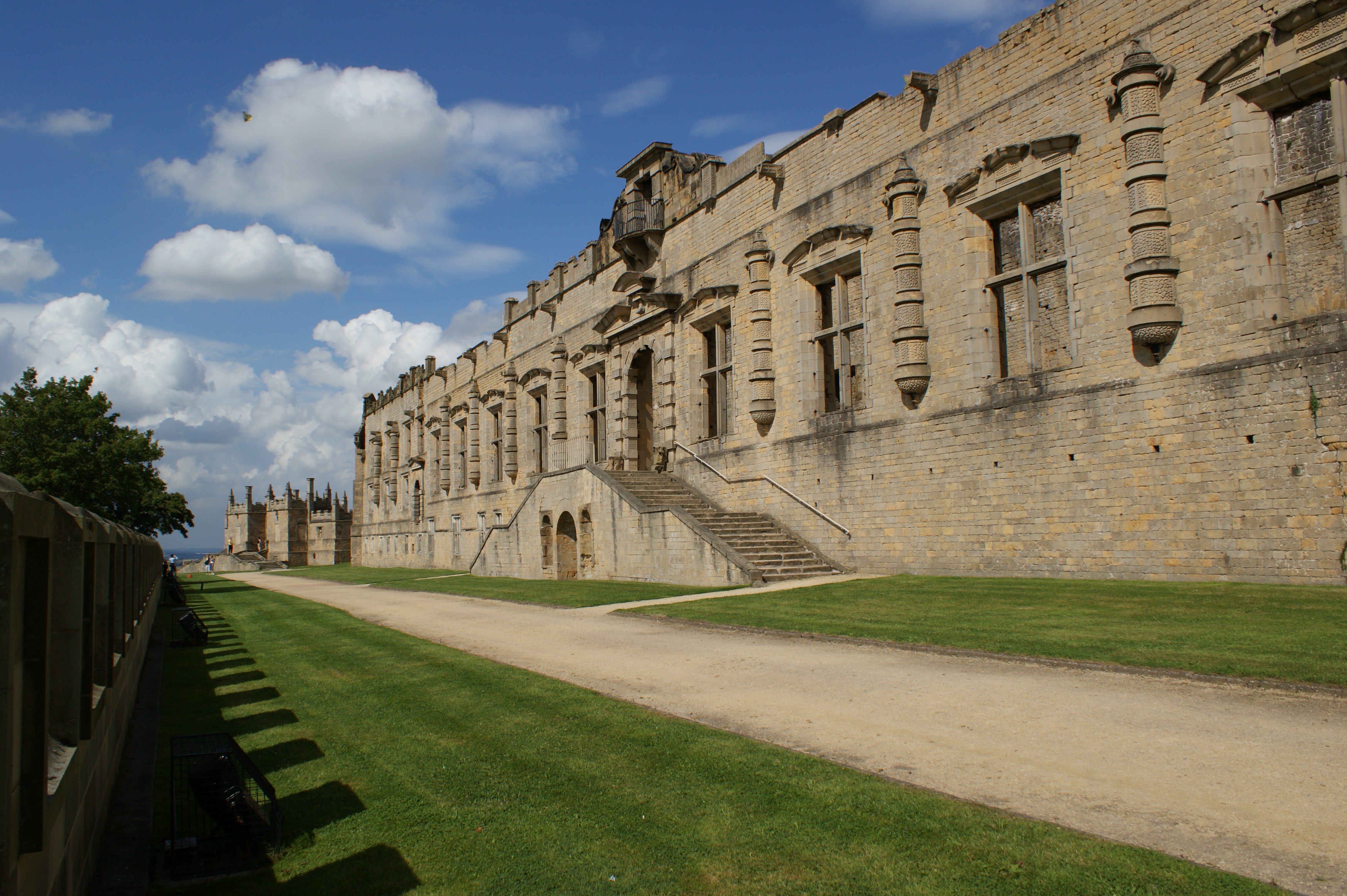
Bolsover Castle
Walk into the Little Castle at Bolsover and you understand immediately that this place was never meant to withstand a siege. The rooms are intimate, richly decorated, filled with painted allegories and elaborate stonework. A Venus Fountain plays in the courtyard. The fireplaces are ornamental fantasies. This is a castle built for pleasure -- a Jacobean gentleman's retreat disguised in medieval clothing, perched on a Derbyshire hilltop where a genuine Norman fortress once stood. That the building which replaced it was designed not for war but for art, conversation, and spectacle tells you something about the ambitions of the family who built it, and about a particular moment in English history when the aristocracy began to imagine that the age of castles might be over.
From Medieval Ruin to Jacobean Fantasy
The original Bolsover Castle was authentically military. Henry II spent 116 pounds fortifying it during the revolt of his own sons in the 1170s, when the garrison was increased to a force led by twenty knights shared between Bolsover, Peveril, and Nottingham. Over the following century, towers were added and the curtain wall repaired. But by the late medieval period, the castle had been granted to a series of local farmers, and under their custodianship it crumbled. Edward VI granted the ruins to Francis Talbot, 5th Earl of Shrewsbury, in 1553. His son, the 6th Earl, was the keeper of Mary, Queen of Scots at nearby Chatsworth House. In 1574, two Scottish servants at Bolsover's stables were suspected of secretly carrying letters to the captive queen -- a reminder that even a ruined castle could still play a role in the dangerous politics of the age.
The Castle That Was Not a Castle
After the 7th Earl of Shrewsbury sold the ruins, his step-brother Sir Charles Cavendish bought them with a singular vision: to build a new structure on the old foundations that would be, in every way, a place for living rather than fighting. Working with the celebrated architect Robert Smythson, Cavendish began the Little Castle in 1612. It was designed as a compact, jewel-like retreat -- the architectural equivalent of a love poem. Both Cavendish and Smythson died before it was finished, in 1617 and 1614 respectively. Construction continued under Cavendish's sons, William and Charles, who were influenced by the Italian-inspired designs of Inigo Jones. The accounts for the early building stages are unusual for the period in recording female labour, noting the women's names alongside their work. On 30 July 1634, the castle reached its social pinnacle when Ben Jonson's masque Love's Welcome at Bolsover was performed during a royal visit by Charles I -- a lavish entertainment designed to demonstrate the Cavendish family's taste, wealth, and loyalty to the Crown.
Slighted, Restored, and Haunted
The English Civil War interrupted everything. Parliamentarian forces captured Bolsover and slighted it -- deliberately damaging the structure to prevent future military use. William Cavendish, who had been created Marquess of Newcastle in 1643, eventually added a new hall and staterooms to the Terrace Range, and by his death in 1676 the castle had been restored to good order. But the long decline that followed was irreversible. After 1883 the castle was uninhabited. In 1945 the 7th Duke of Portland gave it to the nation, and the Ministry of Works began stabilizing the buildings. Today Bolsover is managed by English Heritage, its Little Castle and long gallery open to visitors who come for the painted ceilings, the Venus Fountain, and the views from the Terrace Range across the Derbyshire countryside. In 2017, English Heritage staff voted it the most haunted site in their care -- a distinction that the builders of the Little Castle, who filled their rooms with allegorical figures and celestial imagery, might have appreciated. They built a castle to house the imagination. Ghosts, it seems, were inevitable.
From the Air
Bolsover Castle sits at 53.23°N, 1.30°W on an elevated site above the town of Bolsover in northeastern Derbyshire. The Little Castle and Terrace Range are visible from lower altitudes against the hilltop. East Midlands Airport (EGNX) is approximately 20nm to the south-southwest. The M1 motorway runs to the west.