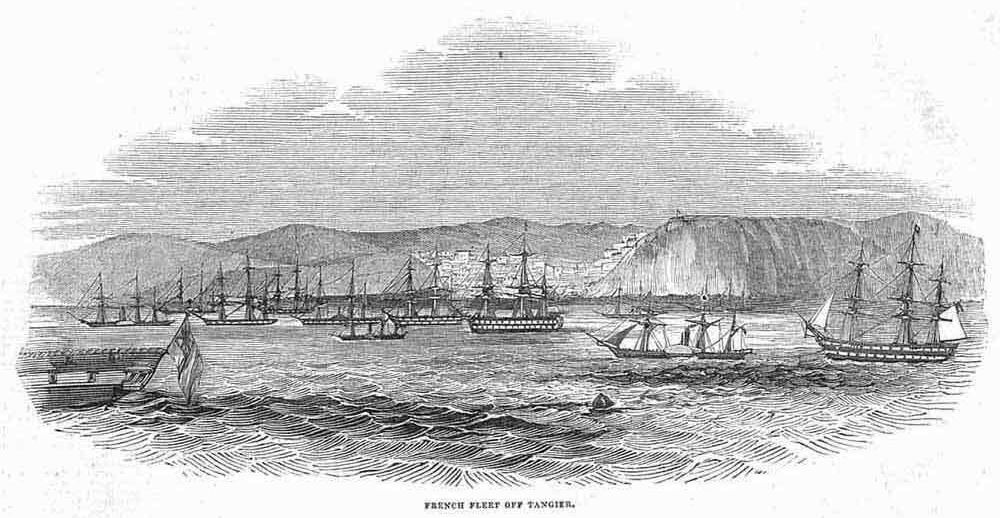
Bombardment of Tangier
The French warships appeared off Tangier on the morning of August 6, 1844, their gun ports open. At the command of Francois d'Orleans, Prince of Joinville -- the third son of King Louis-Philippe -- the fleet opened fire on the city. The bombardment was brief but decisive, and it was only the beginning. Within nine days, the same fleet would fight the Battle of Isly and bombard the port of Mogador, hammering Morocco into submission in a conflict that would reshape the power dynamics of North Africa.
Algeria's Shadow War
The bombardment did not emerge from a dispute with Tangier itself. Its roots lay 800 miles to the east, in Algeria, where France had been fighting to consolidate its colonial conquest since 1830. Abd el-Kader, the Algerian resistance leader who had waged a fierce guerrilla campaign against French forces, had found sanctuary and support across the border in Morocco. France demanded that Morocco abandon its support for the Algerian resistance. Morocco refused, bound by ties of religious solidarity and tribal alliance that ran deeper than any diplomatic calculus. For France, the calculation was simpler: Morocco's border with Algeria had become a rear base for an enemy, and that situation had to end. The bombardment of Tangier was the opening statement of the First Franco-Moroccan War.
A Prince Commands the Fleet
The French Navy forces were commanded by Francois d'Orleans, Prince of Joinville, a member of the French royal family who had earned a reputation as an aggressive naval officer. His fleet included some of the most modern warships in the French Navy, armed with heavy guns capable of reducing Tangier's coastal defenses to rubble. The city's fortifications, built for an earlier era of warfare, were no match for the concentrated firepower of a 19th-century steam-age fleet. The bombardment demonstrated something that would become painfully clear across North Africa and the Middle East over the following decades: traditional coastal defenses, however thick their walls, could not withstand modern European naval artillery.
Nine Days That Changed Morocco
The bombardment of Tangier was the first blow in a rapid three-part campaign. Eight days later, on August 14, French and Moroccan forces met at the Battle of Isly, where a French army decisively defeated a much larger Moroccan force. The following day, August 15, the Prince of Joinville's fleet struck again, bombarding the Atlantic port of Mogador. In the span of nine days, France had demonstrated overwhelming military superiority on both land and sea, shattering Morocco's confidence in its ability to resist European power. The Treaty of Tangier, signed on September 10, 1844, forced Morocco to reduce its support for Abd el-Kader and accept French demands regarding the border with Algeria.
The Long Consequence
The bombardment left scars on Tangier that extended beyond the physical damage to its walls and buildings. It established a pattern that would define Morocco's 19th century: European military pressure, diplomatic concessions, and the gradual erosion of sovereignty that would culminate in the French and Spanish protectorates of the early 20th century. The Illustrated London News published engravings of the French fleet off Tangier and of the bombardment itself, bringing the spectacle of European imperial violence into drawing rooms across Britain. For Morocco, the lesson was stark. The country that had been among the first to recognize American independence in 1777 now found itself on the receiving end of a different kind of Western attention -- not diplomatic recognition, but the barrel of a naval gun.
From the Air
Coordinates: 35.777N, 5.804W. The bombardment targeted Tangier's harbor and coastal fortifications, visible from the air as the port area where the city meets the Strait of Gibraltar. The narrow strait, just 14 km wide at its minimum, is visible to the north with the Spanish coast beyond. Nearest airport: GMTT (Tangier Ibn Battouta, 15 km southwest). Cape Spartel is visible to the west at the entrance to the strait.