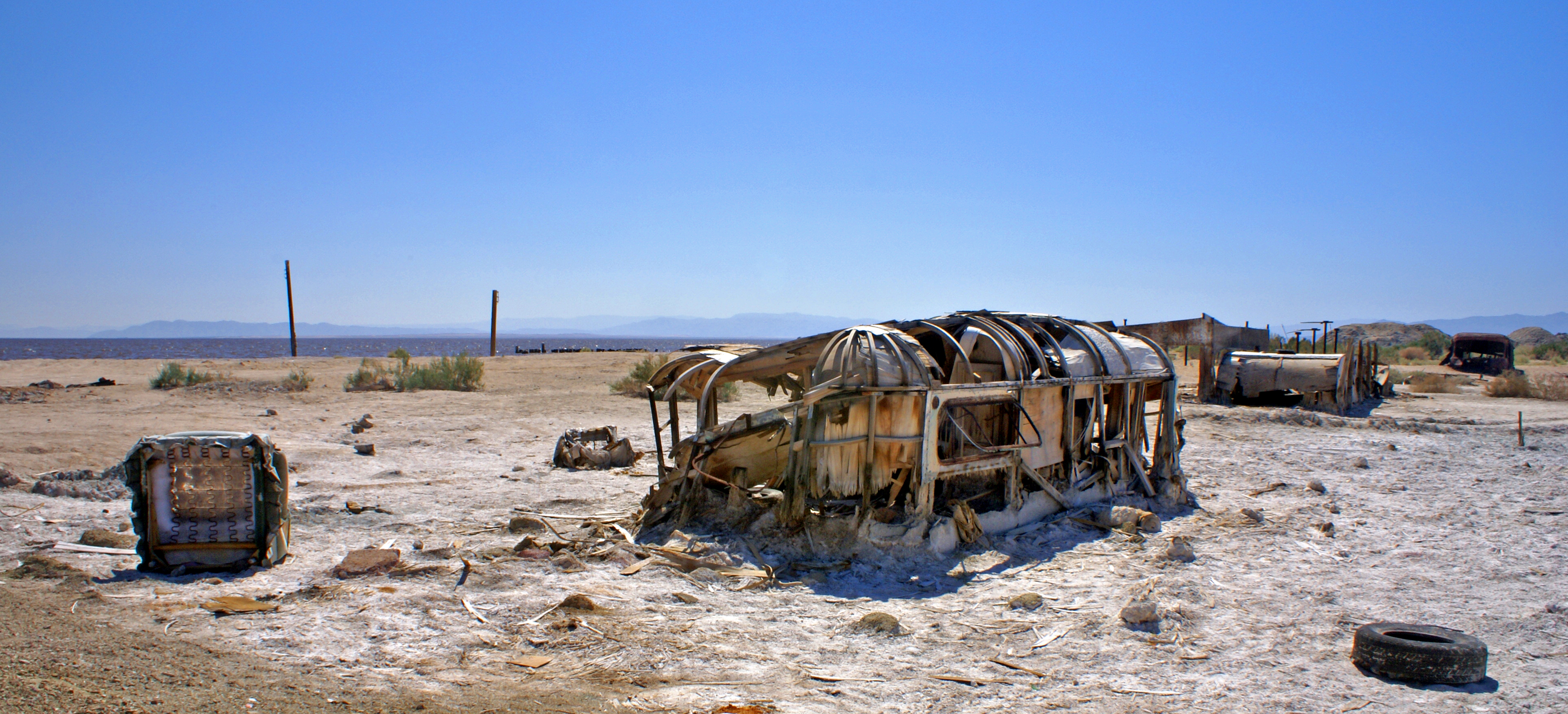
Bombay Beach: The Salton Sea's Post-Apocalyptic Resort
Bombay Beach was supposed to be paradise. In the 1950s, developers promoted the Salton Sea as California's Riviera - a desert ocean for boating, fishing, and resort living. Bombay Beach grew along its eastern shore, attracting visitors who couldn't believe their luck: beachfront property in the California desert, affordable and exotic. Then the sea started dying. Agricultural runoff increased salinity. Fish died by the millions. The water receded, leaving beaches of crushed fish bones. Tourists left. Residents who couldn't afford to leave stayed. Bombay Beach became one of California's poorest communities, a decaying monument to failed ambition. Now artists have discovered it, turning ruins into installations and decay into aesthetic. The apocalypse has become an attraction.
The Creation
The Salton Sea was an accident. In 1905, irrigation canals from the Colorado River breached, flooding the Salton Sink for two years before engineers regained control. The resulting lake - 35 miles long, larger than Lake Tahoe - became an unexpected attraction. Developers saw opportunity: desert beachfront without the drive to the ocean. Communities grew around the shore. Bombay Beach incorporated in 1958, named for the nearby Bombay naval testing station. For two decades, the Salton Sea was a destination - water-skiing, fishing, yacht clubs. The desert was tamed and profitable.
The Death
The sea had no outlet. Agricultural runoff - the only water input sustaining the lake - carried fertilizers, pesticides, and salt. Evaporation concentrated the salts. By the 1980s, salinity exceeded ocean levels. Fish began dying in massive kills - millions of tilapia rotting on beaches, creating stench that reached for miles. Bird populations collapsed from botulism fed by decomposing fish. The water receded, leaving expanding flats of desiccated fish bones and salt. Resorts closed. Property values collapsed. Bombay Beach's population dropped from 5,000 to barely 300. Paradise was officially dead.
The Ruins
What remains is post-apocalyptic. Abandoned trailers rust in the desert heat. Former yacht clubs stand empty. Streets end in salt flats where water used to be. The 'beach' is fish bones and barnacles exposed by the receding waterline. Structures slowly collapse; no one repairs them. The remaining residents are a mix of people who can't afford to leave, eccentrics who prefer isolation, and artists who find beauty in decay. Poverty is pervasive - Bombay Beach median income hovers around $18,000. The community isn't a metaphor for collapse; it's the literal thing.
The Art
Artists discovered Bombay Beach in the 2000s, drawn by exactly the decay that drove others away. The annual Bombay Beach Biennale brings installations to the ruins - a submarine rising from the salt flat, a swing set on the exposed lakebed, sculptures assembled from debris. The aesthetic is deliberate decay, found-object art in a found-object landscape. Some residents resent the artists as poverty tourists; others welcome the attention and revenue. The art doesn't fix anything - the sea is still dying, the town is still poor - but it reframes the narrative. Bombay Beach isn't just failure; it's material.
Visiting Bombay Beach
Bombay Beach is located on the eastern shore of the Salton Sea, roughly 180 miles southeast of Los Angeles via Interstate 10 and Highway 111. The town is accessible by paved road. Visitors can drive through, walk the lakebed, and photograph the ruins and art installations. The smell varies with conditions; the dead fish aroma intensifies in heat. No services are available in town - bring water and fuel. The Salton Sea State Recreation Area offers more conventional facilities. Slab City, the off-grid squatter community, is nearby. Respect residents' privacy; this is someone's home, not an abandoned movie set. Visit during cooler months if possible.
From the Air
Located at 33.35°N, 115.73°W on the eastern shore of the Salton Sea in California's Colorado Desert. From altitude, the Salton Sea is visible as a large body of water in an otherwise arid landscape - currently roughly 35 miles long and shrinking. Bombay Beach appears as a small settlement on the eastern shore, its grid of streets partially extending into what is now dry lakebed. The salt flats and exposed shoreline are visible as white bands around the receding water. The contrast between the green irrigated fields to the south and the barren landscape to the north illustrates the agricultural system that created and is now killing the sea.