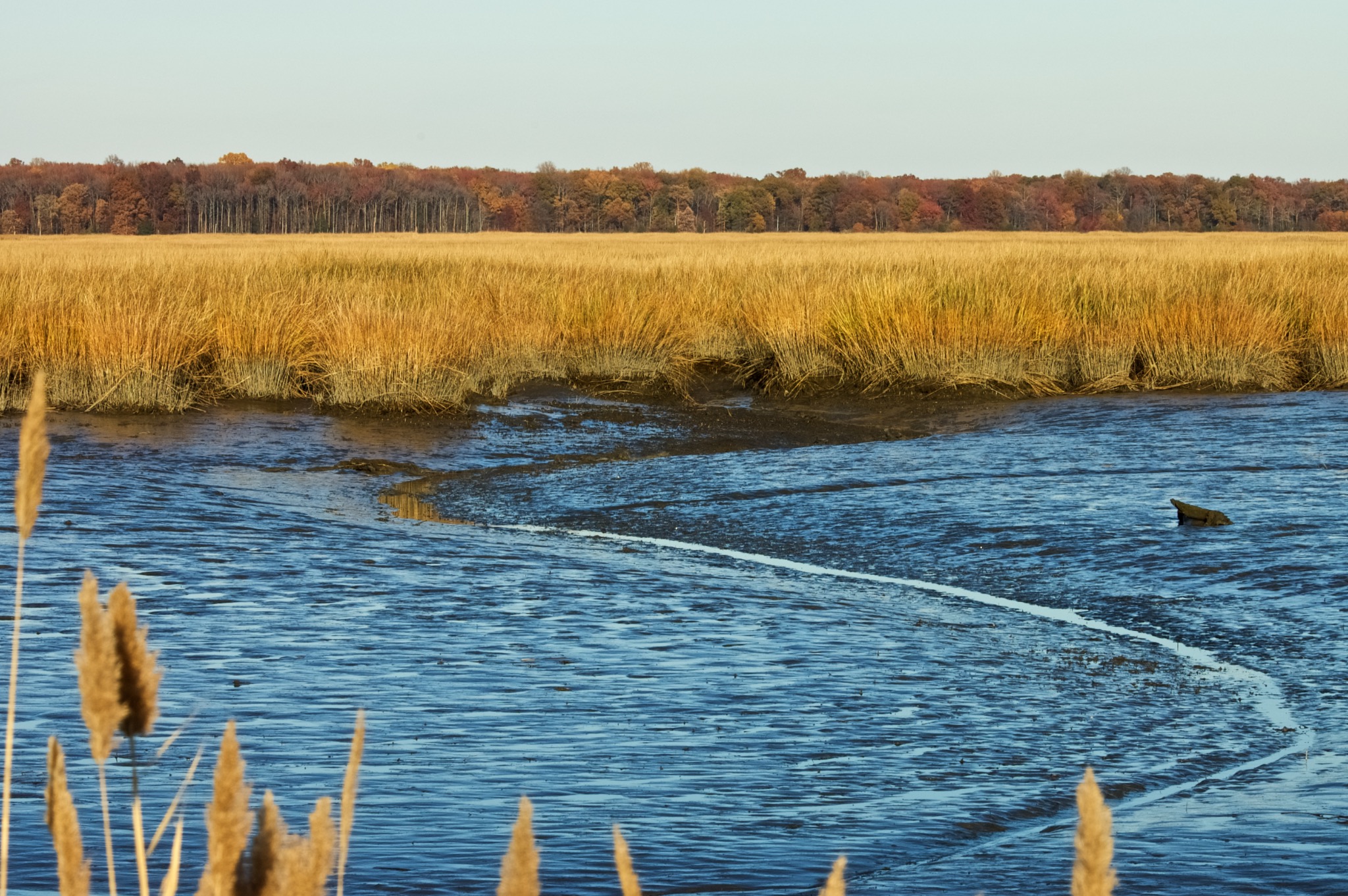
Bombay Hook National Wildlife Refuge
In 1679, Mechacksett, chief of the Kahansink people, sold a stretch of Delaware Bay wetlands to Dutch settler Peter Bayard. The price: one gun, four handfuls of gunpowder, three waistcoats, one anker of liquor, and one kettle. Today that same land shelters nearly 350 species of birds, from bald eagles circling overhead to snow geese arriving in such staggering numbers that they once drew a live satellite broadcast for National Geographic, the BBC, and Turner Broadcasting. Bombay Hook National Wildlife Refuge sprawls along the eastern coast of Kent County, Delaware, a world of tidal salt marsh, freshwater impoundments, and upland fields where the rhythms of migration have played out for millennia.
Little-Tree Point
The name itself tells a story of layered settlement. Native Americans called this place Canaresse, meaning 'at the thickets.' Dutch colonists translated the concept into Ruyge-Bosje, 'shaggy bushes,' before the name evolved through further Dutch corruption: Boompjes Hoeck, 'little-tree point,' eventually became the improbable 'Bombay Hook.' By 1682, a canal connected the town of Smyrna to Delaware Bay, creating the Smyrna River. A lighthouse followed in 1831, its first keeper appointed by President Andrew Jackson himself. Duncan Stewart served until his death at age 92 in 1854, when his daughter Margaret took over the post. The lighthouse was automated in 1912 and sat abandoned for decades before arsonists burned the deteriorating structure in the 1970s.
The Storm That Remade the Marsh
By 1848, Bombay Hook Island had become a popular resort, complete with a hotel and regular steamer service to Philadelphia aboard the Pilot Boy. That genteel chapter ended violently in 1878, when a catastrophic storm that locals called 'the great tidal-wave' destroyed the summer resorts on Collins and Fraland Beach. More significantly, the storm breached the protective dunes that had shielded the inner marshes from tides and storm surges. Those dunes were never repaired. The salt water rushed in, fundamentally altering the biological character of Bombay Hook. What had been sheltered freshwater habitat transformed into the tidal salt marsh that defines the refuge today, a landscape shaped not by careful management but by a single catastrophic night over a century ago.
Built by Duck Stamps and the CCC
In 1937, the federal government purchased the land, mostly tidal salt marsh stretching along Delaware Bay, using federal duck stamp funds to establish the Bombay Hook Migratory Waterfowl Refuge. The following April, Civilian Conservation Corps workers based in nearby Leipsic went to work. They cleared wooded swamps, built dikes to create Raymond and Shearness Pools, constructed a causeway separating Shearness and Finis Pools, and planted over 50,000 trees. They raised a headquarters building, an observation tower, a boathouse with a marine railway, and houses for the manager and patrolman. They dug mosquito-control ditches and conducted wildlife surveys. By the time the CCC camp closed in March 1942, three freshwater impoundments stood where swamp had been. During World War II, the refuge was briefly repurposed as a gunnery range and aerial rocket testing ground. Bear Swamp Pool, the fourth impoundment, was added in 1961.
Crossroads of the Atlantic Flyway
Delaware Bay is the second-largest staging area for spring migratory shorebirds in North America, and Bombay Hook sits at its heart. Nearly 350 bird species have been recorded here, from the great blue heron immortalized on the 2015 America the Beautiful quarter to accidental migrants blown off course by Atlantic storms. Bald eagles nest in the refuge. Snow geese descend in such concentrations that the refuge was selected to represent the United States in a 1986 global satellite broadcast called 'World Safari.' Beyond birds, 35 mammal species inhabit the refuge, including beavers, muskrats, river otters, and red foxes. Horseshoe crabs spawn along the bay shore each May and June, their population carefully monitored since 1990 when a multi-agency survey first raised concerns about overharvesting.
The Huguenot's Farmhouse
Standing among the fields and marshes is the Allee House, built around 1753 by Abraham Allee, the son of a Huguenot refugee from Artois, France. The elder Allee served in the colonial Assembly, was appointed Justice of the Peace, and held the title of Chief Ranger for Kent County. His house is one of the finest preserved examples of early brick construction in Delaware: Flemish bond brickwork with glazed header bricks, handsome wood-paneled parlors, and striking recessed arched china closets with graduated butterfly shelves. After more than 270 years, the house stands in nearly original condition, though decades of water damage have weakened walls and support beams enough that tours have been discontinued. The Allee House sits on the National Register of Historic Places, a quiet monument to the layers of human habitation that preceded the refuge by centuries.
From the Air
Bombay Hook NWR is at 39.259N, 75.474W along the western shore of Delaware Bay in Kent County, Delaware. From altitude, the refuge appears as a vast expanse of green-brown tidal salt marsh intersected by meandering tidal creeks, with four distinct freshwater impoundment pools visible as darker geometric shapes. The auto tour route is sometimes visible as a thin line threading through the marsh. Nearest airports include Dover AFB (KDOV) about 10 nm to the southwest and Summit Airport (EVY) approximately 20 nm to the north. The refuge sits along the Atlantic Flyway, and during migration season the concentration of waterfowl can be visible even from several thousand feet.