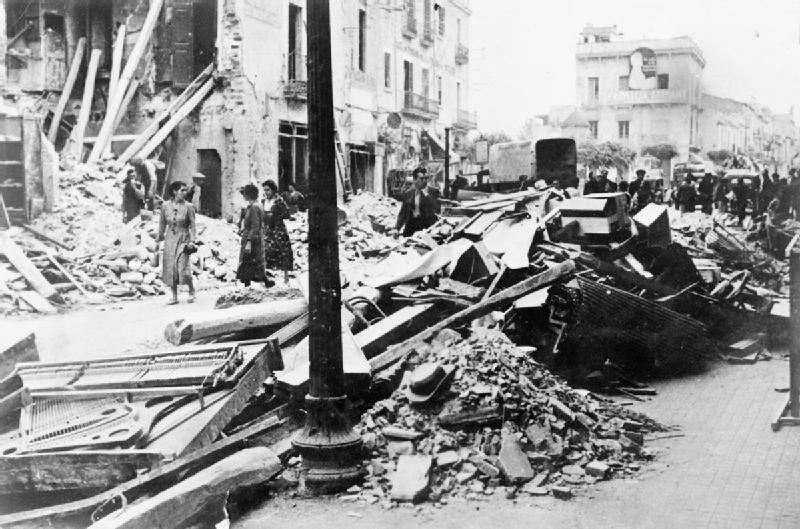
Bombing of Granollers
Five bombers. One town. Up to 224 people dead, most of them women and children. The bombing of Granollers on May 31, 1938, lasted minutes, but it distilled the logic of the Spanish Civil War's air campaigns into a single, concentrated atrocity. The Italian Aviazione Legionaria, flying on behalf of Franco's Nationalist forces, dropped their payloads on a town with no military significance. When British officers investigated afterward, they reported what anyone looking at the rubble could see: the bombing had been aimed at non-military targets. The international response was outrage, protest, and ultimately nothing.
The War from Above
By May 1938, the strategy of terror bombing had become deliberate policy for Franco and his foreign allies. The Nationalists sought to destroy Republican maritime commerce and, more importantly, Republican morale. To achieve this, Franco authorized both the Italian Aviazione Legionaria and the German Legion Condor to conduct indiscriminate bombing raids on Republican cities. Valencia, Barcelona, Alicante, and dozens of smaller towns had already been hit. Granollers, a market town in the Valles Oriental comarca northeast of Barcelona, had no meaningful military infrastructure. It was a target because it was there -- because its civilian population could be terrorized, and because terrorizing civilians was the point.
Thirty-One Days After a Promise
The timing made the bombing particularly cynical. On April 16, 1938 -- just six weeks before the attack -- Italy and Britain had signed the Anglo-Italian Pact, in which Italy agreed to withdraw its troops from Spain once the war ended and both countries pledged to maintain the status quo in the Mediterranean. The ink was barely dry. Italy had sent three thousand fresh troops to Spain on April 11, five days before signing the agreement. The bombing of Granollers on May 31 was carried out by Italian aircraft, flown by Italian crews, dropping Italian ordnance on Spanish civilians. The pact meant nothing, and both sides knew it.
The Dead of Granollers
The official count varies between 100 and 224 civilian dead. The higher figure, 224, comes from local records and commemorative accounts; the lower figure reflects the fog that settles over casualty counts in wartime, particularly in a civil war where both sides had reasons to inflate or suppress numbers. What is not in dispute is the composition of the dead. Most were women and children -- people going about the daily business of a market town on a Tuesday morning. The five Italian bombers struck without warning, and the town had no air defenses, no shelters adequate to the scale of the attack, no military installations that might have justified the raid under any rules of engagement. Granollers was not a battlefield. It was a killing ground.
Outrage Without Consequence
The British government protested to Burgos, Berlin, and Rome. The Vatican added its voice. These were not trivial gestures -- diplomatic protests from a major power and the Holy See carried weight, at least in theory. Italy's Foreign Minister, Galeazzo Ciano, responded with characteristic duplicity. He told the British that Franco had ordered the attacks and that the Italians bore no responsibility, while promising to do what he could. To the German ambassador, he was more honest: Actually, we have, of course, done nothing, and have no intention of doing anything either. The bombing continued. Other towns were hit. The war ground on for another eleven months until the Republic collapsed in March 1939.
A Town That Remembers
Granollers has not forgotten May 31, 1938. The town maintains a peace museum, the Can Jonch Centre de Cultura per la Pau, dedicated to the memory of the bombing and to broader themes of conflict and reconciliation. Annual commemorations mark the anniversary, and the sixty-eighth anniversary in 2006 drew national attention. The bombing of Granollers is less well known internationally than the destruction of Guernica, which occurred a year earlier, but it belongs to the same grim catalog -- evidence that the deliberate targeting of civilians, later refined and industrialized in the Second World War, was already standard practice in Spain. The five bombers that came to Granollers on that Tuesday morning were not anomalies. They were policy.
From the Air
Located at 41.62N, 2.30E in the Valles Oriental comarca, approximately 30 km northeast of Barcelona. The town lies in a flat valley surrounded by low hills. Nearest major airport is Barcelona-El Prat (LEBL). The town center, where the bombing occurred, is the dense urban core visible along the Congost river. The Can Jonch peace museum is in the historic center. Best viewed at 3,000-5,000 feet. The approach from the southeast follows roughly the same trajectory the Italian bombers would have taken from their bases.