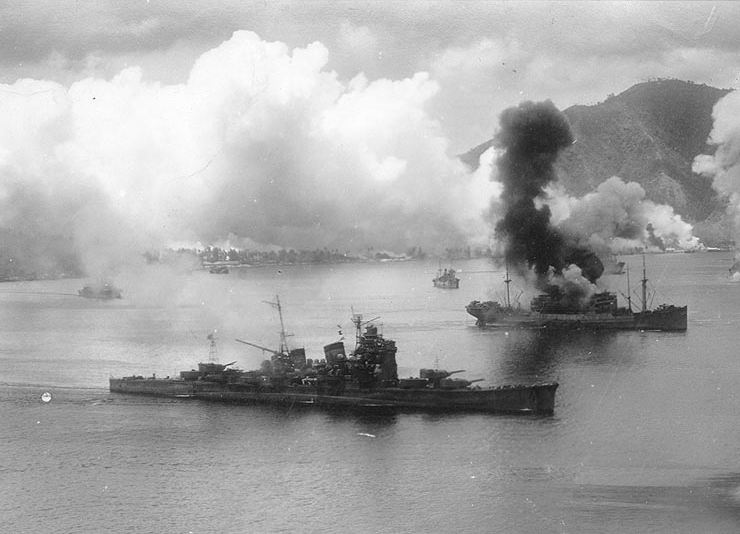
Bombing of Rabaul (November 1943)
Navy aviators had a name for Rabaul. They called it a hornet's nest. The harbor was ringed by 367 anti-aircraft guns, five airfields, and the best Japanese defensive network in the South West Pacific - the kind of target that carrier doctrine said you did not attack. Before 1943, the only precedent for carriers striking a major fortified port was the raid at Pearl Harbor, and that had gone the other way. Then in early November, Admiral William Halsey looked at what was assembling in Simpson Harbour - a fresh cruiser force down from Truk, built to crush the American landing at Bougainville - and decided he had no choice. He later called the moment "the most desperate emergency that confronted me in my entire term" as commander of the South Pacific.
The Threat Coming Down From Truk
On the night of 1 November 1943, American forces landed at Cape Torokina on Bougainville, the southern flank of the Allied advance toward Rabaul. The screen of cruisers and destroyers at Empress Augusta Bay turned back a Japanese counterattack that night, but Admiral Mineichi Koga, commanding the Combined Fleet at Truk 800 miles to the north, responded fast. Rabaul-based aircraft struck the landing site the next morning. Dive bombers tracked the American surface fleet and put three bombs into a cruiser despite the AirSols fighters flying overhead. And over the next few days, Koga sent a heavy cruiser force down from Truk to reinforce Rabaul - the kind of surface strength that could cut the Bougainville landing off from its supply line. Halsey's own battleships and most of his cruisers were gone, transferred north to cover the upcoming invasion of Tarawa. All he had in hand was two aircraft carriers.
A Carrier Raid No One Had Tried
Rear Admiral Frederick C. Sherman commanded Task Force 38. Halsey ordered him north through the night of 4-5 November to get within launch range of Rabaul for a daybreak strike. Sherman approached behind a weather front for concealment. At dawn on 5 November, he launched all 97 of his available aircraft - every plane he had - leaving nothing behind as combat air patrol over his own carriers. Fighters from the newly captured airfield at Vella Lavella and from Barakoma flew out to meet the carrier force and provide what protection they could. The orders to the aircrews were deliberately modest: damage as many warships as you can. Do not try for sinkings. The point was not to win a naval battle - it was to break up the cruiser force before it could sail against Bougainville.
Morning in the Hornet's Nest
The Navy strike hit Simpson Harbour at daybreak on 5 November. An hour later, 27 B-24 Liberators of the Fifth Air Force, escorted by 58 P-38s, came in behind them. The heavy cruiser Maya took a bomb above one of her engine rooms that killed 70 of her crew. Mogami was hit by a 500-pound bomb that set her afire and killed 19. Takao took two 500-pound bombs and lost 23 men. Atago was slightly damaged by near-misses; Chikuma lost one crewman to a hit near an anti-aircraft gun. Three destroyers took light damage. The attack was short, violent, and complete enough. Under the threat of more strikes, most of the surviving Japanese warships departed for Truk the next day. Koga's cruiser force, the thing that had forced Halsey to throw his carriers into a target Navy doctrine said could not be attacked, was no longer a factor in the Bougainville campaign. American aircraft losses were light.
11 November: A Second Strike
Two days later, Rear Admiral Alfred E. Montgomery's Task Group 50.3 arrived - the carriers Essex, Bunker Hill, and the light carrier Independence, among the first of the new fast carriers that would dominate the late-war Pacific. On 11 November, Halsey used Montgomery's task group alongside Sherman's to hit Rabaul again. Sherman launched from near Green Island northwest of Bougainville in bad weather, struck at around 08:30, and retired south undetected. Montgomery launched from the Solomon Sea 160 miles southeast of Rabaul. The light cruiser Agano, which had stayed behind after the 5 November raid, was torpedoed and heavily damaged. A destroyer took a direct bomb hit while loading torpedoes near the harbor mouth, blew up, and sank with 148 of her crew. The Japanese counterattacked with 120 aircraft against the American carriers that afternoon. Thirty-five of those planes did not return. The American ships were not damaged.
What the Raids Meant
The two strikes changed the equation in the South West Pacific. Rabaul had been the anchor of Japanese naval power in the region since its capture from the Australians in January 1942 - called "the Pearl Harbor of the South Pacific" by the men who manned it. After November 1943, it was still a fortress, but a hollow one. The cruiser force that had made it a threat to amphibious operations had been pulled back to Truk. With Bougainville and Buka in Allied hands, land-based US Navy and Marine Corps bombers could reach Rabaul from the south for the first time, and on 17 December 1943 the systematic air campaign to isolate the base began. By the end of the war, tens of thousands of Japanese troops were still dug into Rabaul's tunnels and gun positions, fighting a war that had long since moved on without them. The Allies did not capture Rabaul. They simply flew past it, as Halsey had bet they could, once the cruisers were gone.
From the Air
Rabaul lies at 4.20 degrees S, 152.17 degrees E, on the Gazelle Peninsula at the northeastern tip of New Britain. Simpson Harbour is the drowned caldera that drew both the Japanese Navy and Allied bombers - one of the finest deep-water anchorages in the Pacific, ringed by the active volcanoes Tavurvur and Vulcan. Tavurvur's 1994 eruption buried much of the old town. Tokua Airport (AYTK / RAB) serves the area today from the new town site 20 km east. Recommended viewing altitude 6,000-10,000 ft to see the caldera, the harbor, the volcanic cones, and the layout of the former WWII airfields at Vunakanau, Lakunai, Rapopo, and Tobera. Nearest alternates: Hoskins (AYKB) roughly 200 nm west on northern New Britain, and Kavieng (AYKV) 140 nm north on New Ireland. Weather is equatorial maritime; afternoon convective activity is typical and the surrounding volcanic plume can affect visibility.