Bombing of Singapore (1944-1945)
The round trip was 4,000 miles, flown from airfields in Kharagpur, India, across the Bay of Bengal and the Malay Peninsula to a tiny island at the tip of Southeast Asia. When B-29 Superfortresses of the XX Bomber Command first appeared over Japanese-occupied Singapore in November 1944, they were undertaking the longest daylight bombing operation conducted up to that time. For the Japanese, who had seized the island nearly three years earlier, the raids were an unwelcome reminder that the war had turned. For Singapore's civilians, watching silver bombers glide above the reach of anti-aircraft fire, they were something else entirely: the first tangible sign that liberation might come.
The Prize at Sembawang
Britain had spent decades building Singapore Naval Base at Sembawang into one of the most important military installations in the British Empire. The facility housed the massive King George VI graving dock and the Admiralty No. IX floating dry dock, and it anchored Britain's entire defense strategy in the Far East. When Singapore fell to Japan on 15 February 1942, the base passed into Japanese hands largely undamaged. It became the Imperial Japanese Navy's most critical facility outside the home islands. By early 1944, the Japanese Second and Third Fleets had relocated from the central Pacific to Singapore and the nearby Lingga Islands, bringing with them the bulk of the IJN's remaining battleships and aircraft carriers. The concentration of naval power made Singapore a target of obvious strategic importance, but its distance from Allied airfields had kept it beyond reach until the deployment of the B-29, the only bomber with the range to make the journey.
Superfortresses Over the Straits
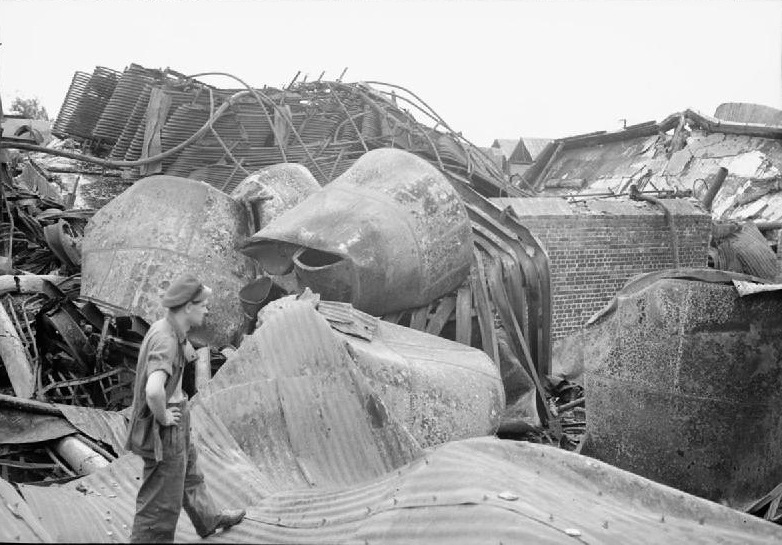
After the Japanese defeat at the Battle of Leyte Gulf in October 1944, General Henry H. Arnold, who personally directed the Twentieth Air Force from Washington, ordered Major General Curtis LeMay to strike Singapore. LeMay's staff doubted a daylight mission requiring a 4,000-mile round trip could succeed, but Arnold insisted. The first raid proved the concept was feasible, if imperfect. Subsequent missions through early 1945 targeted the naval base and dockyard facilities with mixed results. The most successful attack came on 1 February 1945, when 112 B-29s hit the Admiralty IX Floating Dock. Sixty-seven bombers reached the target, sinking the dry dock and destroying a 460-foot ship berthed inside it. Other aircraft struck the West Wall area, flattening the base's main administrative buildings. Not every raid landed as intended. Anti-aircraft fire from Japanese warships in the Straits of Johor disrupted several missions, and an attack on 24 February with incendiary bombs burned out 39 percent of warehouse space near the Empire Dock but also destroyed over 100 civilian buildings, leaving 396 people homeless.
Mines in the Moonlight
Alongside the conventional bombing, XX Bomber Command conducted a parallel campaign of aerial minelaying, timing missions to coincide with full moons for better visibility. On the night of 25 January 1945, forty-one B-29s laid six minefields in the approaches to Singapore in what was then the largest single aerial minelaying effort in the Pacific. Further missions seeded the Straits of Johor and surrounding waters in February and March. The mines sank three ships and damaged ten more, disrupting Japanese convoy routes and ship-repair operations. After the American bombers redeployed to the Mariana Islands, the RAF's No. 222 Group took over minelaying duties using B-24 Liberators, continuing operations until 24 May 1945 when they ceased so that unswept mines would not endanger planned Allied landings in Malaya.
A Propaganda War in the Skies
Japan's air defenses over Singapore were remarkably thin. Two army companies with automatic cannon, a few naval anti-aircraft units, and a handful of fighters constituted the entire defensive force, hampered further by poor coordination between the army and navy and a complete absence of fire-control radar or barrage balloons. Only nine B-29s were shot down across all the American raids. The occupied population noticed. Civilians came to believe the Superfortresses were virtually invulnerable, and their raids became a source of quiet celebration. The Japanese occupation authorities tried to counter this by displaying wreckage of downed B-29s and captured crew members, and by pointing to damage inflicted on a mosque during raids on 11 January and 24 February, the latter coinciding with celebrations of Muhammad's birthday. None of it worked. The bombers had come to symbolize liberation, and no amount of propaganda could undo that.
The Calculus of Restraint
One of the campaign's most striking features was the tension between destruction and preservation. In February 1945, Admiral Louis Mountbatten, commanding Allied forces in Southeast Asia, ordered that the King George VI Graving Dock and other key naval infrastructure be spared from further attack. His reasoning was practical rather than merciful: the Allies would need those facilities once they retook Malaya and Singapore. Brigadier General Roger Ramsey, who had replaced LeMay, met Mountbatten at Kandy in Ceylon to negotiate a revised target list. The result was a constrained campaign focused on expendable warehouse areas, oil stores, and commercial docks. The final American raids in March 1945 targeted oil storage on Bukom and Sebarok islands, destroying seven of forty-nine oil tanks on Bukom before XX Bomber Command departed for the Marianas. Singapore would not be liberated by bombing. The island was finally freed in September 1945, after Japan's surrender, its naval base battered but intact enough to serve its new masters.
From the Air
Located at 1.367N, 103.800E, centered on Singapore Naval Base at Sembawang on the island's north coast. The base area is visible from altitude as a large waterfront complex along the Straits of Johor. Bukom Island and Sebarok Island, targeted in the oil storage raids, are small islands off Singapore's south coast. Singapore Changi Airport (WSSS) lies approximately 8 nm to the east. Best viewed at 3,000-5,000 ft AGL, with the entire island and surrounding straits visible at higher altitudes.