Bombing of Tokyo
The planners used Japanese insurance company maps. Before a single incendiary fell on Tokyo, analysts at the Office of Strategic Services had ranked each of the city's wards by how well they would burn, drawing on prewar fire-risk assessments produced by Japan's own insurers. This chilling detail captures the calculated nature of the strategic bombing campaign that struck Japan's capital between 1942 and 1945, a campaign that culminated in Operation Meetinghouse on the night of March 9-10, 1945, the single deadliest air raid in the entire history of warfare.
Sixteen Bombers Over Tokyo
The first American bombs to fall on Tokyo arrived on April 18, 1942, delivered by sixteen B-25 Mitchell medium bombers launched from the aircraft carrier USS Hornet. The Doolittle Raid was a retaliatory gesture following Pearl Harbor, and its military impact was negligible. The bombers hit Tokyo and Yokohama, then flew on toward airfields in China, but every aircraft was lost, either crash-landing, ditching at sea, or diverting to the Soviet Union. Two crews were captured by the Japanese, and three crewmen were executed. The raid mattered not for the damage it inflicted but for what it proved: Japan's home islands were not beyond reach. The propaganda victory was enormous, and the strategic implications would take three years to fully materialize.
The Weapon That Changed Everything
What transformed the symbolic gesture of the Doolittle Raid into sustained devastation was the B-29 Superfortress, a strategic bomber with the range and payload to strike Japan from island bases across the Pacific. Almost ninety percent of all bombs dropped on the Japanese home islands were delivered by B-29s. Early raids flew from bases in China under Operation Matterhorn, but these could not reach Tokyo and were logistically unsustainable. The capture of Saipan and Tinian in the Mariana Islands in June 1944 changed the calculus entirely. Yet even with closer bases, high-altitude precision bombing proved ineffective. Winds at altitude, later identified as the jet stream, scattered bombs far from their targets. Bombing trials at Dugway Proving Ground in Utah had already demonstrated that incendiary weapons were devastating against Japan's wood-and-paper construction. General Curtis LeMay ordered a radical tactical shift: his bombers would fly low, at night, stripped of defensive guns to carry more ordnance, and they would carry fire.
The Night of Black Snow
On the night of March 9, 1945, 334 B-29s took off for Tokyo. Their target was the Shitamachi district, a densely packed working-class neighborhood near the docks in the Koto and Chuo wards. The first aircraft dropped incendiaries in a massive X pattern; follow-on bombers simply aimed for the flaming crosshairs. The ordnance was terrifyingly efficient. E-46 cluster bombs released thirty-eight M69 napalm bomblets each, which punched through thin roofing and ignited seconds later, spewing jets of burning napalm. M47 white phosphorus bombs ignited on impact. Within two hours, the fires had overwhelmed every firefighting capability in the city. Individual blazes merged into a general conflagration driven by winds gusting at high speed. Approximately sixteen square miles of central Tokyo were destroyed. An estimated 100,000 civilians died that night, and over one million were left homeless. Of the 339 B-29s launched, 282 reached the target; 27 were lost to anti-aircraft fire, mechanical failure, or the savage updrafts generated by the inferno itself.
More Destructive Than the Atom Bomb
Operation Meetinghouse surpassed the bombings of Dresden and Hamburg in destructive scale. It also caused more immediate casualties than either the Hiroshima or Nagasaki atomic bombings considered as single events. Historian Richard Rhodes placed the toll at over 100,000 dead, a million injured, and a million made homeless. Before the firebombing campaign, over fifty percent of Tokyo's industrial output came from small workshops scattered through residential neighborhoods. The raids cut the city's total production in half, not by hitting major factories but by incinerating the homes and small shops of the workers who supplied them. The moral calculus of targeting civilian neighborhoods for their combustibility has haunted the historical memory of the Pacific War ever since. Some modern analysts have classified the raids as war crimes. The Japanese government itself has characterized the bombings as contrary to humanitarian principles.
What the Sky Remembers
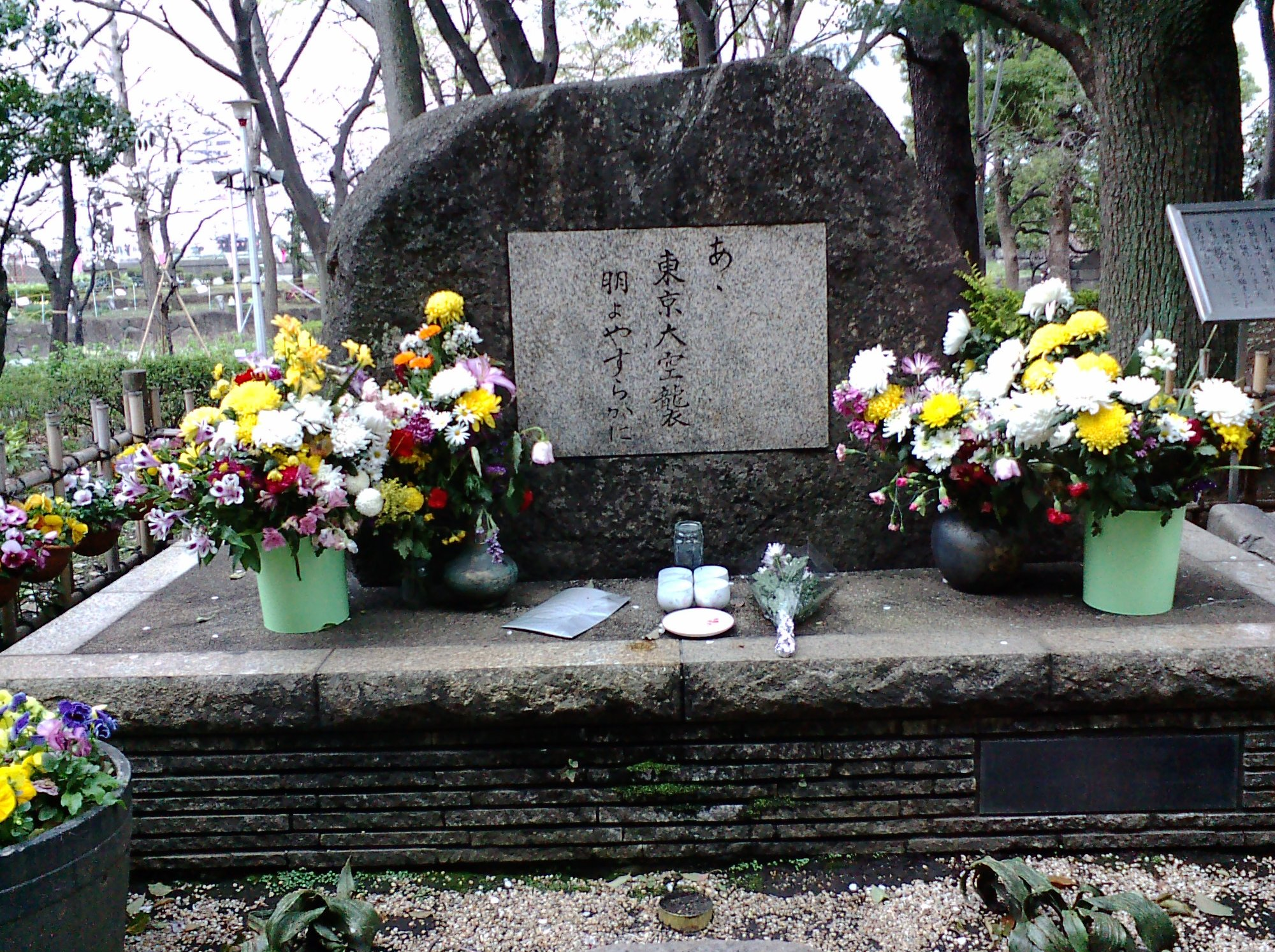
Tokyo rebuilt itself so completely that few visible traces of the firebombing remain at street level. The Shitamachi district is now a modern cityscape of concrete and glass. But the geography is unchanged. The waterfront where the flaming X was laid down, the flat expanse of the eastern wards, the river corridors that channeled the firestorm's winds, all of it is still legible from the air. A memorial hall and peace park at Yokoamicho in Sumida Ward preserves the memory of the raids. Flying over modern Tokyo, the sheer density and scale of the rebuilt metropolis is itself a testament to what was lost and what was reconstructed from ashes in the decades that followed.
From the Air
Located at 35.77N, 139.50E over metropolitan Tokyo. The primary target area of the March 1945 firebombing was the Shitamachi district in the Koto and Chuo wards along Tokyo Bay's western shore. From the air, the flat eastern wards and waterfront areas mark the zone of greatest destruction. Tokyo Haneda International Airport (RJTT) lies approximately 15 km to the south. Narita International (RJAA) is 60 km to the east. Chofu Airport (RJTF) is 15 km to the west. Best appreciated from 5,000-10,000 feet, where the full extent of the rebuilt city conveys the scale of what was destroyed.