Bonaventure Cemetery: Savannah's City of the Beautiful Dead
In October 1867, a young naturalist named John Muir arrived in Savannah with empty pockets and nowhere to sleep. He was walking a thousand miles from Indiana to the Gulf of Mexico, and the city offered nothing he could afford. So he walked southeast to Bonaventure Cemetery, spread his blanket on the ground between the graves, and stayed for six days and nights. He found the place so beautiful that he wrote an entire chapter about it, calling it one of the most impressive assemblages of animal and plant creatures he had ever met. The cemetery that sheltered a penniless wanderer in the 1860s would shelter some of Savannah's most distinguished dead for the next century and a half, becoming a place where Spanish moss, marble angels, and the slow brown Wilmington River conspire to make death look almost inviting.
From Plantation Ruin to Garden of the Dead
The land that became Bonaventure Cemetery started as a plantation on a bluff above the Wilmington River, southeast of downtown Savannah. Peter Wiltberger purchased the property and developed it as a private burial ground, with the first interments taking place in 1850. Three years later, Wiltberger himself was entombed in a family vault on the grounds. The plantation's ruins, already softened by decades of encroaching vegetation, lent the new cemetery an atmosphere of romantic decay that the Victorians found irresistible. Live oaks already arched overhead, their limbs heavy with Spanish moss, and the river provided a natural boundary that kept the world at a comfortable distance. Greenwich Cemetery was absorbed as an addition in 1933, expanding the grounds to nearly their current size. Today Bonaventure is the largest of Savannah's municipal cemeteries, and citizens can still purchase interment rights.
The Famous and the Forgotten
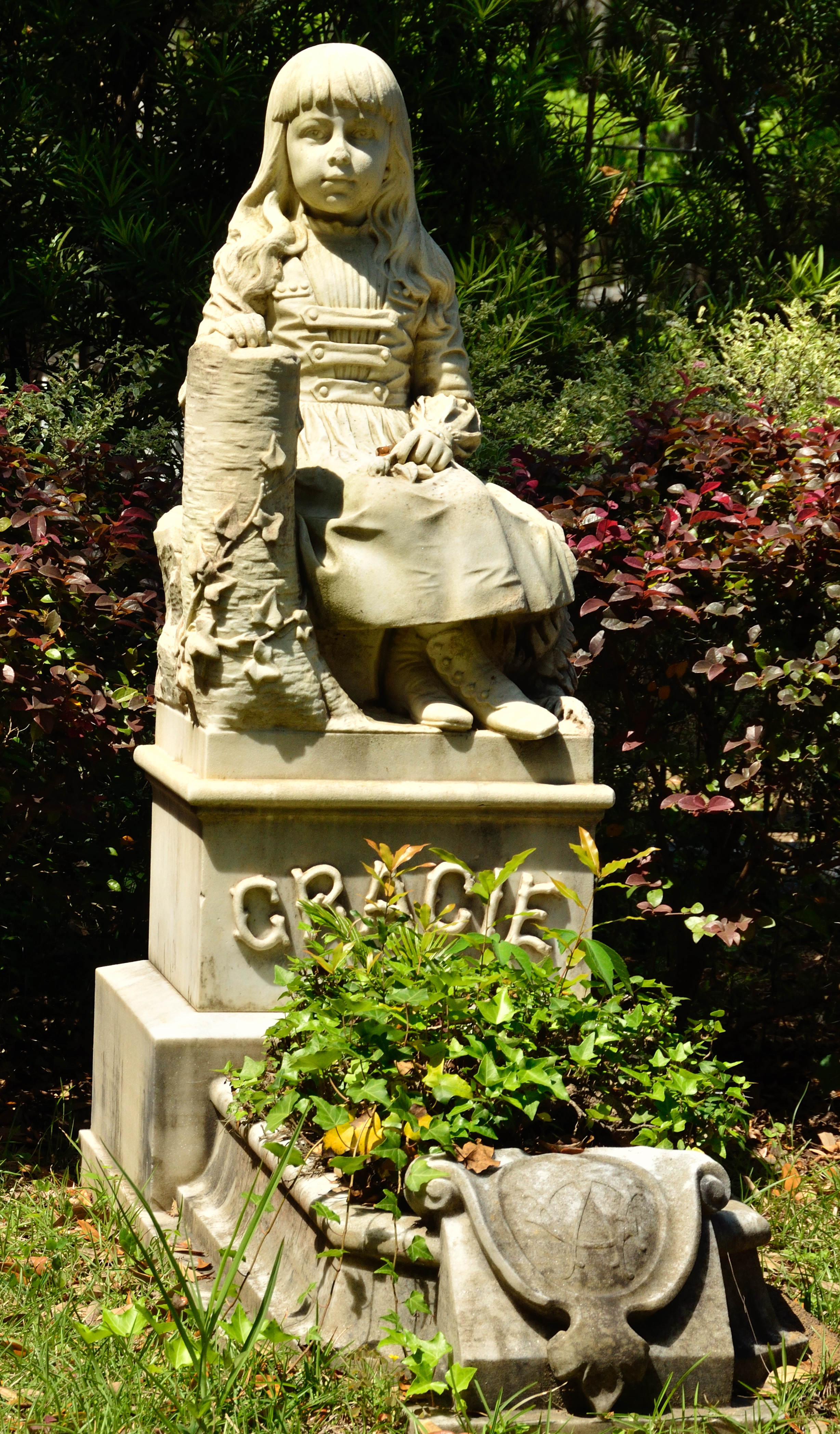
Bonaventure reads like a compressed history of Savannah and the American South. Johnny Mercer, the songwriter behind Moon River and Come Rain or Come Shine, rests here, the great-grandson of Confederate general Hugh W. Mercer, who is buried nearby. Poet and novelist Conrad Aiken chose Bonaventure as his final address. Governor Edward Telfair and his daughter Mary, a philanthropist and art collector who helped establish the museum system that bears the family name, both lie within the grounds. Six-year-old Gracie Watson, who died in 1889, is memorialized by a life-sized marble statue so lifelike that visitors still leave toys and flowers at her grave. The cemetery also holds the nation's second-largest area dedicated to Spanish-American War veterans, from Worth Bagley Camp #10 in Section K. Every headstone marks a story; the moss-draped paths connect centuries.
Midnight Made It Famous
Bonaventure was a local treasure for most of its existence, known to Savannahians but largely invisible to the wider world. That changed in 1994 when John Berendt published Midnight in the Garden of Good and Evil, a nonfiction account of a Savannah murder trial laced with the city's most colorful characters and Gothic settings. Photographer Jack Leigh shot the cover image in Bonaventure, capturing the Bird Girl statue on the Trosdal family plot in fading light. The book became a massive bestseller, and tourists arrived by the thousands. Bonaventure transformed from a quiet burial ground into one of Savannah's premier attractions. The Bird Girl was removed in 1997 to protect the gravesite from foot traffic and relocated to the Telfair Museums. In 1997, the Bonaventure Historical Society formed as a nonprofit to preserve and document the cemetery, compiling a comprehensive index of burials.
Monuments in Moss and Marble
Walking Bonaventure is like touring an open-air museum of Victorian funerary art. The monuments reflect a culture that invested heavily in commemorating the dead: weeping angels, draped urns symbolizing the veil between worlds, broken columns representing lives ended too soon, and elaborate family mausoleums built to last centuries. The craftsmanship ranges from folk simplicity to high sculptural art. The landscape itself is part of the design. Live oaks with limbs thick enough to walk on create a canopy that filters sunlight into shifting green-gold patterns. Azaleas and magnolias mark the seasons. The Wilmington River, tidal and unhurried, moves past the eastern edge of the grounds. The cemetery was conceived as a beautiful place first, a burial ground second, and the original intent still holds.
A Resting Place That Never Rests
Bonaventure remains an active cemetery. New burials take place alongside headstones that date back to the 1850s, and families still tend plots that have been theirs for generations. Ghost tours wind through after dark, and photography workshops use the grounds as a studio. History walks trace the connections between the names on the stones and the streets, squares, and buildings of Savannah. Jack Leigh, the photographer whose cover image made Bonaventure internationally known, died of colon cancer in 2004. He is buried here, in the same cemetery where he found the shot that defined his career. The living and the dead share the space comfortably, as they have since Wiltberger laid out the first plots on the old plantation bluff above the river.
From the Air
Located at 32.044°N, 81.046°W on a bluff overlooking the Wilmington River, roughly 4 miles southeast of downtown Savannah. From altitude, Bonaventure appears as a dense canopy of live oaks covering approximately 160 acres, with the tidal Wilmington River forming its eastern boundary. White marble monuments are occasionally visible through gaps in the tree cover. The cemetery contrasts sharply with the surrounding residential development. Savannah/Hilton Head International Airport (KSAV) is approximately 9 nautical miles to the northwest. On approach from the east or southeast, the cemetery's tree canopy and river setting are distinctive landmarks. Savannah's famous grid of historic squares is visible to the west.