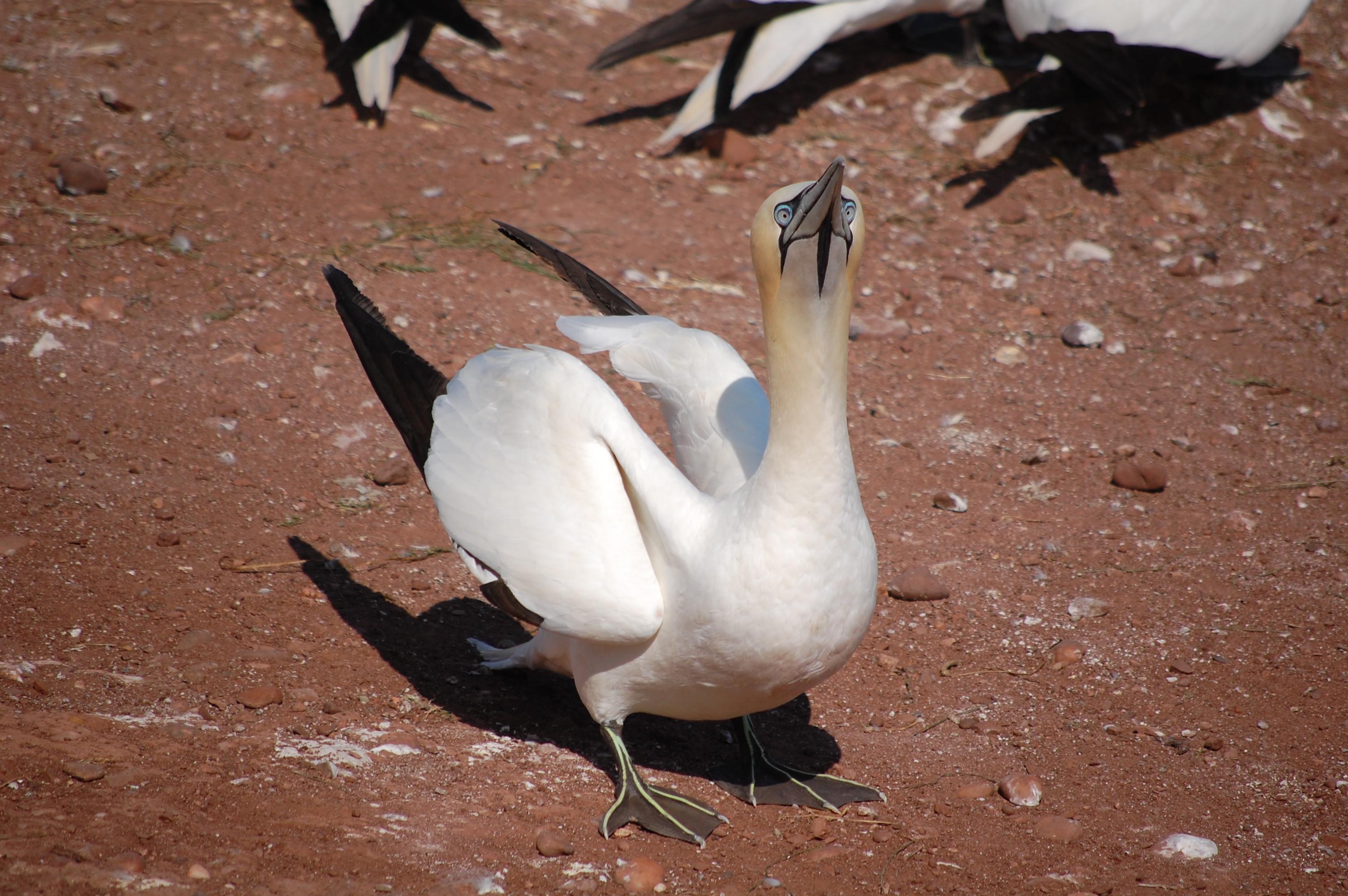
Bonaventure Island
The noise reaches you before the island does. Tens of thousands of northern gannets -- white-bodied, amber-headed, with six-foot wingspans -- crowd the eastern cliffs of Bonaventure Island in a colony so dense it looks like snow from a distance. With 51,700 breeding pairs recorded in 2011 and 218 species documented overall, this roughly circular island off Quebec's Gaspe Peninsula is one of the largest and most accessible seabird sanctuaries in the world. But Bonaventure was not always a bird refuge. For centuries it was home to fishermen, farmers, and artists who lived alongside the gannets until the province evicted them all.
Cod, Colony, and the Denys Legacy
Bonaventure Island, along with nearby Perce, was among the earliest seasonal fishing ports of New France. The island's history is intertwined with Nicolas Denys, the French colonist and merchant who controlled much of the Gulf of St. Lawrence trade in the 17th century. By the late 18th century, settlers from southern Ireland had established themselves on the island, arriving in the early 1790s. Peter Du Val, a native of Jersey in the Channel Islands, set up a fishery company before 1819 that endured until 1845. The population grew around cod processing -- fishermen from Jersey and Guernsey worked the northern tip of the island, drying and salting their catch for shipment back to Europe. It was a hard, seasonal life built around the abundance of the Gulf, and the island's protected western shore provided the harbor that made it viable.
The Expropriation
In 1919, the island became a migratory bird sanctuary under the Migratory Bird Convention between Canada and the United States, but people continued to live there. That changed in 1971, when the Province of Quebec acquired ownership of the entire island by expropriation. Approximately 35 families were forced to leave -- fishermen, farmers, and the artists who had been drawn to the island's dramatic cliffs and isolation. Among the displaced were descendants of the original Irish and Norman settlers, people whose families had lived on Bonaventure for nearly two centuries. The naturalist William Du Val, the best-known islander, had embodied the connection between human community and natural history. By the 1960s, painters like Jacques Hurtubise and Kittie Bruneau, sculptor Morton Rosengarten, and poet Michael La Chance were spending summers among the residents. All were evicted in the 1970s. In 1985, Quebec grouped the island with Perce Rock to create the Parc national de l'ile-Bonaventure-et-du-Rocher-Perce.
A Kingdom of Gannets
The birds are the reason for everything that happened after the expropriation, and they are extraordinary. Northern gannets are the island's dominant species, their colony ranking among the largest in the world. But gannets are only the beginning. Black-legged kittiwakes nest on the cliff ledges. Common murres crowd the rocky shelves. Atlantic puffins, razorbills, black guillemots, Leach's storm-petrels, great cormorants, and double-crested cormorants all breed here. Herring gulls and great black-backed gulls patrol the periphery. Boreal chickadees and blackpoll warblers inhabit the island's interior forest. The eastern cliffs, where the gannet colony concentrates, present one of the great wildlife spectacles of the North Atlantic -- a vertical city of birds nesting, feeding, fighting, and launching themselves into the Gulf winds in an unending cycle of noise and motion.
Approaching the Island
Bonaventure Island lies southeast of the village of Perce, and the boat ride from the mainland is part of the experience. Tour boats run from May through October, circling the island's cliffs before landing on the western shore, where trails lead across the interior to the gannet colony on the eastern side. The abandoned homesteads of the former residents are still visible along the western trails -- stone foundations and weathered walls slowly returning to forest. Perce Rock, the island's famous geological neighbor, rises from the sea between the mainland and Bonaventure, its massive limestone arch one of the most photographed natural features in eastern Canada. Together, the rock and the island form a national park that draws visitors for the birds, the geology, and the particular quality of light along this exposed stretch of the Gaspe coast. The aircraft carrier HMCS Bonaventure, which served in the Canadian navy from 1957 to 1970, was named after this island.
From the Air
Located at 48.50N, 64.16W in the Gulf of St. Lawrence, southeast of the village of Perce on Quebec's Gaspe Peninsula. The island is clearly visible from altitude as a roughly circular landmass. Perce Rock, a massive natural limestone arch, is visible between the island and the mainland. Nearest airport is Michel-Pouliot Gaspe Airport (CYPG) approximately 40 km northwest. The eastern cliffs, where the gannet colony concentrates, appear white from the air. Approach from the east for the most dramatic view of the seabird cliffs.