Bone Valley
Nine barrels of prehistoric bones changed everything. In 1881, Captain Francis LeBaron of the United States Army Corps of Engineers was surveying the lower Peace River for a canal project when he noticed something peculiar about the fossils embedded in the sandy river bars: they had a phosphatic quality, and the deposits surrounding them were extraordinarily valuable. He shipped his specimens to the Smithsonian Institution and tried to interest investors in New York, Boston, and Philadelphia. None would bite. Frustrated, LeBaron left the country for the ill-fated Nicaraguan Canal Project. But the secret of what lay beneath central Florida's sandy soil was out, and within a decade, the region that would become known as the Bone Valley was producing trainloads of phosphate rock bound for fertilizer plants across the world.
The Scramble Beneath the Sand
LeBaron's test results eventually reached Colonel G.W. Scott of Atlanta, who sent a representative to the sleepy town of Arcadia to buy up land along the Peace River. Colonel T.S. Moorhead of Pennsylvania, who had also heard about the deposits from LeBaron but not their exact location, traveled to Arcadia independently and stumbled onto the famous phosphate-rich sand bars. Moorhead formed the Arcadia Phosphate Company. The first shipment of Florida phosphate rolled out in May 1888 -- ten carloads dispatched to Scott's Fertilizer Works in Atlanta. By the winter of 1889, the Peace River Phosphate Company was mining in earnest, shipping ore by narrow-gauge railroad to Punta Gorda, where it was loaded onto ships bound for Europe. Pick-and-shovel crews worked the exposed sand bars by hand, loading material onto barges. Suction dredges soon followed, and mining spread along the lower Peace River. A cascade of company mergers and railroad construction consumed the next decade as investors realized the scale of what LeBaron had found.
Draglines and Slurry Pipes
Modern phosphate mining in the Bone Valley looks nothing like those early river-bar operations. Giant walking draglines -- some of the largest land machines on Earth -- operate around the clock in open-pit surface mines, excavating a mixture of pebble phosphate, clay, and sand known as matrix. This matrix contains naturally occurring uranium at concentrations of roughly 100 parts per million. The raw material is dropped into pits, mixed with water to create slurry, and pumped through miles of steel pipes to washing plants. There, the phosphate is crushed, sifted, and separated from waste material before being shipped by rail to fertilizer processing facilities. The final products -- diammonium phosphate, monoammonium phosphate, and trisodium phosphate -- end up on farm fields across the globe. Port Tampa Bay handled 3.9 million tons of phosphate in 2021, a significant decline from 8 million tons just four years earlier, reflecting shifting global trade patterns.
Toxic Inheritance
The waste from phosphate processing accumulates in phosphogypsum stacks -- massive, slightly radioactive mounds that can rise hundreds of feet above the flat Florida landscape, surrounded by clay settling ponds measuring thousands of acres. These structures have failed repeatedly. In 1971, a dam breach sent phosphate waste surging into the Peace River, killing over three million fish and spreading a tide of toxic clay slime across pastures and wetlands. Hurricane Frances overwhelmed a phosphogypsum stack in 2004, sending acidic process water into Tampa Bay. In August 2016, a sinkhole opened beneath a gypsum stack at Mosaic's New Wales plant in Mulberry, dumping 215 million gallons of contaminated water into the Floridan Aquifer. Most recently, in March 2021, millions of gallons of industrial wastewater from the former Piney Point plant in Manatee County were released into Tampa Bay after the facility's second leak in a decade.
Railroads Built on Phosphate
The Bone Valley's railroad heritage runs as deep as its ore deposits. Narrow-gauge lines were the first infrastructure built to move phosphate from river to port, and the region's rail network grew in lockstep with the mining industry. For most of the 20th century, two rival railroads -- the Atlantic Coast Line and the Seaboard Air Line -- competed for phosphate traffic, with many mines and processing plants served by both. The 1967 merger that created the Seaboard Coast Line ended the rivalry, and that railroad was eventually absorbed into CSX Transportation. Today, unit trains of covered hopper cars still carry processed phosphate north for domestic use, while rail-to-ship transloading facilities along Tampa Bay handle export cargo. The infrastructure that Captain LeBaron could only dream about in 1881 -- investors, railroads, ports, ships -- eventually materialized in a form far larger than anyone in those early years imagined.
A Landscape in Perpetual Recovery
From the air, the Bone Valley is a patchwork of active mines, settling ponds, reclaimed land, and untouched Florida scrub. Florida law requires that mined land be reclaimed, and modern permits demand that companies recreate more wetlands than existed before mining began. But the scale is staggering. Thousands of acres have been mined and reclaimed in the Peace River watershed, and as northern reserves deplete, mining companies are seeking permits to push operations further south into Hardee and Manatee Counties. The Peace River itself tells the story of cumulative impact: since the 1960s, average annual flow of the middle Peace River has declined significantly, and clay settling ponds continue to slow rainwater drainage across the region. Today, the Mosaic Company mines the area exclusively, the sole inheritor of an industry that began with nine barrels of bones shipped to the Smithsonian from a Florida riverbank.
From the Air
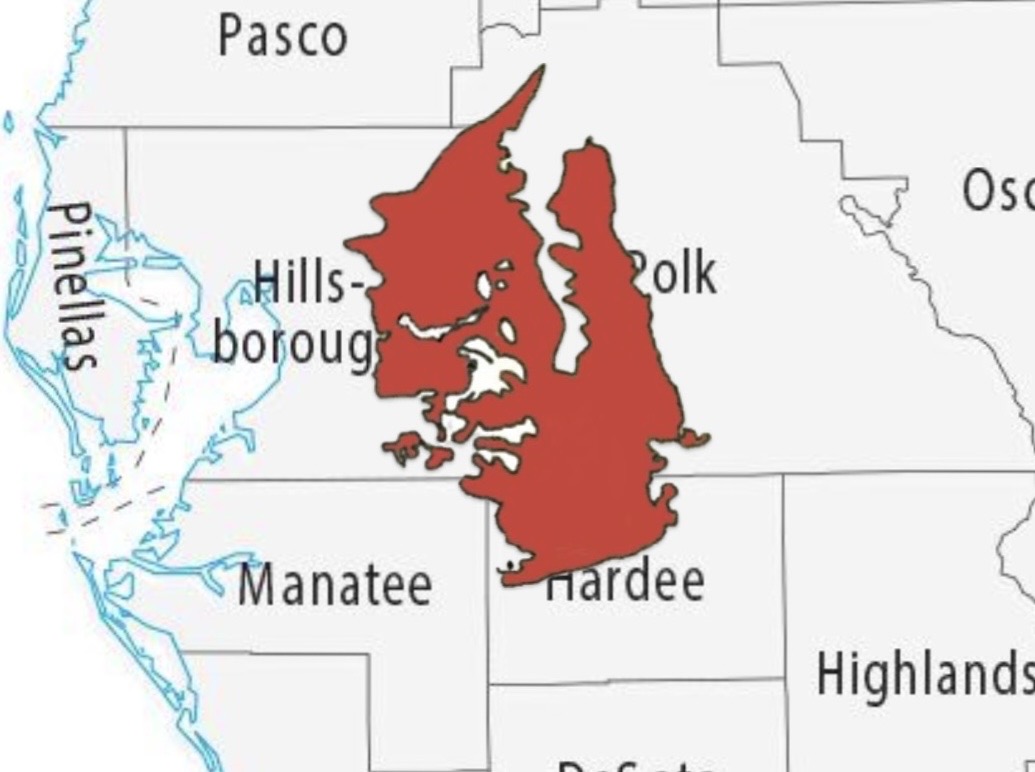
Located at 27.92N, 81.71W in the heart of central Florida's phosphate district, spanning portions of Hardee, Hillsborough, Manatee, and Polk counties. From cruising altitude, the Bone Valley is unmistakable: vast open-pit mines with turquoise-green settling ponds, white phosphogypsum stacks rising above the flat terrain, and the geometric scars of active dragline operations. The contrast between mined land, reclaimed areas, and natural Florida landscape is dramatic from 5,000-10,000 ft AGL. Nearest airports: KLAL (Lakeland Linder International) approximately 15nm east, KTPA (Tampa International) approximately 35nm west, KBOW (Bartow Municipal) directly within the mining district. The Peace River winds through the southern portion of the region. Summer months bring afternoon thunderstorms; morning flights offer the best visibility over the mining operations.