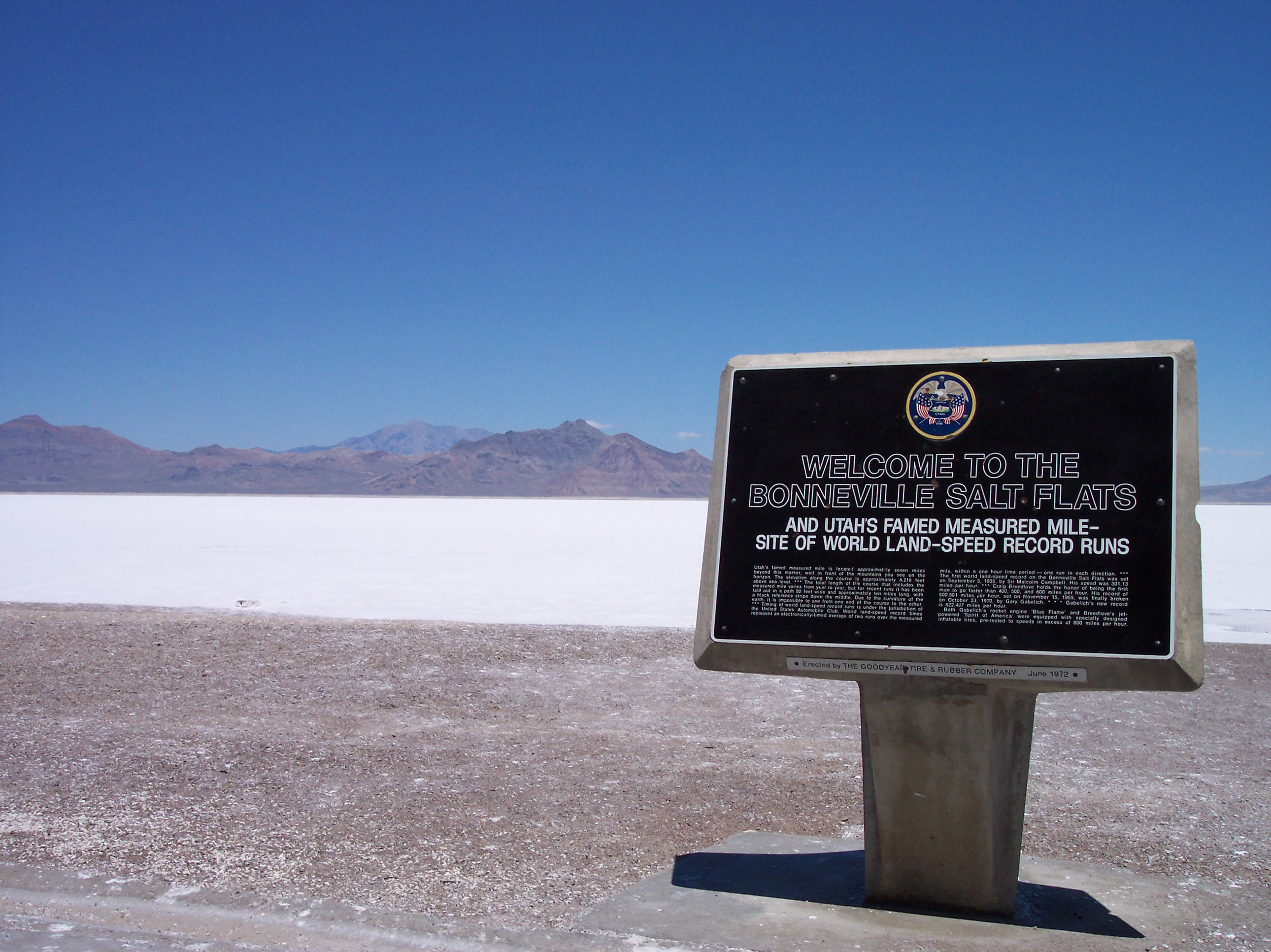
Bonneville Salt Flats
The Bonneville Salt Flats are what remains of ancient Lake Bonneville, a vast Pleistocene lake that once covered much of Utah. When the lake evaporated, it left behind 30,000 acres of salt - a blindingly white, perfectly flat surface so hard and smooth that it has served as a racetrack since 1914. Here, racers have pushed vehicles beyond 600 miles per hour, chasing land speed records in jet-powered cars, streamlined motorcycles, and hot rods. Speed Week, held each August, draws thousands of racers and spectators to watch everything from belly tanks to rocket cars compete on courses up to 11 miles long. The setting is surreal: white salt stretching to the horizon in every direction, heat waves shimmering, mountains rising impossibly distant. Bonneville is a place that looks like nowhere on Earth - which is why it's been used to film alien planets - and a place where the fastest vehicles on Earth come to prove themselves.
The Geology
Lake Bonneville covered 20,000 square miles of western Utah during the last ice age, reaching depths of 1,000 feet. As the climate warmed, the lake evaporated, leaving salt deposits in the lowest areas. The Bonneville Salt Flats occupy the floor of what was the lake's deepest point. The salt is up to 5 feet thick in places - potassium chloride over sodium chloride over mud. Each winter, rain and snowmelt dissolve the surface; each summer, evaporation recrystallizes it. This natural process creates the flat, hard surface. The flats are managed by the BLM and are shrinking - potash mining and diversion of runoff have reduced the salt area significantly since the 1960s.
The Records
Land speed racing at Bonneville began in 1914 when Teddy Tetzlaff drove a 142 mph run. Ab Jenkins set numerous records in the 1930s. After World War II, hot rodders discovered the flats, and racing culture exploded. In 1965, Craig Breedlove drove Spirit of America to 600 mph - the first vehicle to pass 600. The current wheel-driven record is 470 mph. The absolute land speed record was set at Bonneville multiple times before moving to Black Rock Desert (Nevada) for faster runs. Speed Week, run by the Southern California Timing Association since 1949, draws 400+ vehicles annually for timed runs.
The Culture
Bonneville is a pilgrimage site for speed freaks. The annual Speed Week (August) and World of Speed (September) events draw racers from around the world - hot rods, motorcycles, streamliners, diesel trucks, anything with wheels. Categories range from vintage vehicles to purpose-built machines with jet engines. The salt flats' length allows long acceleration runs; courses up to 11 miles let vehicles reach speeds impossible on conventional tracks. The culture is democratic: a guy with a modified lawn mower can run on the same salt as a million-dollar streamliner. Volunteering, camaraderie, and DIY ingenuity define the community.
The Threats
The Bonneville Salt Flats are shrinking. Potash mining at the flats' edge diverts salt-laden water that would otherwise flow onto the racing surface. Climate change is altering the rainfall patterns that replenish the salt. The racing surface has thinned significantly since the 1960s. Some years, racing is cancelled due to deteriorated conditions. The racing community, BLM, and mining companies are working on mitigation efforts, including pumping salt-saturated water back onto the flats. The iconic racetrack's future is uncertain.
Visiting Bonneville
The Bonneville Salt Flats are located off Interstate 80, about 100 miles west of Salt Lake City near the Nevada border. Public access is allowed when racing events aren't occurring. The main viewing area and a paved road onto the salt are near the Bonneville Speedway exit. During Speed Week (August) and World of Speed (September), spectators can watch racing up close - there are no grandstands, just salt. The flats are photogenic year-round but best in dry weather. Walking on the salt is allowed; driving personal vehicles on it requires care (salt is hard but not indestructible). Salt Lake City International Airport (SLC) is the nearest major airport. Wendover, on the Utah-Nevada border, has casinos, motels, and services.
From the Air
Located at 40.73°N, 113.89°W in northwestern Utah, near the Nevada border. From altitude, the Bonneville Salt Flats appear as a brilliant white expanse surrounded by the gray-brown desert of the Great Basin. The geometric black lines of racetracks and tire marks are visible on the white surface. Interstate 80 runs along the northern edge. The Silver Island Mountains rise to the north. The Salt Lake City metropolitan area is visible 100 miles to the east. The stark white salt against desert terrain is unmistakable.