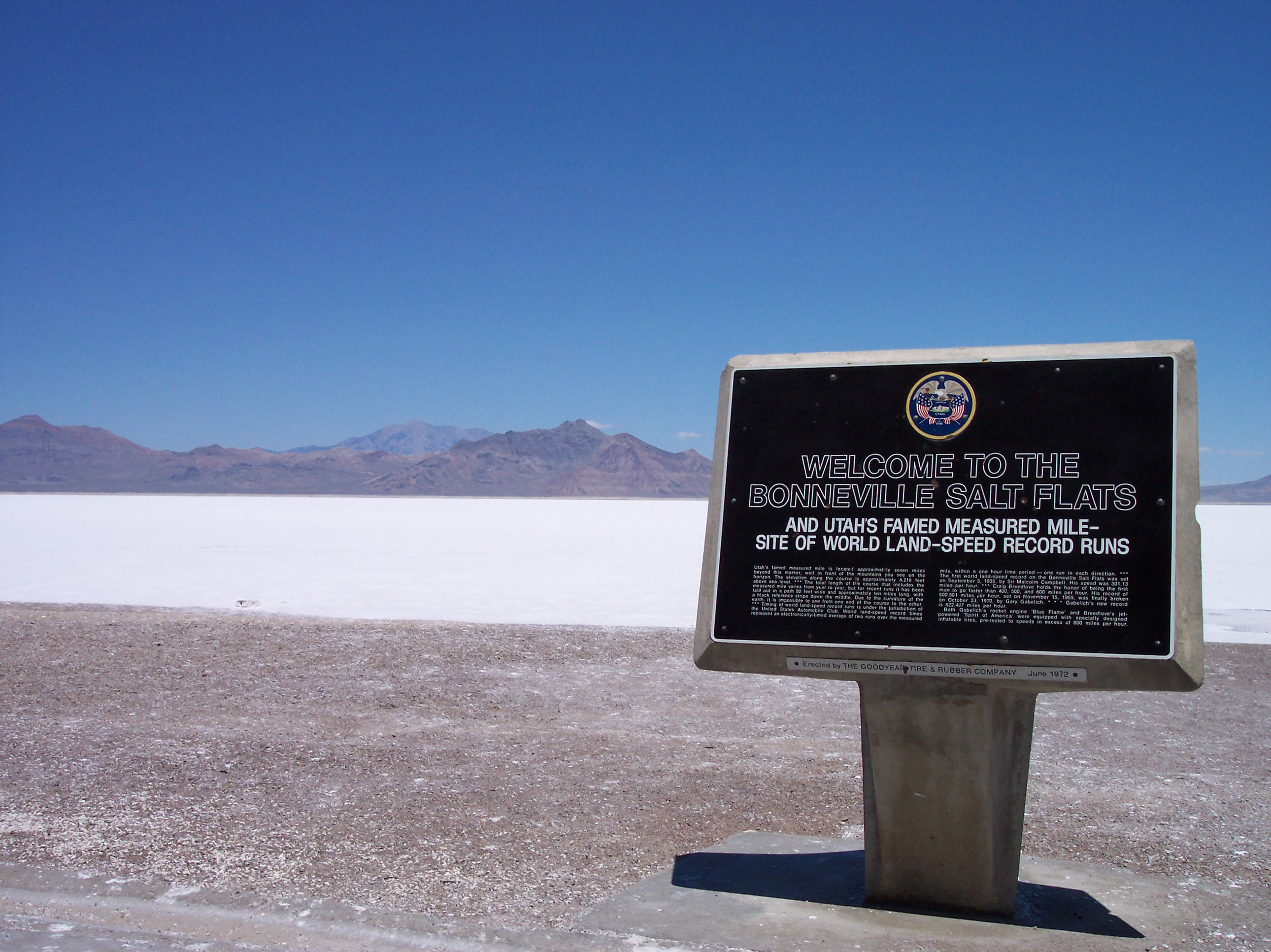
Bonneville Salt Flats: The Fastest Place on Earth
The Bonneville Salt Flats are so flat you can see the curvature of the earth. Forty square miles of crystallized sodium chloride, remnant of ancient Lake Bonneville, stretch to the horizon in blinding white. This improbable surface has been the site of land speed records since 1914, when racers discovered that nothing else on Earth offers so much distance with so little friction. Hundreds of world records have been set here; cars have exceeded 600 mph; jet-powered vehicles have approached the sound barrier. The salt is free, the surface regenerates each winter, and the only limit is how fast humans can make machines go. The salt flats are both eternal and disappearing - mineral extraction is dissolving the surface that made the records possible.
The Surface
Lake Bonneville once covered 20,000 square miles of western Utah. When the climate changed 14,000 years ago, the lake evaporated, leaving mineral deposits across the basin. The densest concentration - the Bonneville Salt Flats - formed a surface harder and smoother than concrete. The salt layer averages 5 feet thick, underlain by clay that creates a self-healing surface: each winter's floods dissolve and redistribute the salt, erasing tracks and imperfections. The result is a natural track requiring almost no preparation - just stake out a course and drive.
The Records
Organized land speed racing began at Bonneville in 1914, when racer Teddy Tetzlaff reached 141 mph. Records fell continuously: 300 mph in 1935, 400 in 1964, 500 in 1965, 600 in 1965. Craig Breedlove's jet-powered Spirit of America set multiple records; Gary Gabelich's Blue Flame reached 622.407 mph in 1970. The current absolute record of 763 mph was set in Nevada's Black Rock Desert, but Bonneville remains the spiritual home of land speed racing. Speed Week each August brings hundreds of cars and thousands of spectators.
The Culture
Speed Week isn't just professional racing - it's a gathering of anyone who wants to see how fast their machine can go. Hot rods, motorcycles, streamliners, and purpose-built record cars line up for timed runs on measured miles. Classes accommodate everything from mostly-stock cars to jet engines on wheels. The atmosphere is uniquely democratic: billionaire record-seekers share the salt with backyard mechanics who trailered their projects from across the country. The salt flats are motorsport's commons, open to anyone willing to meet safety requirements.
The Threat
The salt flats are shrinking. Potash mining has altered the water flow that regenerates the surface; the salt layer that was once 5 feet thick has thinned to inches in places. Course lengths have been reduced as the usable area diminishes. Some years, monsoon rains leave the surface too soft for racing. Restoration efforts are underway, but the fundamental tension remains: the same mineral wealth that created the flats makes them commercially valuable in ways that destroy racing conditions. The fastest place on Earth may not be fast forever.
Visiting Bonneville Salt Flats
The Bonneville Salt Flats are located 100 miles west of Salt Lake City via Interstate 80, in Tooele County, Utah. Exit at Bonneville Speedway and drive onto the salt (when dry). The surface is publicly accessible and free year-round except during events. Speed Week occurs in August; other events scatter through summer. Walking on the salt is permitted - and surreal. The salt will coat shoes and anything else that contacts it. Wendover (Utah/Nevada) has motels, casinos, and restaurants. Salt Lake City has full services. Visit when the surface is dry; flooding can make the salt impassable. The vast white expanse photographs dramatically but requires sun protection.
From the Air
Located at 40.78°N, 113.85°W in western Utah. From altitude, the Bonneville Salt Flats appear as a brilliant white expanse amid the brown desert - unmistakable against surrounding terrain. The flat surface extends to the horizon; the salt is so reflective that it can be blinding in direct sunlight. Interstate 80 passes along the flats' southern edge. Wendover is visible on the Utah-Nevada border. The measured courses for speed records run across the northern portion. During events, vehicles and support equipment create visible concentrations. The surface looks solid from altitude; the thinning that threatens it is invisible until you're on the ground measuring salt depth.